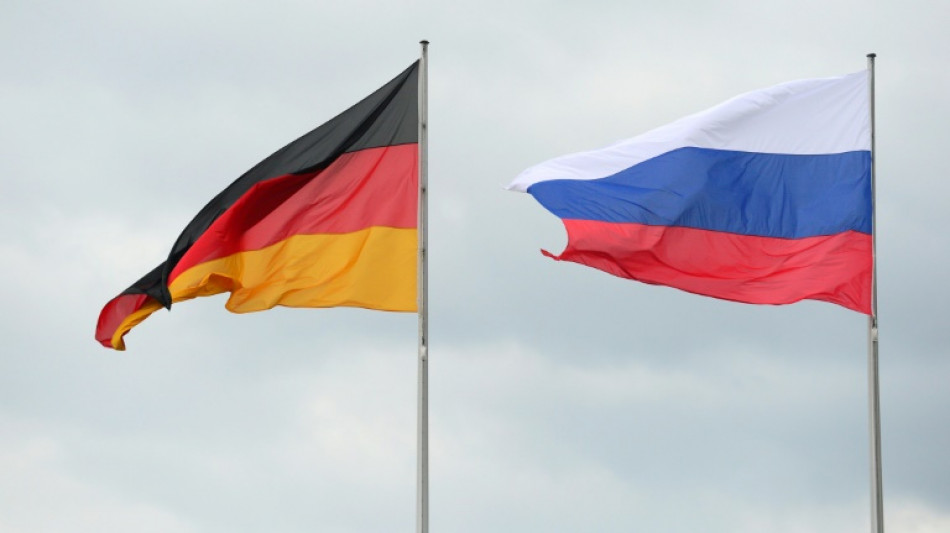
Hundreds working for Germany in Russia forced to quit, leave / Photo: © AFP
Hundreds of civil servants and local employees working for German institutions in Russia will need to leave the country or lose their jobs in the coming days following an order by Moscow, Germany's foreign ministry said Saturday.
Starting from June, Russia will slash the number of people that Germany can employ in its embassies or institutions in Russia in the education and cultural sectors, the ministry said.
Several hundred people are affected, including officials from the embassy and consulate, but mostly employees of the Goethe cultural institute in the country, German schools, nurseries and teachers working in Russian schools, it added.
Both German and local Russian employees are affected, the ministry said, without giving precise figures on each category of staff.
German employees will have to quit the country by June 1.
Russian employees should not be required to leave the country, but will lose their jobs since German institutions will no longer be able to employ them, the ministry said -- clarifying initial indications the locals would have to leave too.
The news was first revealed on Saturday in the German newspaper Sueddeutsche Zeitung, which spoke of a "diplomatic declaration of war by Moscow" against Berlin.
"This is a unilateral, unjustified and incomprehensible decision," the German foreign ministry said in a statement.
A close economic partner with Russia before Moscow invaded Ukraine, Germany has since moved away from Moscow, financially and militarily supporting Kyiv in the conflict.
Since the onset of the conflict in Ukraine, Russian espionage in Germany has grown at a rate rarely equalled in recent years, according to German security services.
- Expulsions -
In mid-April, Germany expelled a number of Russian diplomats "to reduce the presence of intelligence services" which prompted a tit-for-tat response from Moscow which booted out some 20 German embassy staff.
The Russian foreign ministry in April set a ceiling for the number of German diplomats and representatives of public organisations allowed to stay in Russia or be employed by German institutions, the German foreign ministry said.
"This limit set by Russia from the beginning of June implies major cuts in all areas of (Germany's) presence in Russia," the ministry said.
German authorities have tried in recent weeks to get the Russian ministry to reverse its decision, but without success, Sueddeutsche Zeitung said.
Berlin will aim to ensure "a real balance" in its response, the foreign ministry said.
In spring 2022, Germany already expelled some 40 Russian diplomats which Berlin believed to represent a threat to its security.
Before Moscow invaded Ukraine, Russia was Germany's main supplier of gas and a major supplier of oil.
However Germany stopped supplies and has since become one of the biggest providers of arms and financial support to Ukraine in its war against Russia, souring relations which had been warming over decades.
Last October, the head of Germany's cybersecurity agency, Arne Schoenbohm, was fired after news reports revealed his proximity to a cybersecurity consultancy believed to have contacts with Russian intelligence services.
A month later, a German reserve officer was handed a suspended prison sentence of a year and nine months for spying for Russia.
M.A.Walters--TNT