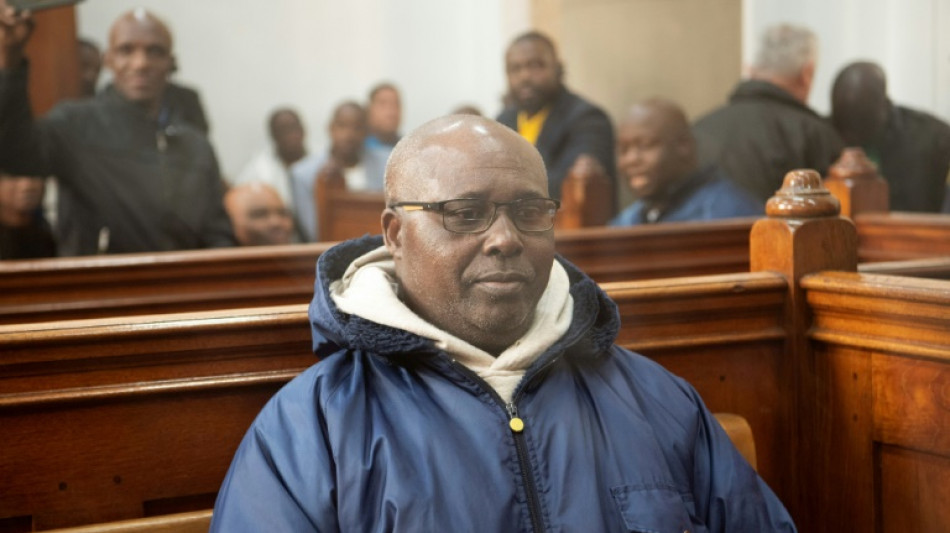
Rwanda genocide fugitive Fulgence Kayishema appears in S.Africa court / Photo: © AFP
Fulgence Kayishema, one of the last fugitives sought over the 1994 Rwanda genocide, appeared before a court in Cape Town on Friday, two days after being arrested following 22 years on the run.
He allegedly took part in one of the genocide's bloodiest episodes, when thousands of men, women and children who had sought shelter in a church were slaughtered.
Wearing a blue jacket, black trousers and spectacles, and flanked by armed officers with helmets and bullet proof vests, Kayishema identified himself before the packed courtroom.
The 62-year-old appeared calm and composed as a state prosecutor read out the accusations against him.
They include "genocide" and conspiracy to commit genocide "relating to the slaughter of more than 2,000 people in Rwanda in 1994," prosecutor Nathan Adriaanse told the court.
At the end of a short hearing, magistrate Ronel Oliver remanded him into custody, with a next appearance scheduled for June 2.
The former Rwandan police inspector was arrested on Wednesday at a grape farm in the small winelands town of Paarl, 60 kilometres (35 miles) north of Cape Town, where he had been living under an alias, investigators say.
- Church massacre -
He is described by the International Residual Mechanism for Criminal Tribunals (MICT) -- the successor to the UN court that prosecuted scores of major suspects -- as "one of the world's most wanted genocide fugitives."
Around 800,000 Rwandans, most of them ethnic Tutsis, were slaughtered over 100 days at the hands of Hutu extremists.
Kayishema and others allegedly murdered more than 2,000 men, women and children who had taken refuge in a Catholic church in Nyange in Kivumu district.
"Kayishema directly participated in the planning and execution of this massacre, including by procuring and distributing petrol to burn down the church with the refugees inside," the MICT said on Thursday, announcing his arrest.
"When this failed, Kayishema and others used a bulldozer to collapse the church, burying and killing the refugees inside."
"Kayishema and others then supervised the transfer of corpses from the church grounds into mass graves."
South African police said the arrest was made in response to an Interpol red notice, and the suspect had been living under the false name of Donatien Nibashumba.
On Friday, the court was told Kayishema would be facing additional charges of fraud and contravening immigration laws in South Africa, and further charges were likely to follow.
Extradition to Rwanda was not discussed.
- Aliases -
The hunt for Kayishema spanned countries across Africa, targeting a man who used many aliases and false documents and relied on a "network of trusted supporters", the MICT said.
These included family members, members of the former Rwandan armed forces, the Democratic Forces for the Liberation of Rwanda (FDLR) rebel group "and those aligned with the genocidal Hutu Power ideology."
The United States had offered up to $5 million reward for information leading to Kayishema's arrest, transfer or conviction, but there have been no details as to whether this played a role in the capture.
The MICT in 2015 took over the work of the International Criminal Tribunal for Rwanda (ICTR), set up by UN after the genocide.
Before handing over the reins, the ICTR sentenced 62 people, including a 30-year term handed to former minister Augustin Ngirabatware, and acquitted 14.
Rwanda started trying genocide suspects in 1996, and on a single day in April 1998 had 22 of them executed by firing squad.
It abolished the death penalty in 2007, lifting the main obstacle for the ICTR to extradite genocide suspects to Rwanda for trial.
Between 2005 and 2012, more than 12,000 community-based courts put nearly two million people on trial and convicted 65 percent, sending most to prison.
Other convictions have been handed down in the former colonial power Belgium as well as in France, Sweden, Finland, Norway, Germany, the Netherlands, the United States and Canada.
F.Harris--TNT