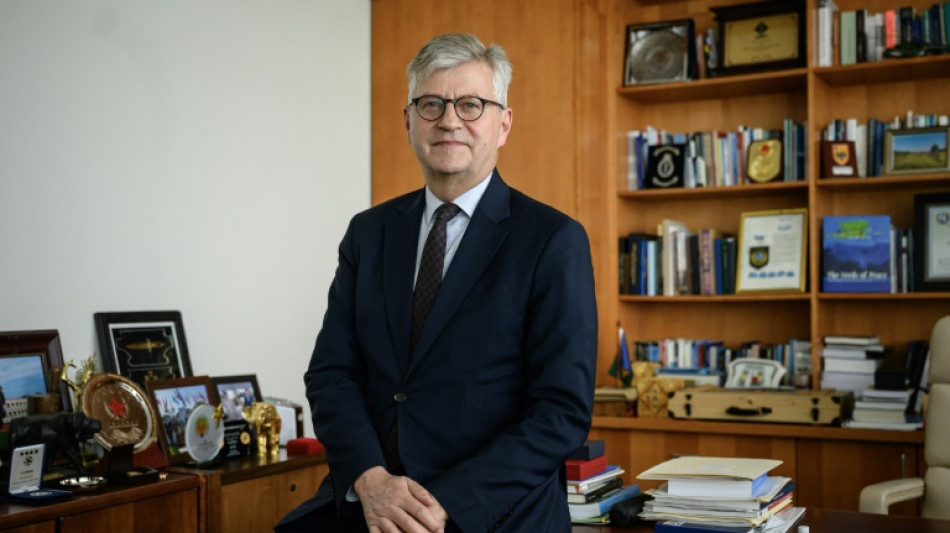
As 'Blue Helmets' turn 75, chief laments UN divisions / Photo: © AFP
The UN's head of peacekeeping operations told AFP that a divided Security Council was hampering the work of the so-called Blue Helmet forces, which turn 75 on Monday.
Jean-Pierre Lacroix said a long list of countries had benefited from the "millions of men and women who have served under the UN flag" since the forces' creation in 1948.
But he added that paralysis and conflict between the United States, Britain and France on one side and Russia and China on the other was making operations difficult.
"We are suffering from the fact that our member states are divided," the Under-Secretary-General for Peace Operations said.
The French diplomat, 63, added that the UN was finding it "more difficult to achieve the ultimate objectives of peacekeeping: to deploy, support the implementation of a peace agreement and then gradually leave."
Although the 15-member council regularly renews the mandates of peacekeeping missions, Lacroix called for more unity so they can better "influence the implementation of peace agreements and political processes."
May 29 marks the International Day of United Nations Peacekeepers, created in 2002 by the UN General Assembly to honor those who serve in conflict zones.
Because next Monday is the Memorial Day holiday in the United States, the UN celebrated the peacekeepers' 75th anniversary on Thursday, in memory of the "more than 4,200 peacekeepers killed in the cause of peace" since 1948.
Secretary-General Antonio Guterres observed a minute's silence for the 103 peacekeepers who died last year.
More than 87,000 people from 125 countries are presently deployed on 12 peace operations around the world. They include in Lebanon, Mali, the Democratic Republic of Congo, Cyprus, India and Pakistan.
Lacroix noted that the "list of countries that have regained stability is long," citing Ivory Coast, Liberia, Sierra Leone, Angola and Cambodia in the 1990s and 2000s.
But he argues that "the international community was much more united at the time, and the political processes in these countries were implemented with the active and united support of our member states."
As well as being expensive and increasingly contested, peacekeeping missions can also be extremely dangerous militarily and diplomatically, as is the case in Mali with the mission known as Minusma.
French solders left the Sahel country last year under pressure from a hostile junta which, although it denies it, called in Russian mercenaries from the Wagner group.
Minusma, which has 12,000 peacekeepers deployed, has suffered the most fatalities of any mission in recent years. Since its creation in 2013, 185 of its members have died in hostile acts.
Germany, the biggest contributor to Minusma with a thousand peacekeepers, confirmed this month that it would withdraw its troops within a year.
So is Minusma under threat?
Lacroix said he does not think so, pointing to "regular and transparent relations with the Malian authorities" and "demonstrations of support for Minusma in some regions" of Mali.
A.M.James--TNT