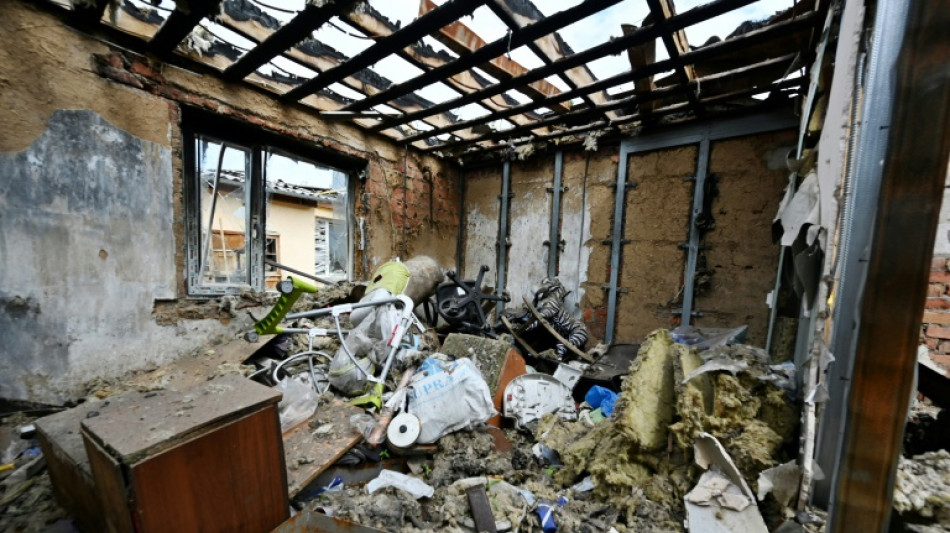
Civilians flee, Kremlin 'concerned' after Ukraine border clashes / Photo: © AFP
Moscow on Tuesday voiced deep concern on the second day of the most serious armed incursion to date over its border with Ukraine, after explosive strikes forced civilians to flee.
Russia said the Belgorod border region had come under sustained artillery and mortar fire during fighting with a group that it claimed had crossed from Ukraine.
Belgorod's governor said civilians have been evacuated from nine border villages in the region, which has previously faced shelling attacks that have killed dozens of people since Moscow launched its offensive last year.
"What happened yesterday is a cause for deep concern and once again confirms that Ukrainian militants continue their activities against our country," Kremlin spokesman Dmitry Peskov told reporters on Tuesday.
Members of the anti-Kremlin Freedom of Russia Legion have claimed responsibility for the incursion into Belgorod, while Ukraine's deputy defence minister Ganna Malyar said "we are not waging war on foreign territories."
In a video released by a Telegram channel claiming to represent the anti-Kremlin group, a camouflaged spokesman, surrounded by armed men in fatigues, said: "Russia will be free!" -- a slogan frequently used by Russian opposition activists.
"We want our children to grow up in peace and be free," the spokesman added, with the channel claiming that two settlements including Graivoron had been attacked.
- Too soon to return -
Security operations were ongoing Tuesday in the border areas, said governor Vyacheslav Gladkov, who previously reported eight people had been injured.
Several drones struck houses and a government building overnight but no one was killed or wounded, said Belgorod's governor as Ukraine's leader visited the eastern front line.
Gladkov added on Tuesday that it was too soon for residents who fled to return to their homes and said that authorities would give the all-clear when it was safe.
On Monday, Russia said its troops were battling a "sabotage" group that entered from Ukraine and introduced an "anti-terror regime" in Belgorod, a first since the start of Moscow's campaign in Ukraine in February 2022.
Britain's Ministry of Defence noted that "Russia is facing an increasingly serious multi-domain security threat in its border regions, with losses of combat aircraft, improvised explosive device attacks on rail lines and now direct partisan action."
Ukrainian presidential advisor Mikhaylo Podolyak suggested that Russian "guerrilla groups" could be responsible.
"The only driving political force in a totalitarian country of tightened screws is always an armed guerrilla movement," he said on Monday.
- Zelensky visits front -
The "anti-terror regime" gives special powers to security services and entails the enforcement of a number of restrictions and measures including beefed-up security and communications surveillance.
A similar regime was in place in Chechnya between 1999 and 2009, when Russian authorities battled insurgents during Moscow's second military campaign in the mountainous region.
The attack on Russia's region was reported ahead of a widely expected Ukrainian offensive, though President Volodymyr Zelensky has said his country is not yet ready.
The timing and focus of Ukraine's offensive have been the subject of months of speculation, while Kyiv has said almost nothing except that it needs more weapons from its backers.
At the same time, Russia has been reinforcing hundreds of kilometres of front line with tank barriers, trenches and troops.
Zelensky on Tuesday visited Ukrainian troops on the frontline in the eastern region of Donetsk, where Russian forces have concentrated their efforts to capture territory.
"Every day on the battlefield, Ukrainian marines prove that they are a powerful force that destroys the enemy, liberates Ukrainian land and performs the most difficult tasks in the most difficult conditions," Zelensky said.
"And we need more of this force. So, from today, we are significantly increasing the potential of the marines and creating a marine corps," Zelensky said.
Ukrainian troops held back Russian forces around Vugledar during Moscow's winter offensive that gave the Kremlin only limited gains in the battle-scarred Donetsk region.
A.M.Murray--TNT