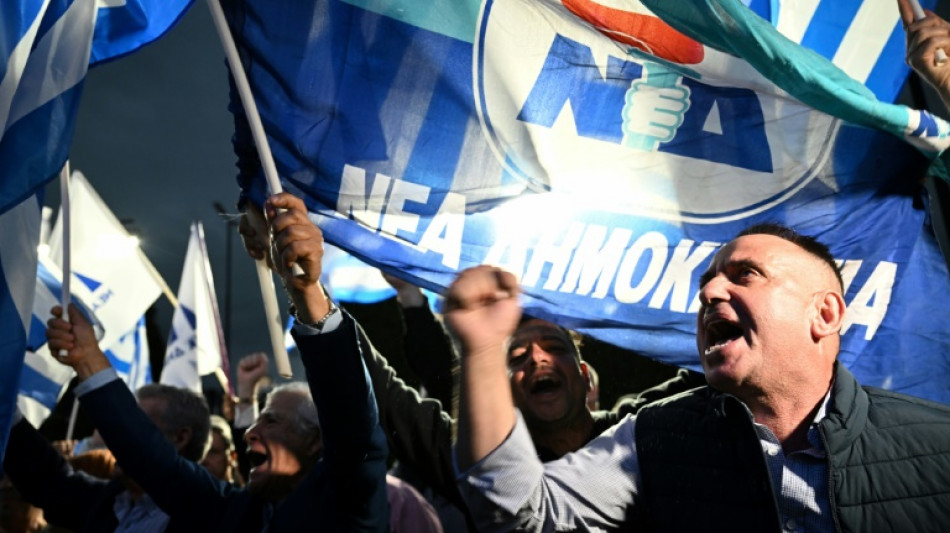
Greece eyes new vote as PM to seek absolute majority
A day after national elections, Greece on Monday was bracing for a new ballot which vote-winner Prime Minister Kyriakos Mitsotakis' party is poised to seek in order to govern alone.
The conservative New Democracy party of Mitsotakis scored a thumping win in Sunday's vote, with a clear 20-point lead over its nearest rival -- Syriza led by leftist Alexis Tsipras.
Voters handed the conservatives their best result in 14 years, crediting the party with bringing economic stability back to a nation once known as an EU laggard.
Mitsotakis himself said the "great victory surpassed our own expectations".
But it fell short of an outright majority, leaving Mitsotakis with the option of either seeking a coalition or calling a new vote.
The 55-year-old Harvard graduate on Sunday made clear his preferred option.
"Together we will fight as of tomorrow, so that in the next elections, what citizens have already decided -- a self-reliant New Democracy -- will be mathematically confirmed at the ballot."
"We will move forward, boldly and steadily, to complete today's important first step, and be the final winners," he said, adding that Greeks "want a strong government".
Tsipras also set the stage for a new vote, saying "the electoral cycle is not over yet".
The next battle, he said, will be "critical and final".
- Economic stability -
In power over the last four years, former McKinsey consultant Mitsotakis, 55, had steered the country through the pandemic which devastated Greece's vital tourism industry.
On his watch, the erstwhile EU economic headache has enjoyed a post-Covid revival, booking growth of 5.9 percent in 2022.
With unemployment and inflation falling, and growth this year projected at twice that of the European Union average, Greece's outlook was a far cry from the throes of the crippling debt crisis a decade ago.
Mitsotakis' term had been blighted by a wiretapping scandal as well as a train crash that claimed 57 lives in February.
The government initially blamed the accident -- Greece's worst-ever rail disaster -- on human error, even though the country's notoriously poor rail network has suffered from years of under-investment.
Nevertheless, neither the accident nor the wiretapping scandal appeared to have dented support for his conservatives -- which scored a far bigger win than that predicted by opinion polls ahead of the vote.
Despite the massive protests that broke out in the aftermath of the rail crash, the transport minister at the time, Kostas Karamanlis, was reelected on Sunday.
- Turn the tide -
Under a new electoral law that comes into play in the next election, the winner can obtain a bonus of up to 50 seats. Based on Sunday's showing and that calculation, New Democracy is virtually assured of a victory.
But the left will likely seek to turn the tide by campaigning on cost-of-living problems which occupy many voters' minds.
Both Tsipras and socialist party Pasok-Kinal, led by 44-year-old Nikos Androulakis, face an uphill task however.
Pasok was credited with just 11.5 percent of the vote.
Another casualty Sunday was Tsipras' former maverick finance minister Yanis Varoufakis, whose anti-austerity MeRA25 party failed to garner enough support to make it to parliament.
F.Morgan--TNT