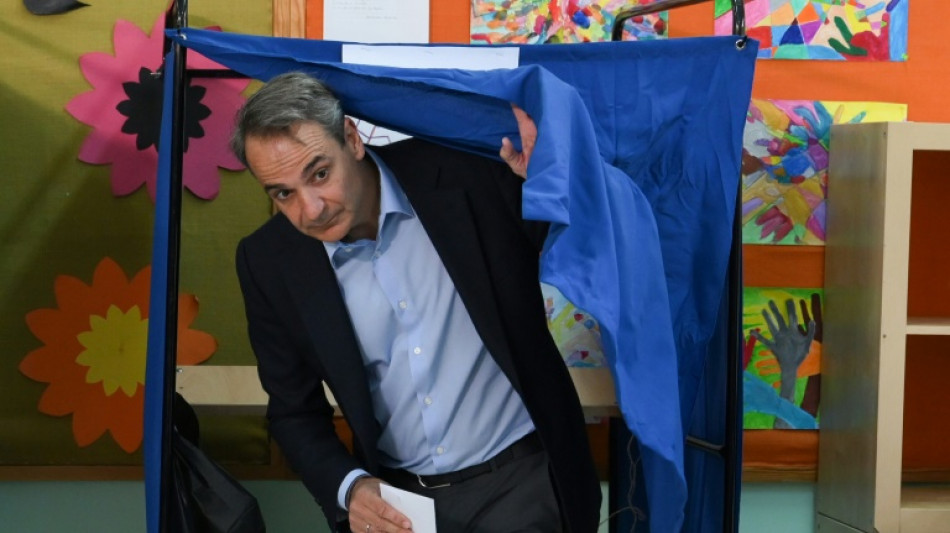
Mitsotakis calls for 'stronger' Greece as nation votes
Greeks voted on Sunday in a general election that could deliver a chaotic outcome with leading candidate Prime Minister Kyriakos Mitsotakis asking to be returned to power to ensure a "stronger country".
The EU nation went into the polls in fairly robust economic health, with unemployment and inflation falling and growth this year projected to reach twice that of the bloc -- a far cry from the throes of a crippling debt crisis a decade ago.
But economic issues remain squarely in focus even though a post-Covid tourism revival helped Greece book growth of 5.9 percent last year.
Mitsotakis, 55, has urged voters not to squander hard-fought economic stability.
"Today we are voting for our future, for more and better jobs, for a more efficient health care system, for a stronger country with an important role in Europe and protected borders," he said after casting his ballot along with two of his three children.
But his main opponent, former leftist premier Alexis Tsipras, has warned that the rosy hardline figures belie growing poverty as wages fail to keep pace with rising prices.
Tsipras is seeking a comeback after a first mandate in 2015 to 2019, during which he led rocky negotiations with creditors that nearly crashed Greece out of the euro.
He called on the country to "turn the page on four difficult years" and pick a "fair government for a better future".
- Horse-trading? -
Close to 10 million Greeks are eligible to cast a ballot, including 440,000 first-time voters.
Opinion polls suggested Mitsotakis held a clear lead of five to seven percentage points.
Yet the outcome of the vote is unpredictable, as changes to the electoral rules mean no party is expected to obtain an outright majority.
Whether the party that tops the polls would seek a coalition or turn to another round of votes by early July to determine who governs Greece could depend on the size of the lead it amasses.
That could spell weeks of horse-trading, with the socialist party Pasok-Kinal, led by 44-year-old Nikos Androulakis, a potential kingmaker.
By mid-day, turnout had reached 31.5 percent, according to the Interior Ministry.
With a likely second vote, fears had been running high that many could sit out the first ballot after abstentions reached 42 percent in 2019.
- 'Living on coupons' -
Sunday's vote marks the second national elections in which Mitsotakis, a Harvard graduate and former McKinsey consultant, is pitted against Tsipras, a 48-year-old former communist and trained engineer.
The outgoing premier says he has delivered on his previous electoral promises of lower taxes, tougher immigration rules and steady growth.
But Tsipras has accused Mitsotakis of promising "better jobs and wages, only to have the middle class live on coupons".
The cost of living and jobs occupy many voters' minds.
"Life, especially for young people, is very difficult. Unemployment is high, there are no work prospects and salaries vanish at the end of the month," said Athens resident Dora Vasilopoulo, 41.
Retiree Maria Tombabakis, 67, said she was hoping for change but was "not very optimistic".
In Greece's second-biggest city Thessaloniki, Giorgos Antonopoulos, 39, who works at a commercial store, said, "Salaries are used up halfway through the month and nothing is done to address this issue. We work just to survive."
- 'Disturbing' -
Ahead of the vote, Mitsotakis' government came under pressure over the devastating head-on train collision in February that claimed 57 lives.
The government initially blamed the accident on human error, even though Greece's notoriously poor rail network has suffered from years of under-investment.
Mitsotakis' tough stance against immigration also came under the spotlight as The New York Times this week published footage allegedly showing Greek coastguards expelling migrants by setting them adrift in the Aegean Sea.
Androulakis, the Pasol-Kinal leader, had been seen as a potential coalition partner for Mitsotakis but things went sour when he discovered he had been under state surveillance.
S.Mitchell--TNT