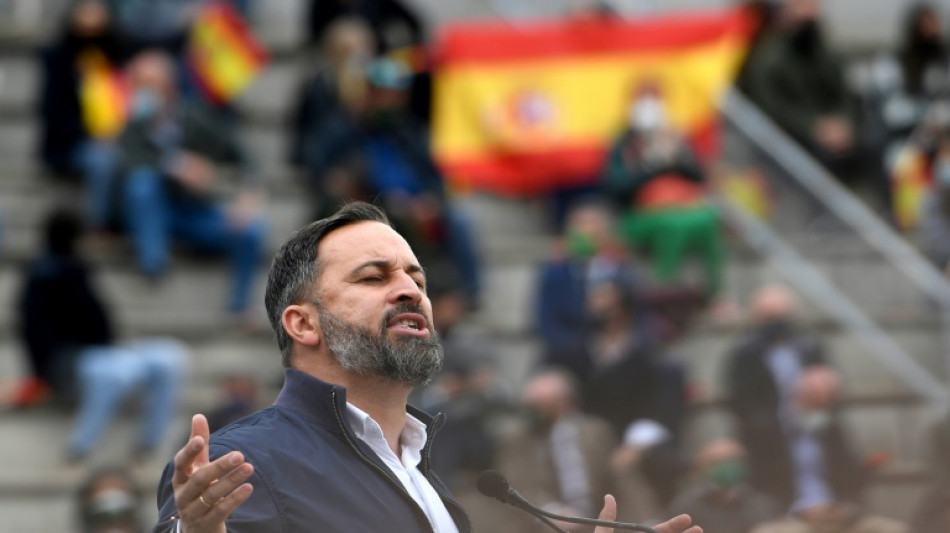
Spanish far right eyes gains in regional polls / Photo: © AFP/File
Far-right party Vox has shaken up Castilla y Leon since it entered the government of the Spanish region last year, attacking unions and pushing polarising positions on social issues.
It is now poised to spread its influence beyond the sparsely populated region near Madrid, with the party set to make gains in regional and local elections on May 28.
Surveys suggest the main opposition conservative Popular Party (PP) could need the support of Vox to govern in half of the 12 regions casting ballots, just as it did in Castilla y Leon last year.
Polls also indicate the PP is on track to win a year-end general election but will need Vox to form a working majority and oust Socialist Prime Minister Pedro Sanchez's coalition government from office.
Vox leader Santiago Abascal has called the PP-VOX coalition government in office in Castilla y Leon since March 2022 a "showroom" and "an example of the alternative Spain needs".
It is Spain's first government to include a far-right party since the dictatorship of Francisco Franco.
In Castilla y Leon, Vox has slashed funding to unions, which the party has vowed to "put in their place" if it comes to power nationally.
Trade union UGT was forced to lay off 40 percent of its staff in Castilla y Leon last month and scale back programmes to promote workspace safety.
Spain's other main union, the CCOO, is preparing to follow suit.
"We are submerged in a serious economic crisis," the secretary general of CCOO's branch in Castilla y Leon, Vicente Andres, told AFP at his office in Valladolid, the region's biggest city.
- 'Feel much more unsafe' -
Vox has also angered LGBTQ groups by refusing to allow the regional parliament to be lit up in the colours of the rainbow, the symbol of the gay rights movement, for Pride festivities as in past years when the PP governed alone.
In addition, the regional vice-president, Vox's Juan Garcia-Gallardo, has railed against a law passed by Spain's leftist central government that extends transgender rights.
The 32-year-old lawyer warned earlier this month that women would now be "forced to share locker rooms with hairy men at municipal swimming pools."
Vox's positions have made LGBTQ people in Castilla y Leon "feel much more unsafe," said the head of the regional branch of Spanish gay rights group Fundacion Triangulo, Yolanda Rodriguez.
"There are people who are now afraid to hold hands in the streets, to kiss in a bar," the 53-year-old told AFP.
Vox's most contested initiative was a proposal that doctors offer women seeking an abortion a 4D ultrasound scan to try to discourage them from going ahead with the procedure.
The idea was swiftly condemned by Spain's leftist central government, and Castilla y Leon's PP president Alfonso Fernandez Manueco stopped the measure from going ahead.
- 'Lots of noise' -
The row highlighted the hazards for the PP of joining forces with Vox, which was launched in 2013 and is now the third largest party in the national parliament.
"It makes it more difficult for the PP to appeal to centrist voters," said Antonio Barroso, an analyst at political consultancy Teneo.
"And it makes it easier for Sanchez to attack the PP by arguing they want to move the country to the far right," he added.
Vox's Garcia-Gallardo, who did not reply to a request for an interview, has defended his government's record, arguing it reduced "dispensable" spending and "inaugurated a new form of governing".
Francisco Arairo, a 67-year-old retired hardware store owner, praised Vox for bringing up "issues other parties avoid", although he said he still preferred the PP.
"They seem more serious and realistic," he said at at Valladolid's El Campillo municipal market.
But Nuria Perez Pardo, a 43-year-old day care worker, was not impressed.
"They make lots of noise but I see few results," she said as she waited in line at a fish stall.
D.Cook--TNT