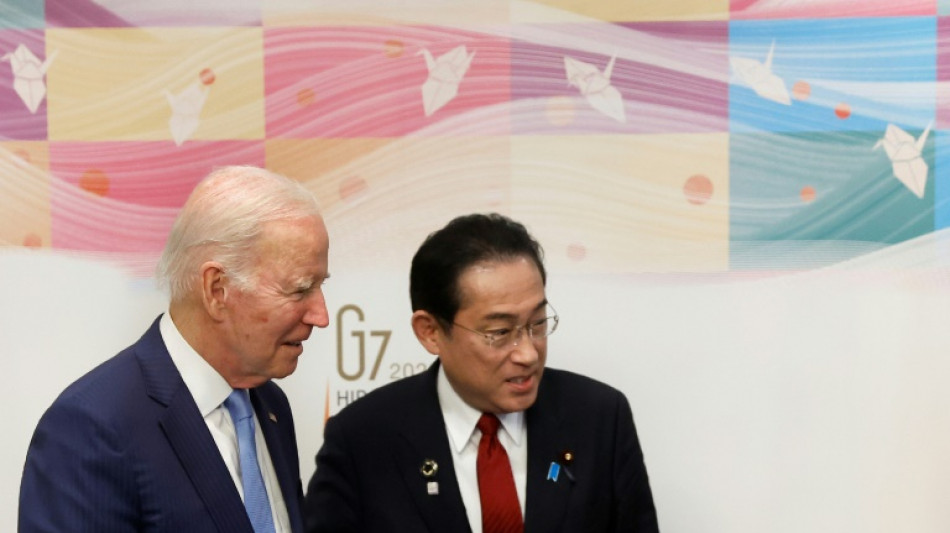
US to unveil 'significant' new Russia sanctions at G7 / Photo: © AFP
The United States unveiled "significant" new sanctions targeting Russia's "war machine" on Friday, as President Joe Biden meets fellow G7 leaders in Japan.
The heads of seven wealthy democracies are gathered in Hiroshima, where they will discuss tightening the screws on Russia's ailing economy as well as how to respond to China's growing military and economic power.
Washington got the ball rolling Friday, with a senior US administration official promising "a significant effort that will extensively restrict Russia's access to goods that matter for its battlefield capabilities".
"It will cut off roughly 70 entities from Russia and other countries from receiving US exports by adding them to the Commerce blacklist. And there will be upwards of 300 new sanctions against individuals, entities, vessels and aircraft," the official said.
Other G7 members are also preparing to "implement new sanctions and export controls", he added.
The bloc wants to disrupt Russian war supplies, close evasion loopholes and further reduce reliance on Russian energy, he said.
It will also continue to squeeze Moscow's access to the international financial system and commit to keeping Russian assets frozen until the end of the war in Ukraine.
On Thursday, a European Union official said one potential target for discussion was Russia's multi-billion-dollar diamond industry.
"We believe we need to limit exports from Russian trade in this sector," the official said, adding that Indian buy-in would be crucial to making any new measures work.
India accounts for a large portion of the world's trade in rough diamonds.
"We would like to engage in a dialogue with them, because the diamond industry is quite important in India," the official said.
- Peace park visit -
There will be a chance for G7 leaders to make their case directly to Indian Prime Minister Narendra Modi, whose country has close military ties with Russia and has so far declined to condemn Moscow's invasion.
Modi is among several leaders from major developing economies invited to the summit as the bloc tries to win over sceptical nations to its way of thinking on both Moscow's war and China's increasing sway.
Ukrainian President Volodymyr Zelensky is also expected to address the summit over the weekend by videolink, with Japan's government squashing speculation that he could make a last-minute, in-person appearance.
Talks officially open Friday afternoon, after Prime Minister Fumio Kishida takes leaders to Hiroshima's peace park memorials and museum.
In a moment heavy with symbolism, they will lay wreaths at the Hiroshima cenotaph, which commemorates the estimated 140,000 people killed in the attack and its aftermath.
Kishida, who comes from Hiroshima, has tried to move nuclear disarmament up the agenda, reportedly insisting leaders visit not only peace memorials but also the museum, where they will see evidence of the suffering and devastation caused by the bomb.
"I hope that here in Hiroshima, the G7 and leaders from elsewhere will show their commitment to peace, which will be remembered in history," he said Thursday.
However, there is little appetite to reduce stockpiles at a time when Moscow has made thinly veiled threats to use the weapons, and while North Korea is stoking fears of a new nuclear test with a barrage of missile launches.
Biden will become only the second American leader to visit the city Washington bombed at the close of World War Two though, like former president Barack Obama, he is not expected to make an apology for the attack.
Eighty-two-year-old Masao Ito survived the bombing as a small child. If given the chance, he said, he would warn leaders: "As long as there are nuclear weapons in the world, there is a possibility that your city could become like Hiroshima."
"Is that really something you are willing to accept?"
- China 'de-risking' -
Apart from Ukraine, China will dominate the three days of meetings.
There the focus will be on diversifying crucial supply chains away from China and insulating sectors from "economic coercion".
But European countries insist that doesn't mean breaking ties with China, one of the world's largest markets.
"Not a single country" is pursuing "decoupling", German Chancellor Olaf Scholz told reporters in Hiroshima.
"However, we want to organise global supply relations, trade and investment relations, in such a way that the risks are not increased by dependence on individual countries," he said.
Lewis--TNT