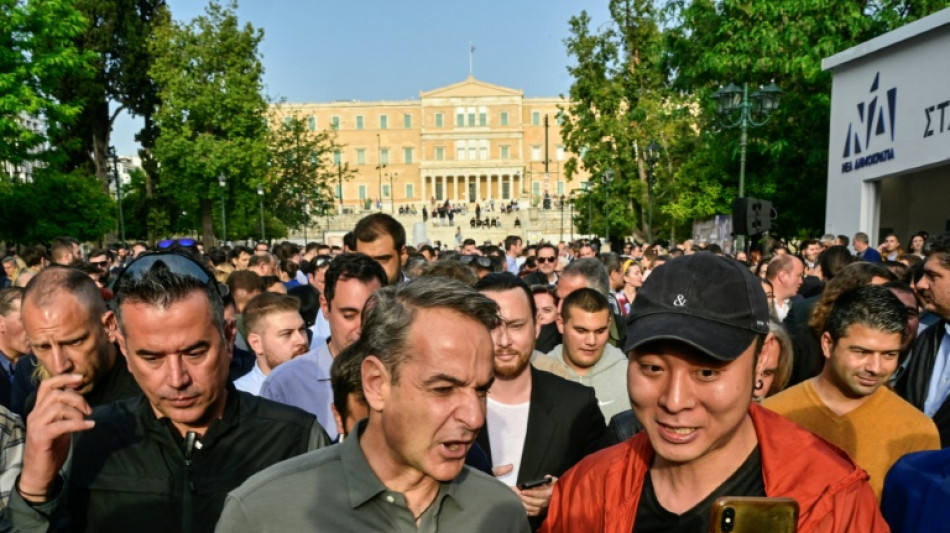
Women still struggling with boys' club of Greek politics / Photo: © AFP
As the credits rolled on Greek television's long-awaited election debate between the party leaders, one thing united them -- they were all men.
While the three battled for three hours over defence spending, unemployment and a wiretapping scandal, there is no reference to the elephant in the room, that Greek politics largely remains a man's game.
Women only acquired the vote in Greece in 1952, two decades after their British and Spanish sisters, and only one in five MPs are women, one of the lowest rates in the EU.
Outgoing conservative prime minister Kyriakos Mitsotakis has only 10 women in his cabinet of 58, and only two of them are full ministers.
In 2015, Vasiliki Thanou became the country's first female prime minister -- but her tenure was purely technical and temporary before leftist Alexis Tsipras' re-election.
The former head of the supreme court was in charge for nearly a month with the country on the verge of bankruptcy and facing a refugee crisis.
"The number of women involved in politics is not satisfactory", Thanou told AFP.
"Perhaps Greek society is not mature enough to recognise that women have the same potential as men to assume political responsibilities," said the 72-year-old.
- 'Patriarchal society' -
Things seem to change under New Democracy's Mitsotakis, whose big sister Dora Bakoyannis was first woman mayor of Athens and Greek foreign minister.
In 2019, his government introduced a mandatory quota of at least 40 percent of female candidates on electoral lists.
A year later, his party made veteran judge Katerina Sakellaropoulou president, a largely honorific post.
But progress at the polls has been another matter.
"There are (indeed) a lot of women on the ballots, but they are not elected," said New Democracy candidate Dora Palli-Petralia, whose mother was one of the party's few women ministers in the 2000s.
Even so the place of women is changing in the country of 10 million people.
The belated arrival of the #MeToo movement, spearheaded by the revelations of an Olympic sailing champion who was a victim of rape, raised awareness regarding violence against women.
But sexist remarks are still rife.
When the former Greek vice-president of the European Parliament Eva Kaili was held during the Qatargate corruption scandal, Greek media focused on her "beauty" and "beautiful blue eyes".
Speaking to young female YouTuber Nefeli Meg last month, Mitsotakis vowed to appoint "many more" women in government if re-elected.
His main rival, leftist leader Tsipras has promised to bring parity -- but his own cabinet in 2015 had just two women in its ranks.
"We live in a patriarchal society, we are a Mediterranean society and many gender stereotypes persist," Stella Kasdagli, co-founder of the non-profit organisation "Women on top", told AFP.
In Greece "the life of women is almost entirely defined by family tasks", in particular the education of children and frequently the care of elderly parents, she added.
Despite the five million women who are eligible to vote on Sunday outnumbering men, their place in Greek politics leaves a lot to be desired.
A.Robinson--TNT