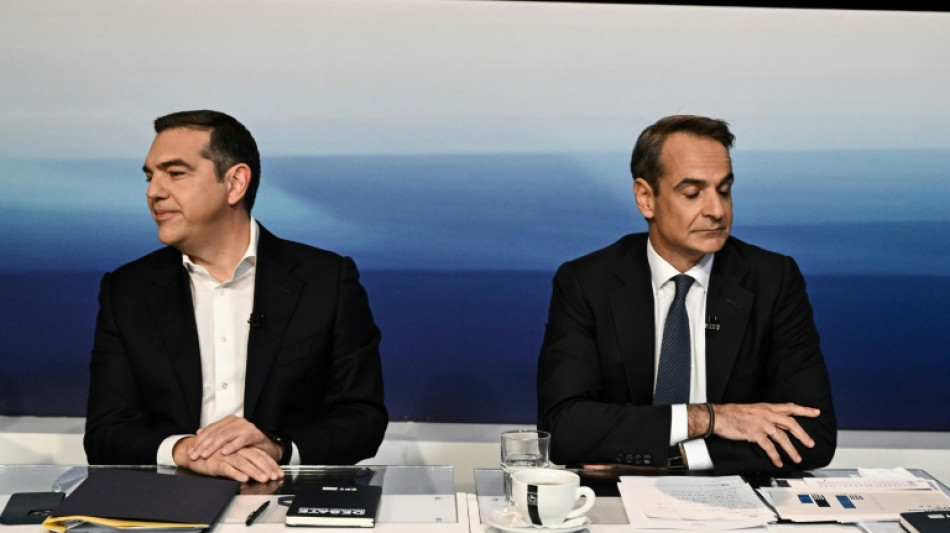
Greece's Mitsotakis eyes new term in uncertain ballot / Photo: © AFP
Greeks will vote on Sunday in the most unpredictable national polls in a decade with an inconclusive result likely to lead to the election needing to be re-run.
Outgoing conservative Prime Minister Kyriakos Mitsotakis holds a clear lead of around 6 percent over his nearest rival, leftist former premier Alexis Tsipras.
But under the election's proportional representation rules, no party is expected to win by a margin large enough to secure an outright majority in the 300-seat parliament.
A follow-up election by early July will likely be necessary, and will use a new system that would grant the winner bonus seats in parliament.
Mitsotakis, campaigning on four years of tax cuts, tourism revival and steady growth, has warned denying his New Democracy party a strong mandate would lead to "paralysis" at a time of international uncertainty.
"Currently there is no other credible proposal except a self-reliant New Democracy (government)," the 55-year-old told the Kathimerini daily last week.
Tsipras and his Syriza party promise to restore faith in a country shaken by a scandal over wiretapping by the security services and Greece's worst-ever rail disaster that claimed 57 lives in February.
In 2015 he led a high-stakes negotiation with the European Union that nearly crashed Greece out of the euro.
- 'Democracy strikes back' -
"Democracy strikes back to topple the rotten regime ruling over us," the 48-year-old leftist said on the campaign trail Sunday.
"(Mitsotakis) does not care about the many, only about the powerful."
In 2012, back-to-back ballots were needed before a coalition government could be formed between New Democracy, the socialist Pasok party and a now-defunct leftist party, Dimar.
This time, the Greek socialist Pasok-Kinal party founded by political veteran Andreas Papandreou is seen as a possible coalition ally for both Mitsotakis and Tsipras.
But the party's leader, former European parliament deputy Nikos Androulakis, has refused to back either of his two rivals for prime minister.
"We will fight against anyone who undermines the public interest," Androulakis, who was controversially a target of the wiretap scandal, said in his home island of Crete over the weekend.
Mitsotakis' New Democracy party has promised to further increase the monthly minimum wage to 1,000 euros ($1,090), reduce unemployment and heavily invest in Greece's underfunded public health system that was stretched by the pandemic.
"I've always believed that two four-year terms are required for someone to change Greece," he said last month.
Tsipras vows to combat inflation which he blames on domestic "cartels", increase public spending on education and boost wages for civil servants and health workers.
"Greece has Bulgarian wages and British prices," he said last week.
- One in 10 undecided -
One in ten Greeks are undecided on how to vote, and many say they are disillusioned by politics.
"For the first time in my life, I have not yet decided who to vote for. Maybe I will cast a blank ballot," said Andreas, a 30-year-old former Syriza supporter.
"Who thinks of us? (Campaign) promises are not kept and our daily life gets worse by the year," said Nikos Dimitriadis, 62, complaining that their pension payment did not last a full month.
Mitsotakis has never lost an election against Tsipras, beating him three times -- at national, local and European level.
He taunted his opponent last week, saying: "In the US, when we played (pickup) basketball, it was 'lose and you're out."
Almost 10 million Greeks are eligible, and nearly 440,000 Greeks as young as 16 will vote for the first time.
G.Morris--TNT