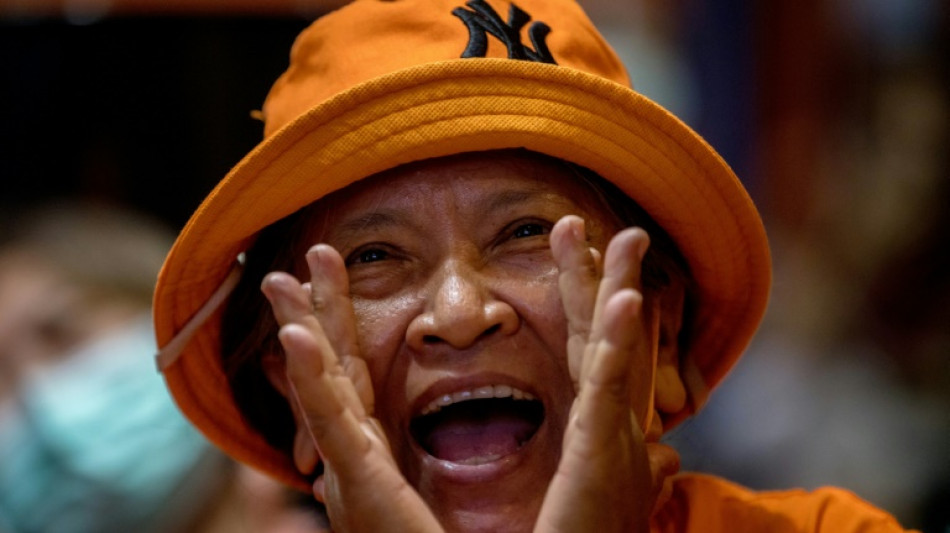
Thais reject army-backed government, opposition to open coalition talks / Photo: © AFP
Thai voters have delivered a clear rejection of nearly a decade of military-backed government, election results showed Monday, backing two major pro-democracy opposition parties who are now expected to open coalition talks.
The progressive Move Forward Party (MFP), which wants to reform Thailand's strict royal insult laws, looks on course to be the biggest party -- setting up a potential clash with the kingdom's powerful royalist-military elite.
Thais voted in large numbers after an election campaign pitting a young generation yearning for change against the conservative elite embodied by Prime Minister Prayut Chan-O-Cha, the ex-army chief who seized power in a 2014 coup.
But in a kingdom where coups and court orders have often trumped the ballot box, there are fears that the result may yet be thwarted, raising the prospect of fresh instability.
With ballots counted from 97 percent of polling stations, Election Commission data showed MFP on 13.5 million in the popular vote followed by Pheu Thai on 10.3 million with Prayut's United Thai Nation party third on 4.5 million.
The result is a striking achievement for the MFP, an upstart party that channelled the energy of radical youth-led pro-democracy street protests that shook Bangkok in 2020.
The party's leader, Pita Limjaroenrat, 42, declared it had "closed the door" on any chance of army-backed parties forming a minority government.
MFP will seek talks with Pheu Thai and a coalition deal is "definitely on the cards", Pita told reporters.
Pheu Thai leader Paetongtarn Shinawatra congratulated MFP on their success and said "we can work together".
"We are ready to talk to Move Forward, but we are waiting for the official result," she said.
The Election Commission is not expected to officially confirm the final number of seats won by each party for several weeks.
But early Monday it forecast MFP to win 113 out of a total of 400 constituency seats, just ahead of Pheu Thai on 112. A further 100 seats will be allocated to parties on a proportional basis.
The result is a heavy blow for Pheu Thai, the latest iteration of the political movement founded by Paetongtarn's father, billionaire former premier Thaksin Shinawatra.
Before this, Thaksin-linked parties had won most seats at every election since 2001 and Paetongtarn had urged voters to deliver them a landslide to see off the threat of military interference.
Despite their success, MFP and Pheu Thai may still face a battle to secure power thanks to the junta-scripted 2017 constitution.
The new premier will be chosen jointly by the 500 elected MPs and 250 senate members appointed by Prayut's junta -- stacking the deck in the army's favour.
Adding to the uncertainty, rumours are already swirling that MFP could be dissolved by court order -- the same fate that befell its predecessor Future Forward Party after it performed unexpectedly well at the 2019 poll.
- Protest legacy -
This election was the first since the major street protests that erupted in 2020 with demands to curb the power and spending of Thailand's king -- breaching a long-held taboo on questioning the monarchy.
The demonstrations petered out as Covid-19 curbs were imposed and dozens of leaders were arrested, but their energy fuelled growing support for the more radical opposition MFP.
"Younger generations these days care about their rights and they will come out to vote," Pita told reporters as he arrived to vote on Sunday.
While MFP sought support from millennial and Gen Z voters -- who make up nearly half the 52 million-strong electorate -- Pheu Thai drew on its traditional base in the rural northeast where voters are still grateful for the welfare policies implemented by Thaksin in the early 2000s.
As results came in, a glum-looking Prayut thanked voters for their support as he left his party HQ.
"I'll continue to do my best regardless of the result," he told reporters.
The former general made an unashamedly nationalist pitch to older voters, painting himself as the only candidate capable of saving Thailand from chaos and ruin.
But he was blamed for a sputtering economy and feeble recovery from the pandemic, which battered the kingdom's crucial tourism industry.
Rights groups accused Prayut of overseeing a major crackdown on basic freedoms, with a huge spike in prosecutions under Thailand's draconian royal defamation laws.
The country has seen a dozen coups in the last century and has been locked over the last two decades in a rolling cycle of street protests, coups and court orders dissolving political parties.
It remains to be seen whether the powerful royalist-military elite will find an accommodation with the radical MFP.
O.Nicholson--TNT