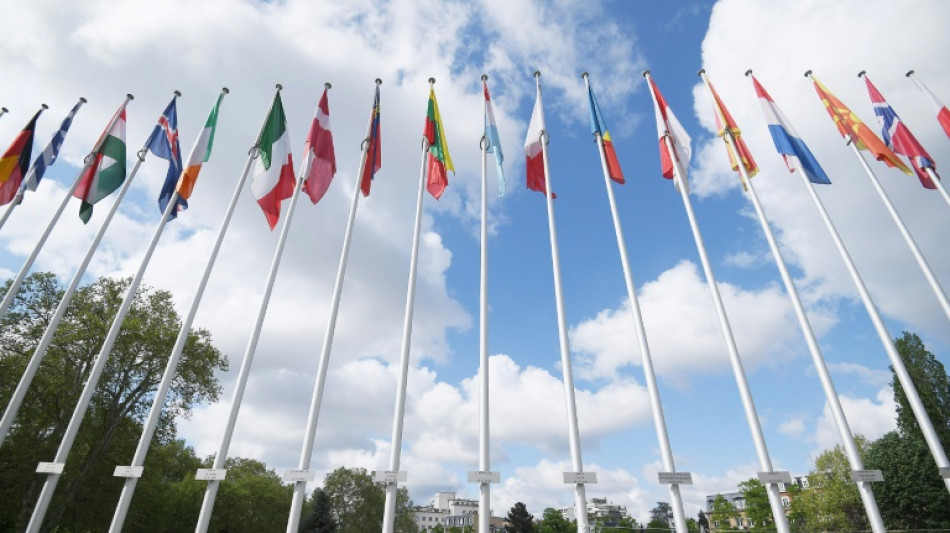
Council of Europe under scrutiny over remaining Russian staffers / Photo: © AFP/File
Dozens of Russian nationals continue to work at the Council of Europe more than a year after Russia was expelled, posing a diplomatic headache for the human rights organisation, according to diplomats at the Strasbourg-based body.
Ukrainians at the Council are especially unhappy that Russians still work there, and several other members have also expressed their misgivings, including Estonia, and Latvia which called the situation "intolerable".
Council of Europe members are to meet in Reykjavik on Tuesday for a summit dedicated mostly to Russia's invasion of Ukraine.
Russia was kicked out of the organisation in March 2022, weeks after it invaded Ukraine, and is no longer listed as a member.
The now 46-member organisation was founded in 1949 and seeks to uphold human rights, democracy and the rule of law in Europe. It employs around 2,000 people on permanent or fixed-term contracts.
"The presence of Russian nationals in the Council of Europe undermines the security and the credibility of this international institution," said Viktor Nikitiuk, Ukraine's deputy permanent representative at the Council.
"The secretariat is supposed to be composed of people from the member states," he told AFP.
- 'You never know' -
The organisation is potentially still vulnerable to Russian influence and information-gathering, added a diplomat who declined to be named.
"Those persons still have access to documents, to discussions. You never know when the backdoor will be open, and what harm it will do," the diplomat said.
The Council of Europe's secretariat has responded by letting fixed-term employment contracts of Russians lapse without the possibility of renewal.
But the body is keeping Russian staff with permanent contracts on the payroll because sacking them would expose the institution to lawsuits for unfair dismissal.
Insiders say more than 40 Russian nationals still work at the Council of Europe, down from 90 at the start of the year.
Some of those remaining hold high positions in the institution.
The Council of Europe declined AFP's request for an interview, stating simply that its staff is "obliged to respect the highest standards of professional and personal integrity".
Some Russians are re-deployed to avoid incidents like one in November, when the Council's secretary general, Marija Pejcinovic Buric, met with a representative of the Belarus democratic opposition in the presence of a high-ranking official from Russia.
Redeployments include that of Russian national Igor Nebyvaev, whose father was reportedly a general in Russia's secret service, and who was removed in March from his position heading up a unit for the fight against money laundering and terrorism financing.
Such moves were welcome, said a diplomat who declined to be named, but failed to solve the fundamental problem. "The persons are the same," the diplomat said.
Some of the Russians at the Council of Europe have also acquired French nationality after several years in France, giving the institution an opening to make the problem go away, according to several sources, simply by shifting them to France's staff quota.
Member states have told the secretary general to provide a risk analysis for every Russian employed at the Council of Europe, especially to determine whether any are vulnerable to "external pressure".
The report's conclusions are scheduled for July 1.
S.Ross--TNT