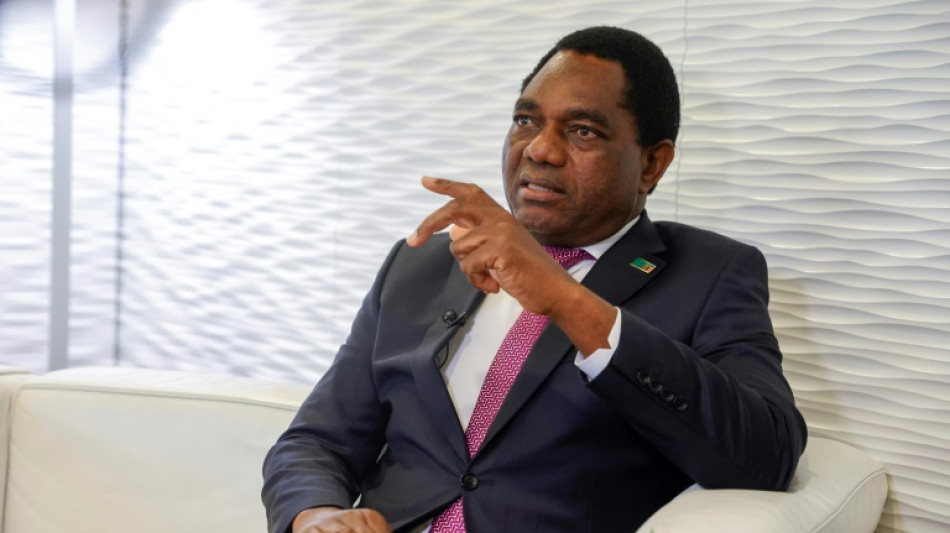
Zambia's president defends 'economic diplomacy' to escape debt / Photo: © AFP
Zambian President Hakainde Hichilema said his copper-rich country needs to forge diverse economic partnerships worldwide to extract itself from a debt burden he described as a "python around our necks."
The African nation in 2020 became the first on the continent to default on its foreign debt -- estimated at $17.3 billion -- since the start of the Covid-19 pandemic.
Zambia has since sought help to restructure its debt through a G20 mechanism, which is co-chaired by Paris and Beijing, but implementation has been slow.
The United States has accused Zambia's biggest creditor China, which according to financial researchers is owed $6.6 billion, of dragging its feet.
The debt is "like a python around our necks, ribs and legs," Hichilema said in an interview with Agence France-Presse in Paris after meeting President Emmanuel Macron for talks on Wednesday.
We need to "close this long overdue debt re-structuring, put it to bed and release resources and time and attention to the development side of our agenda," he said.
Since the businessman-turned-politician's election in 2021, the country has worked towards restoring relations with donors.
Western countries have hailed good governance and progress on reforms under his presidency, seeing in the nation a promising partner on a continent where China, Russia and Turkey are seeking to advance their influence.
- 'Work with each other' -
But Hichilema refused to align himself with any side.
"It is not an issue of polarisation that you're with China or against China, you're with America or against America," he said.
"That sort of argument belongs to the past. The world will be more progressive when we work with each other."
The Zambian president was in France after a series of high-profile visits to his country, including one from US Vice President Kamala Harris in late March in which she called for a "speedy finalisation" of Zambia's debt restructuring.
"Zambia is a country that has to take its place in the global community," he said.
"Purely economic diplomacy is what drives us -- and strengthening our bilateral relations, creating opportunities for joint trade and investment."
Hichilema said this was key to improving prospects in one of the world's youngest countries by median age.
"We need to pump up the economic side –- investment, trade, growth -- to create jobs, business opportunities for this young population, give them some hope in life," he said.
More than 60 percent of Zambia's some 20 million people live in poverty, according to the World Bank.
- 'Not puppyship, but partnership' -
Hichilema took office in 2021 with ambitious plans to turn around the economy of the Africa's second largest copper producer.
He told a mining conference last year that Zambia planned to more than triple production of the mineral to three million tonnes a year within a decade to respond to increasing demand for the metal in green technologies.
"Zambia is ready for business," he said on Wednesday.
It "is host to a number of critical minerals that are important for the electric vehicle industry."
But Hichilema stressed the need to move away from an old model of extracting and exporting raw materials.
We need "to extract these and to process them in country in joint venture with allies –- domestic investors, Europe investors, China investors, US investors," he said.
At home, the attention from the West has meant the leader has faced accusations from domestic critics of being a puppet of Western countries.
But the president, who was prominent member of the opposition before his landslide victory in 2021, insisted he was not dependent on any foreign power.
"I am no puppy of nobody, absolutely not," he said.
"We are talking about not a puppyship, but partnership, that's the way to go," he added.
P.Johnston--TNT