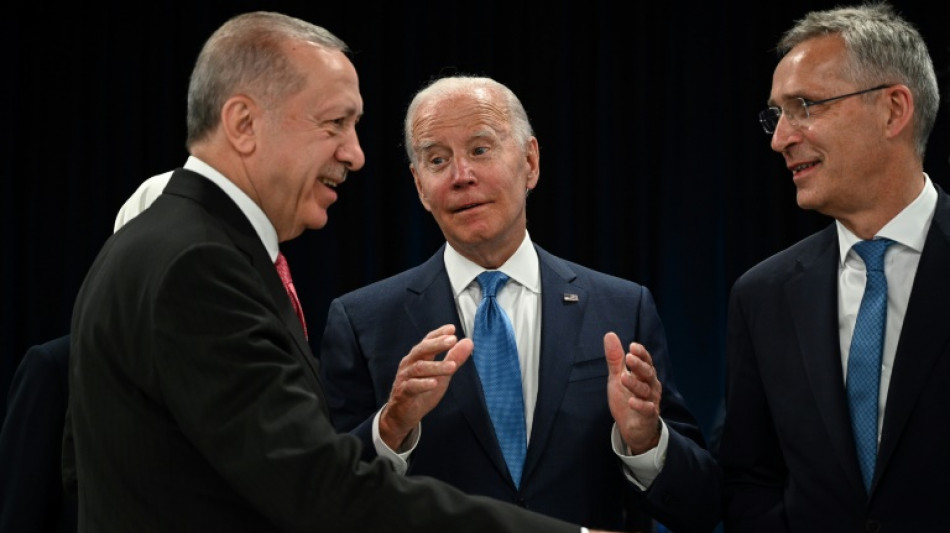
'Real partner': Erdogan's rival seeks softer foreign touch / Photo: © AFP
If it comes to power in Sunday's elections, the Turkish opposition led by Kemal Kilicdaroglu pledges to restore trust with Washington and Europe while mending ties with Syria.
A regional power of 85 million people and NATO's bridgehead in the Middle East, Turkey gradually detached itself from Western allies during President Recep Tayyip Erdogan's 21-year rule.
Ahmet Unal Cevikoz, a former ambassador and special adviser to Erdogan's main rival, thinks a diplomatic reversal and a transition to more democratic rule go hand in hand.
"Most of our problems with the European Union stem from the lack of democracy in Turkey," Cevikoz told AFP ahead of the tight parliamentary and presidential polls.
A return to the rule of law, which Western states accuse Erdogan of eroding during his second decade in power, will change Turkey's image abroad, Cevikoz said.
"It will become a very real partner," he promised.
Turkey's accession talks with the European Union froze over, less than a decade after it applied to join in 1999.
European powers such as France held reservations about admitting the majority Muslim nation, and Erdogan began to feel resentful as the talks dragged on.
Cevikoz said it was vital to revive the process because it "helps the democratisation of the country".
A member of Kilicdaroglu's secular CHP party, Cevikoz also backs extending a 2016 migrants deal with the EU.
Brussels sent billions of euros to Ankara in return for Turkey hosting roughly five million people fleeing war-torn countries, particularly neighbouring Syria.
Cevikoz said the opposition wants to "revitalise and review (the deal) to make it more effective".
The CHP also plans to launch the Syrians' "voluntary and dignified" return, which Cevikoz views as part of a broader reassessment of Turkey's and the EU's migration stances.
"The (migration) problem concerns Europe as much as Turkey," he said. "But the EU does not have a migration policy."
- Erdogan's 'mistake' -
Turkey has become one of NATO's most unruly members in the latter years of Erdogan's rule.
Cevikoz stressed the importance of Turkey's membership of the US-led military alliance, which was shaken by Erdogan's decision to purchase advanced missiles from Russia.
Washington expelled Turkey from its F-35 stealth fighter programme in retaliation.
Analysts felt that Moscow had successfully inserted a wedge in Ankara's relations with the West.
"Turkey's national defence is very much enhanced by its membership of NATO", Cevikoz said.
He called the Russian purchase "a mistake" that "cost us a lot".
Turkey's position in NATO has been further complicated by its refusal to let Sweden join the bloc in the wake of Russia's invasion of Ukraine.
Ankara wants Stockholm to extradite suspects it links to a Kurdish insurgency and a failed 2016 coup attempt.
Sweden has been toughening its anti-terrorism laws in response to Turkey's pressure, planning to put new legislation before parliament on June 1.
Cevikoz recognised Stockholm's "progress", saying this "will certainly ease the way for Sweden's membership".
- 'Balance' with Russia -
At the same time, Cevikoz signalled no significant break from Erdogan's approach to Moscow.
Wartime trade with Russia has boomed despite Turkey's decision to supply Kyiv with weapons.
Erdogan benefitted from a pre-election rebate on Russian energy and used his Kremlin ties to set up truce talks in the first months of the Ukraine war, boosting his stature at home.
"Turkey has always pursued a very balanced approach during the Cold War," Cevikoz said.
"Why not continue the same kind of balanced approach?".
"After the resolution of the Ukrainian conflict, there is the future architecture of European security" to consider, he said.
Such logic, similar to that adopted by French President Emmanuel Macron, worries Washington.
So does the region's reconciliation with Syria, which Cevikoz wholeheartedly backs.
Ankara's ties with Damascus were severed when Erdogan began backing rebel efforts to topple Syrian President Bashar al-Assad in 2011.
But Syria this week was readmitted to the Arab League, and Erdogan is now courting a summit with Assad, which Damascus is refusing until Turkey pulls all its troops out of Syria.
"We want to resume an unconditional dialogue" with Syria, Cevikoz said.
H.Davies--TNT