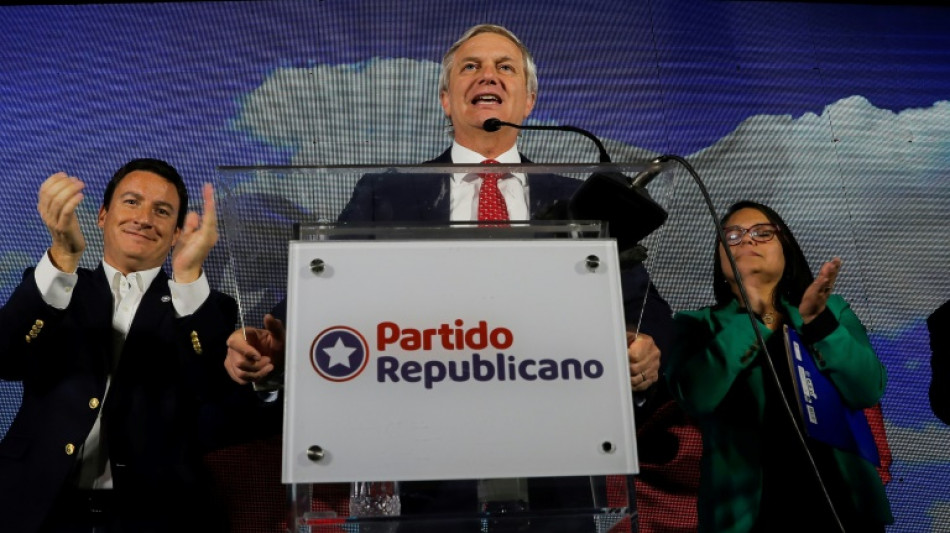
Chile's far right re-emerges after presidential defeat / Photo: © AFP
Chile's far right may have received a bloody nose in a deeply divisive presidential race in 2021, but elections Sunday for a body that will rewrite the country's dictatorship-era constitution have shown it to be an enduring force.
Led by conservative lawyer Jose Antonio Kast, an apologist for deceased military dictator Augusto Pinochet, Chile's Republican Party took 23 of 51 seats on the council that will design a new framework for the country's future.
The outcome of Sunday's vote does not alter the balance of power in the Chilean parliament, where the far right is a minority.
But it does give the Republican Party Kast founded in 2019 overwhelming sway in drafting the document that will shape Chile's new identity.
"The most likely is that something very similar to the 1980 (constitution) will come" from the drafting process, said Claudia Heiss of the University of Chile.
This would, in effect, maintain the status quo in the South American country which had appeared to be on a leftward trajectory ever since anti-government protests broke out in 2019 against deep social inequality.
The protests led to a referendum in 2020 in which 80 percent voted for replacing the Pinochet-era constitution.
In May 2021, Chileans elected a majority left-leaning body to write a new constitution, and that December chose millennial leftist Gabriel Boric as president over Kast.
Then the tide seemed to turn: Last year, more than 61 percent of voters rejected the constitutional draft that would have made Chile one of the most progressive countries in Latin America.
It would have allowed for elective abortion and expanded Indigenous rights -- all elements of Boric's leftist reform agenda.
And on Sunday, voters opted for a majority of Republican Party members on the drafting body.
- 'Vote of mistrust' -
Kast, 57, had been a vocal campaigner against replacing Chile's existing constitution which is free market-friendly and widely blamed for making companies and the elite richer at the expense of the poor, working classes.
His party's success on Sunday, experts say, may be explained by real concerns about criminal insecurity, high inflation and immigration in one of the world's most socially-unequal countries.
Boric's approval rating is a low 30 percent.
"It was an anti-politics vote, a vote of mistrust and a vote not only against the (constitution-writing) process but also traditional political parties," analyst Rodrigo Espinoza of the Diego Portales University told AFP.
Kast himself said that after Sunday's result, there was hope for "a major change of government" ahead of municipal elections next year and general elections in 2025, with Boric ineligible due to a constitutionally limited single term.
A recent poll put Kast ahead in people's presidential preference.
Boric had campaigned on a promise to turn Chile into a greener, more egalitarian "welfare state" and was swept to power in a country clamoring for change.
One percent of Chile's population owns about a quarter of its wealth, and in 2021, the rich classes voted in large numbers for Kast -- an active member of a conservative Catholic movement who has shrugged off attempts to label him "extreme."
- 'Cultural restoration' -
Father-of-nine Kast has expressed admiration for Donald Trump and Jair Bolsonaro, opposes gay marriage and abortion, and wants to cut taxes.
Many who voted for Kast for president approved of his stance against crime, migration and "communism" they associate with the political left.
"It is a far-right party with a cultural restoration project," said University of Santiago political scientist Marcelo Mella.
Kast's presidential bid included promises to reduce social spending, cut taxes and trim the number of ministries, including that of women's affairs.
He also promised to restore order at a time many Chileans looked with anger at violence and arson committed by some anti-government protesters.
A new constitutional draft will be put to a general vote in December.
A.Robinson--TNT