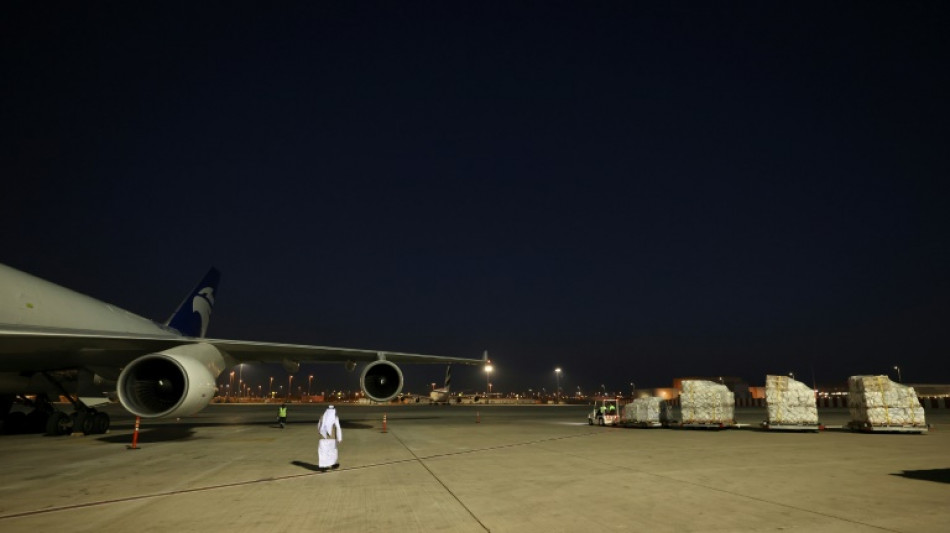
Sudanese war displaced double to more than 700,000: UN / Photo: © AFP
The war between Sudan's generals is having increasingly severe consequences for civilians, with a doubling over the past week of the number uprooted from their homes, the United Nations said Tuesday.
Hundreds have already been killed in the fighting but new worries emerged as separate ethnic clashes claimed at least 16 lives in the country's south, and a powerful group in the east, an area so far untouched by the war, demonstrated in support of the army.
More than 700,000 people are now internally displaced by battles which are now in their fourth week, Paul Dillon, spokesman for the International Organization for Migration, said in Geneva.
"Last Tuesday, the figure stood at 340,000."
An increasing number are also crossing borders to escape the battles between the army, led by Abdel Fattah al-Burhan, and his deputy-turned rival Mohamed Hamdan Daglo who commands the heavily armed paramilitary Rapid Support Forces (RSF).
Fighting has been concentrated in the capital Khartoum but other areas, particularly the western Darfur region bordering Chad, have also seen heavy fighting.
In addition to the internally displaced, another 150,000 have fled to neighbouring countries, the UN refugee agency said on Monday.
Those left behind in the war zones face shortages of water, electricity, food and medical care in a country where, according to the UN, about one-third of the population needed humanitarian assistance even before fighting began.
Foreign-led evacuations by land, sea and air have seen the departure of thousands of other people, many of them from the Red Sea city of Port Sudan, which has so far been peaceful.
But a demonstration on Monday in support of the army, which some called on to arm civilians, raised alarms in a country already marked by a history of ethnic unrest.
"One army, one people," hundreds of protesters belonging to the Beja people chanted.
They also called "no to negotiations", a reference to truce talks happening across the sea in the Saudi city of Jeddah between army and RSF representatives.
Those talks, also backed by the United States, have yielded no progress as fighting continues.
- 'Growing risk' -
"We, all of us the Beja, are ready to be armed and to protect the land and our honour," said Mahmoud al-Bishary, a Beja member, in a speech during the rally.
Such sentiment could signal even more problems for Sudan, where analysts see a protracted fight between the generals.
"As the war drags on and insecurity becomes not just an emergency situation but a feature of a precarious life, there is a growing risk that people might start arming themselves locally, or the army might resort to raising a counter-militia to the RSF, or both," Magdi el-Gizouli of the Rift Valley Institute told AFP.
Even before this war, Sudan suffered localised conflicts that last year killed about 900 people, according to the UN.
Those conflicts are often over access to scarce water and other resources, but they also reflected a security breakdown in Sudan since Burhan and Daglo staged a coup in October 2021, derailing a transition to democracy after the toppling of longtime autocrat Omar al-Bashir.
Burhan and Daglo later fell out in a power struggle, leading to the current fighting.
State media reported on Tuesday that clashes between ethnic groups in Kosti killed at least 16 people, wounded scores more, and prompted a regional night-time curfew.
The fighting occurred on Sunday between the Hausa and Nuba ethnic groups in Kosti, capital of White Nile state, state-run SUNA news agency reported.
Kosti is the last major town before South Sudan, which has received more than 42,000 returnees who had previously sought safety north of the border and are now fleeing war again, the UN refugee agency said.
The UN has described Sudan's humanitarian situation as catastrophic.
There was no letup Tuesday in the fighting.
"Various types of weapons were fired" in northern Khartoum, according to a resident of the Shambat area. Another witness reported continued clashes in the capital's south.
K.M.Thompson--TNT