Illegal mining booms in Brazilian Amazon 'promised land' / Photo: © AFP
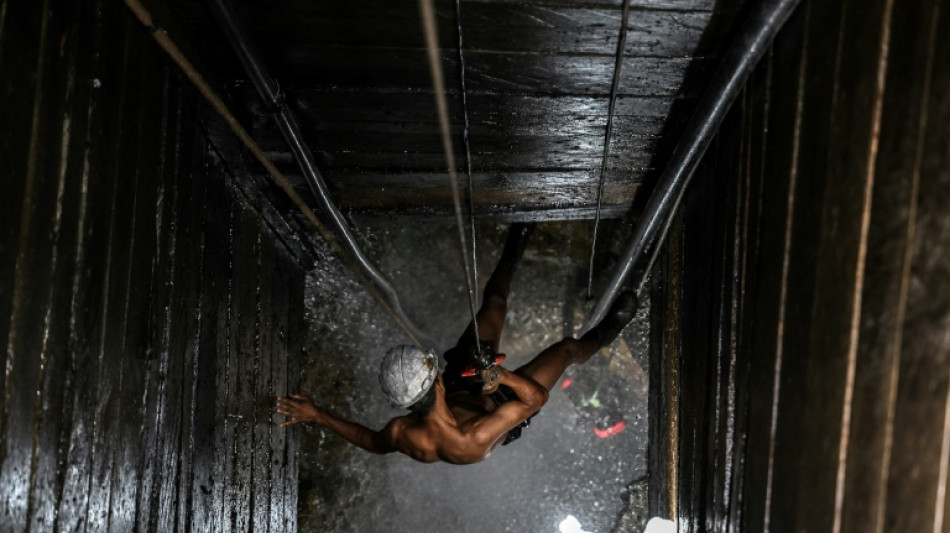
Working under an improvised shed hidden in the rainforest, Webson Nunes hears a shout and flips on his winch, hauling a colleague up from deep inside a giant hole with a bucket full of riches.
Nunes, 28, and his four colleagues are "garimpeiros," illegal miners who dig for precious minerals -- in their case, at a wildcat copper mine outside Canaa dos Carajas, a small city at the edge of the Brazilian Amazon that has become a boom town in recent years thanks to mining.
Canaa -- Portuguese for Canaan, the Biblical "Promised Land" -- is a place of extremes: At one end of the spectrum sits mining giant Vale, which runs one of the world's biggest open-air mines here.
Known as S11D, the iron-ore mine made the city the richest in Brazil in 2020 in GDP per capita.
At the other end are an estimated 100 illegal mines like the one where Nunes is employed, bootstrap operations where "garimpeiros" -- Portuguese for "prospectors" -- make a living digging holes in the earth, living on constant alert in case of a raid.
"I work with one eye here (on the mine), and the other outside. The police could arrive at any moment," says Nunes, inside the tarp-covered shack above the narrow, wet, 20-meter (22-yard)-deep hole into which he lowers his colleagues with a harness and steel cable to haul up big blue buckets of shiny, mineral-rich rocks.
But Nunes, who has been doing this for seven years, says he sees it as just another job -- albeit a lucrative one. The mine owner pays him 150 reais ($30) a day, a nice salary in these parts.
- 'Severe environmental damage' -
Illegal mines make around $800 per metric ton of copper they sell on the black market.
This one typically produces more than that in a day, the miners told AFP.
Authorities say the copper mined illegally in Canaa mainly gets exported to China.
Police say they have also detected illegal gold mines in the area, which cause greater environmental damage because of the mercury used to separate gold from soil.
Canaa's population has boomed along with its economy.
Since 2016, when Vale launched S11D, employing 9,000 people, the town has nearly tripled in size, from 26,000 inhabitants to 75,000.
The town, located in the northern state of Para, voted heavily in Brazil's presidential elections last year for far-right incumbent Jair Bolsonaro, who narrowly lost to veteran leftist Luiz Inacio Lula da Silva.
Bolsonaro, whose father was a garimpeiro, defended wildcat miners as president, pushing to allow mining on protected lands in the Amazon and drawing condemnation from environmentalists.
Since taking office in January, Lula has cracked down on illegal mining in the world's biggest rainforest.
Police have staged six raids in the Canaa region since August 2022, unearthing what they called "severe environmental damage" in the form of "severely" discolored rivers and forestland turned into giant pools of toxic mud.
Officers typically destroy miners' operations, flooding their mine shafts and seizing or burning their equipment.
But it does little to stop them: The same miners can sometimes be seen back at work the next day, says Genivaldo Casadei, a garimpeiro leader.
Casadei, 51, is treasurer of a local small-scale miners' cooperative trying to win legal status for their work.
Under Bolsonaro, miners were in advanced talks with the federal mining agency to do just that, he says.
Lula's victory put an end to that.
"In the cities, people see garimpeiros as criminals. But we're just workers trying to feed our families," says Casadei.
"If (wildcat mining) were regulated, it would create jobs and tax revenue. Canaa could be the richest city in the world."
- 'Dangerous job' -
Garimpeiros say it is unjust that Vale, the world's biggest iron ore producer, has a monopoly on mining rights on local land, but uses just 13 percent of it.
Getting authorization for small-scale mines is nearly impossible, they say.
Crouching over a pile of shiny rocks from a mining pit, Valmir Souza bangs at them with a hammer, separating the copper from the rest.
"It's a hard, dangerous job," says Souza, 33, who works in gloves, rubber boots and a white helmet.
He arrived here seven months ago from his northeastern home state, Maranhao, the poorest in Brazil, where he worked teaching capoeira, a Brazilian dance form and martial art.
There is more opportunity in Canaa, he says.
But "we have to work in secret," he adds. "What else can we do?"
P.Johnston--TNT