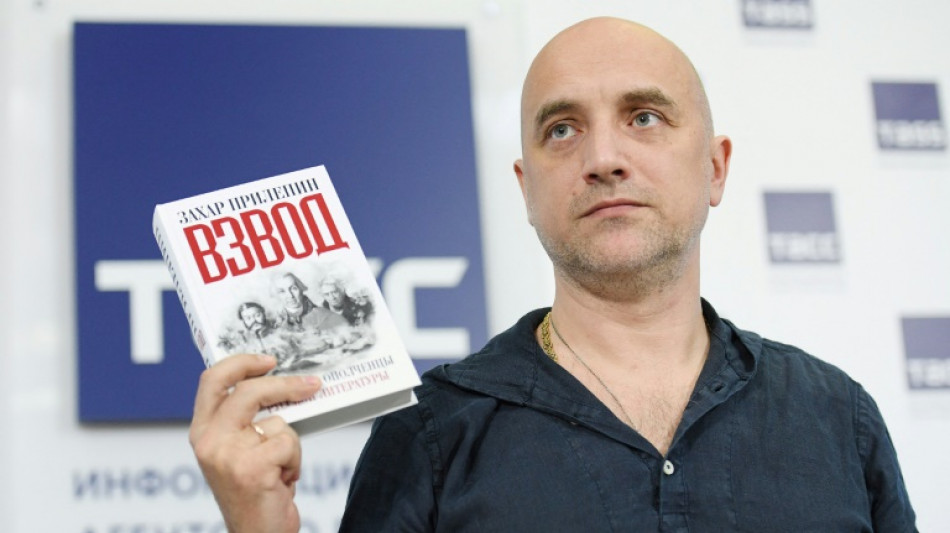
Prilepin, a Russian writer who backs the Kremlin's Ukraine campaign / Photo: © AFP
Zakhar Prilepin, who was wounded in a car blast on Saturday, paints himself as a warrior writer -- once praised by Western critics before he put his pen and his Kalashnikov to the service of the Kremlin in Ukraine.
With his shaved head and quickfire, slightly trembling diction, the 47-year-old writer is a prominent figure in Russia's cultural landscape.
His books inspired by his experiences of war and living in Russia's provinces are popular and his TV appearances frequent.
A veteran of Russia's wars against Chechen separatists in the 1990s, he became an opposition activist as he was building up a name for himself in the literary world in Russia and Europe.
Everything changed with Russia's annexation of Crimea from Ukraine in 2014.
Prilepin has since then embraced President Vladimir Putin's policies and went on to fight alongside pro-Russian separatists in eastern Ukraine, revealing in 2017 that he had created his own battalion.
"I think a writer has a right to any position," Prilepin said at a Moscow news conference following the revelation.
"He can stand with a flag saying peace to the world or he can take up arms."
- Against the oligarchs -
Born in 1975 in Ryazan region before moving to Nizhny Novgorod, he was sent to fight as a young man in Chechnya.
After his return to civilian life, he recounted the horrors of the war in his novel "Pathologies" which describes the actions of a special forces unit, including hard drinking and massacres.
His novels and short stories are particularly good at describing the lives of young people in Russia's provinces.
He won several awards and his works have been translated in western Europe.
During the 2000s, Prilepin was also an activist with the National Bolshevik party of writer Eduard Limonov (1943-2020) which mixed far-left social demands with nationalism and nostalgia for the Soviet empire.
He has long campaigned for Russia's poor against corrupt oligarchs.
Once a critic of Putin, he became a supporter of the Kremlin and appeared frequently on Russian television in between fighting missions to Ukraine.
- 'Held accountable in hell' -
The large-scale assault on Ukraine in February 2022 did not change his opinion.
"I have no guilt about what is happening. It has happened, now we have to see it through," he said in November.
Like many oligarchs, he was placed under European Union sanctions.
He supports a campaign to flush out figures in the cultural world in Russia with "anti-Russian positions".
His activities were a precursor to the repression currently underway in Russia, where voices critical of the conflict are persecuted, imprisoned, or pushed to flee.
The writer has compared himself to two giants of Russian literature -- Leo Tolstoy and Mikhail Lermontov -- both of whom fought as soldiers before turning to writing.
According to Prilepin, Tolstoy and Lermontov would have joined the Russian army in Ukraine had they been alive today.
Interviewed by AFP in Paris in 2018, he said he was fighting out of "empathy" and did not hide his desire for Russia to take over more of Ukraine.
"Our aim is to conquer and control territory," he said.
"Killing is not an aim of itself and we will be held accountable in hell".
W.Phillips--TNT