Peace deal 'within reach' in Armenia-Azerbaijan talks / Photo: © AFP
A peace deal to end Armenia and Azerbaijan's three-decade-old dispute over the Nagorno-Karabakh enclave is "within reach" after four days of talks in Washington, US top diplomat Antony Blinken said Thursday.
The discussions between Armenian Foreign Minister Ararat Mirzoyan and his Azerbaijani counterpart Jeyhun Bayramov did not result in a deal to end the territorial conflict between the two ex-Soviet republics, but Blinken said progress had been made.
"The two sides have discussed some very tough issues over the last few days, and they've made tangible progress on a durable peace agreement," the secretary of state said.
"I hope that they see and I believe that they do, as I do, that there is an agreement within sight, within reach," he said.
Blinken added later that the two sides "demonstrated a sincere commitment" to normalizing relations and ending their longstanding conflict.
"Both Armenia and Azerbaijan agreed in principle to certain terms and have a better understanding of one another's positions on outstanding issues," he said.
The two countries put out identical statements following the talks, saying they had laid out their positions on normalization.
"The Ministers and their teams advanced mutual understanding on some articles of the draft bilateral Agreement on Peace and Establishment of Interstate Relations," the statements said.
Both sides acknowledged, however, "that the positions on some key issues remain divergent."
Armenia and Azerbaijan were both republics of the Soviet Union and gained their independence when it broke up in 1991.
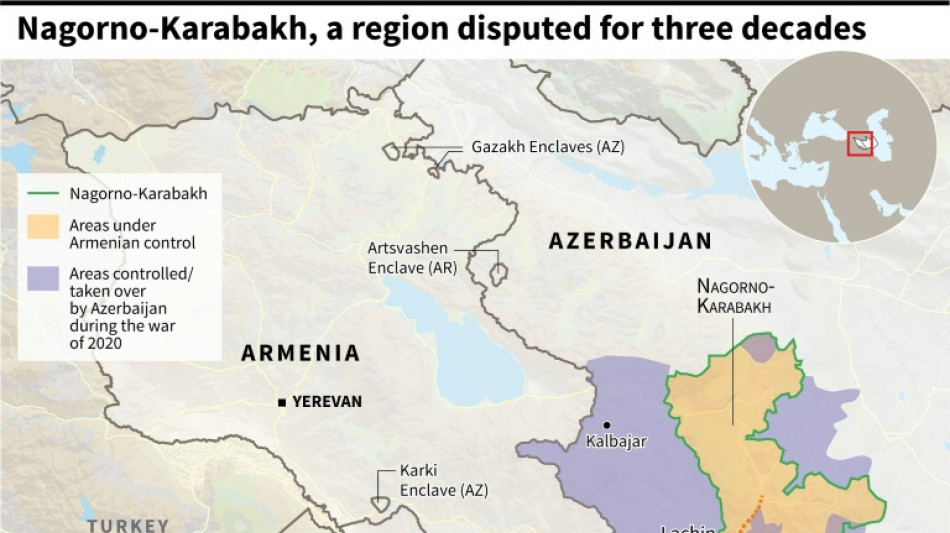
The two sides have gone to war twice over disputed territories, mainly Nagorno-Karabakh, a majority-Armenian enclave inside Azerbaijan.
Tens of thousands were killed in the wars, one lasting six years and ending in 1994, and the second in 2020, which ended in a Russia-negotiated peace deal.
But clashes have broken out regularly since then.
Azerbaijan injected new tensions last week when it placed a checkpoint on the Lachin Corridor, the only land link between Armenia and Nagorno-Karabakh.
Armenia views the move as a violation of a ceasefire negotiated between the two sides.
- 'The last mile' -
The four days of talks between Mirzoyan and Bayramov took place out of the view of media in a secure State Department facility in Arlington, a suburb of the US capital.
Ahead of the talks, a US official said they wanted the sides to sit down together and the primary aim was to move toward normalizing relations.
Blinken praised the foreign ministers for their leadership.
"None of this is easy, but the commitment, the determination to move forward to deal with the remaining challenging issues is real," he said.
"The last mile of any marathon is always the hardest. We know that," he added.
"But the United States is here to continue to help both of our friends cross the finish line."
He said he had proposed the two ministers return to their capitals "to share with their governments the perspective that, with additional goodwill, flexibility and compromise, an agreement is within reach."
Earlier this week, however, Russia said there was "no alternative" to a deal it signed with the two warring countries in 2020.
"For the moment, there is no other legal basis that would help a resolution. There is no alternative to these trilateral documents," Kremlin spokesman Dmitry Peskov told reporters on Tuesday.
M.A.Walters--TNT