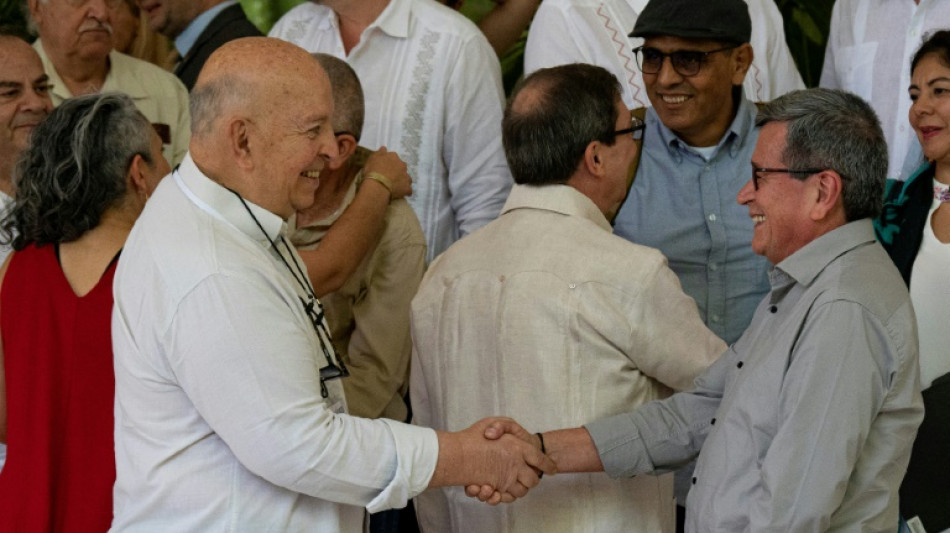
Colombia, ELN guerrillas say they want a ceasefire / Photo: © AFP
Colombia's government and National Liberation Army (ELN) guerrilla group on Tuesday affirmed a commitment to reaching a ceasefire agreement as they met in Havana for a third round of peace talks.
The two sides also agreed on the need for civil society to be involved in any negotiated peace.
"We have the immense responsibility together to find a way out of this ignoble war," said Colombian senator Maria Jose Pizarro, a member of the government's negotiating delegation in the Cuban capital.
"The best way to contribute to solutions to the conflict is to end this cycle (of talks) with an agreement for the participation of society," Pizarro continued, "to build peace with the National Liberation Army, and the ceasefire that should have as its fundamental axis that people should not suffer."
The peace process was launched by Colombia's first-ever leftist President Gustavo Petro -- himself a former urban guerrilla -- at the end of last year.
The first round took place in Caracas in November with further talks in Mexico in March, in which the two sides committed to discussing a ceasefire.
But an ELN ambush on a military convoy in late March that left nine soldiers dead cast doubt over the resumption of talks.
"We are determined to achieve the objectives set in the Mexico cycle: a ceasefire and societal participation," said Pablo Beltran, head of the ELN delegation.
"The sectors that have always been marginalized and exploited cannot be simple spectators in this process," he added.
In Madrid, Petro on Tuesday said "it makes no sense to speak of peace" without a ceasefire.
He proposed what he called "regionalization of ceasefires that can gradually be extended to the national geography."
Considered the last guerrilla group still operating in Colombia, the ELN will next year mark six decades since taking up arms against the state.
Colombia has been embroiled in a decades-long conflict involving radical leftist guerrillas, right-wing paramilitaries and drug traffickers.
All of them finance their activities through smuggling cocaine -- of which Colombia is the world's largest producer -- and increasingly through illegal mining.
The ELN initially refused to join a bilateral ceasefire announced by Petro just before the new year.
Colombia has attempted many times to negotiate peace with armed groups.
The most successful example was the deal that brought about the disarmament of the powerful Revolutionary Armed Forces of Colombia (FARC) rebels in 2017.
According to government negotiator Otty Patino, Bogota hopes to reach a ceasefire before October regional elections.
S.M.Riley--TNT