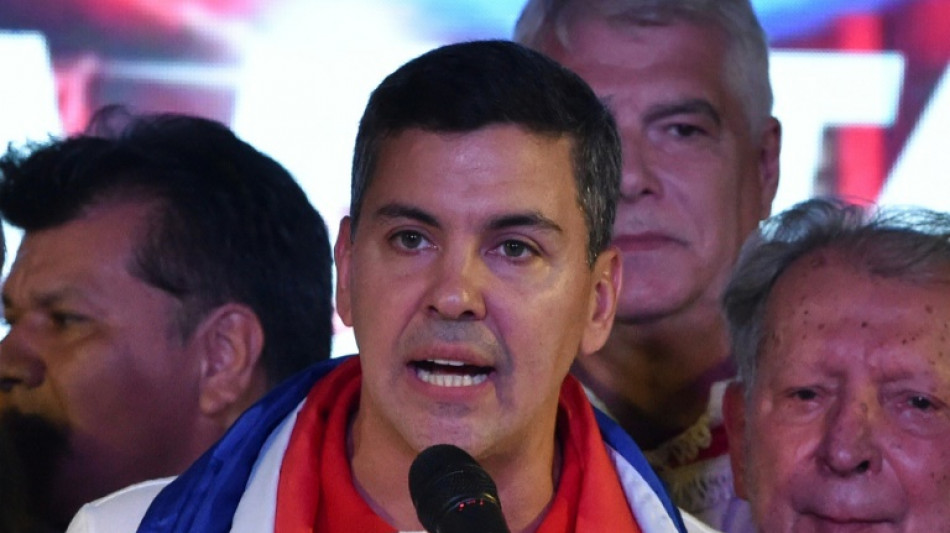
Santiago Pena wins Paraguay vote, keeps rightwing party in power / Photo: © AFP
Paraguayans on Sunday elected a president from the rightwing party in power for nearly eight decades, rejecting a center-left challenger who had railed against endemic institutional corruption.
Economist and former finance minister Santiago Pena, 44, took the election with more than 42 percent of the vote to continue the hegemony of the conservative Colorado Party, results showed.
Sixty-year-old challenger Efrain Alegre of the Concertacion center-left coalition garnered nearly 27.5 percent despite having gone into the vote with a narrow lead in opinion polls.
The outcome bucked a recent anti-incumbency trend in Latin American elections with voters repeatedly punishing establishment parties, often in favor of leftist rivals.
The Colorado Party has governed almost continually since 1947 -- through a long and brutal dictatorship and since the return of democracy in 1989, but has been tainted by corruption claims.
Pena's political mentor, ex-president and Colorado Party leader Horacio Cartes, was recently sanctioned by the United States over graft.
Pena thanked Cartes in his first public address as president-elect for his "stubborn dedication to the party," to loud cheers from supporters at party headquarters.
Conceding defeat, Alegre stated: "The effort was not enough."
Some 4.8 million of Paraguay's 7.5 million inhabitants were eligible to vote Sunday for a replacement for President Mario Abdo Benitez, leaving office after a constitutionally limited single five-year term.
They also voted for new lawmakers in a country where voting is mandatory, but only 63 percent turned out.
Key issues for voters were endemic corruption, a spiraling crime problem and poverty.
- 'Back to Jerusalem' -
Like challenger Alegre, Pena is socially conservative, holding strong anti-abortion and anti-gay marriage stances in an overwhelmingly Catholic nation.
On international policy, he had vowed to retain diplomatic ties with Taiwan -- Paraguay is one of only 13 countries to recognize Taipei over Beijing -- unlike Alegre who had mooted a shift to China.
But Pena has promised to move Paraguay's embassy in Israel from Tel Aviv to Jerusalem.
Paraguay had previously moved its embassy in 2018, under Cartes, but reversed its decision within months, raising the ire of Israel.
"Yes, I would go back to Jerusalem," Pena told AFP before the vote.
"The State of Israel recognizes Jerusalem as its capital. The seat of the Congress is in Jerusalem, the president is in Jerusalem. So who are we to question where they establish their own capital?"
Moving an embassy to Jerusalem is highly contentious. Israel claims all of Jerusalem as its capital while Palestinians view east Jerusalem as the capital of their future state.
- Hoping for 'least worse' -
Alegre repeatedly pointed to corruption in the Colorado Party.
Paraguay is ranked 137 out of 180 countries on Transparency International's Corruption Perceptions Index.
Apart from the shadow of top-level graft, which has angered voters, other election concerns include poverty and an escalating crime problem.
Paraguay's GDP is expected to grow 4.8 percent in 2023, according to the central bank, and 4.5 percent according to the IMF -- one of the highest rates in Latin America.
But poverty plagues a quarter of the population.
Paraguay's Indigenous groups and inhabitants of squalid shantytowns feel especially neglected, with many saying they won't vote at all.
Pena had pledged to create half-a-million jobs, without saying how.
Crime is also a concern, with an anti-mafia prosecutor, a crime-fighting mayor and a journalist murdered in 2022 as cartels settle scores.
Experts say landlocked Paraguay -- nestled between Brazil, Bolivia and Argentina -- has become an important launchpad for drugs headed for Europe.
"We hope the least worse wins. All have their weaknesses," Marta Fernandez, 29, told AFP after casting her ballot in Asuncion.
Also in the capital, 60-year-old voter Ana Barros said: "You have to have at least hope, that there will be less crime. It is what I hope as a mother, that the children can study and have work."
I.Paterson--TNT