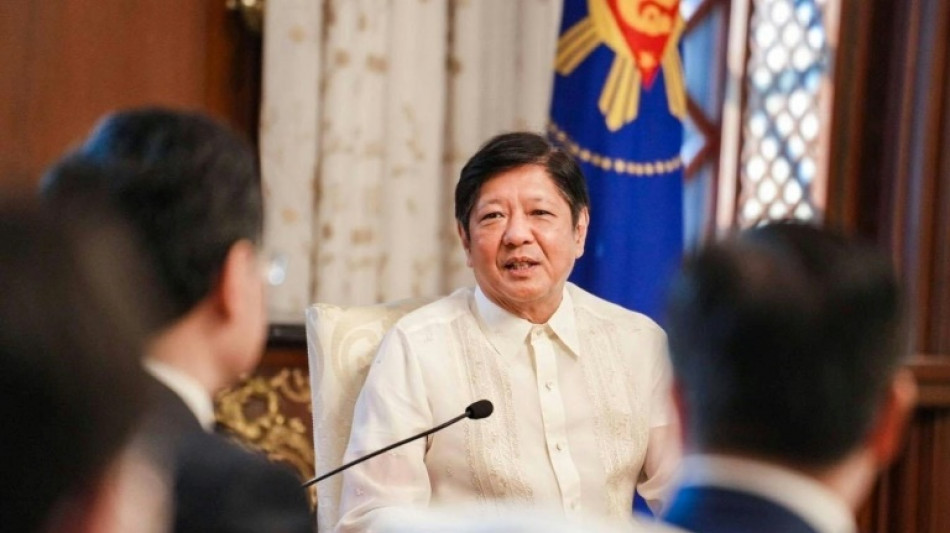
Philippine leader travels to US to bolster ties / Photo: © Presidential Communications Office (PCO)/AFP
President Ferdinand Marcos left Manila for a visit to the United States on Sunday, after the allies bolstered military cooperation in the South China Sea with their largest-ever drills and inked an agreement expanding US troops' access to bases in the Philippines.
Manila and Washington recently agreed to expand their cooperation in "strategic areas" of the Philippines as they seek to counter Beijing's growing assertiveness in the region and its sweeping claims over disputed waters, small islands and shoals.
Marcos's visit comes after the United States called on China to stop "provocative and unsafe conduct" in the contested South China Sea after a recent near-collision with a Philippine coast guard vessel.
Marcos begins his four-day trip with a meeting with US President Joe Biden on Monday at the White House, which the Philippine leader described as "essential to advancing our national interest and strengthening that very important alliance".
"We will reaffirm our commitment to fostering our long-standing alliance as an instrument of peace and as a catalyst of development in the Asia Pacific region," Marcos said in a pre-departure statement.
Ahead of the visit, US State Department spokesman Matthew Miller slammed China over the near-collision of one of its ships with a Philippine patrol boat a week ago, saying it was a reminder of Beijing's "harassment and intimidation" in the disputed waterway.
"We call upon Beijing to desist from its provocative and unsafe conduct," he said in a statement, adding that any attack on Philippine armed forces would trigger a US response.
Biden has been working to bolster relations with Asian allies as the US-Chinese relationship remains in a historically deep chill.
The Philippines' proximity to key sea lanes and Taiwan gives it strategic importance.
Beijing claims sovereignty over almost the entire South China Sea, ignoring an international ruling that its assertion has no legal basis.
- A near-miss -
On April 23, as a Philippine Coast Guard boat carrying journalists neared the Second Thomas Shoal in the Spratly Islands, a Chinese vessel more than twice its size sailed into its path.
AFP journalists witnessed the incident from another Philippine boat less than a kilometre (0.6 miles) away.
The first vessel's commanding officer said the Chinese ship came within 45 metres (50 yards) of his boat, and only quick actions avoided a collision.
The Chinese foreign ministry said Friday that the Philippine boats had "intruded" without China's permission and called it a "premeditated and provocative action".
Manila responded that "routine patrols in our own waters can be neither premeditated or provocative" and insisted the patrols would continue.
Marcos has said he will not let China trample on the Philippines' rights in the sea, and has gravitated towards the United States as he seeks to strengthen defence ties.
This month, the Philippines identified four military bases -- in addition to five existing sites -- to which US forces will have access, including one near the Spratly Islands.
The allies also carried out their largest-ever military manoeuvres in recent weeks.
This shift has alarmed China, which has accused Washington of trying to drive a wedge between Beijing and Manila.
- 'Ironclad commitment' -
US-Philippine ties were badly frayed under Marcos's predecessor, Rodrigo Duterte.
Marcos has sought to allay public fears that the alliance with the United States could bring the Philippines into a conflict if China were to invade Taiwan, which Beijing sees as its own territory to be reclaimed one day.
Marcos has said he will speak with Biden about the "need to tone down the rhetoric" over the South China Sea, Taiwan and North Korea.
White House Spokeswoman Karine Jean-Pierre said this month that Biden intended, in the meeting with Marcos, to "reaffirm the United States' ironclad commitment to the defence of the Philippines".
Before departing Sunday, Marcos said he would convey to Biden that Manila wished to forge stronger ties in areas ranging from food and energy security, to "ensuring our resilience from threats to our economy, including global supply chain disruptions and economic coercion".
Marcos added that he would push for "greater economic engagement" between the two countries and expected to meet US business leaders to promote trade and investment.
W.Baxter--TNT