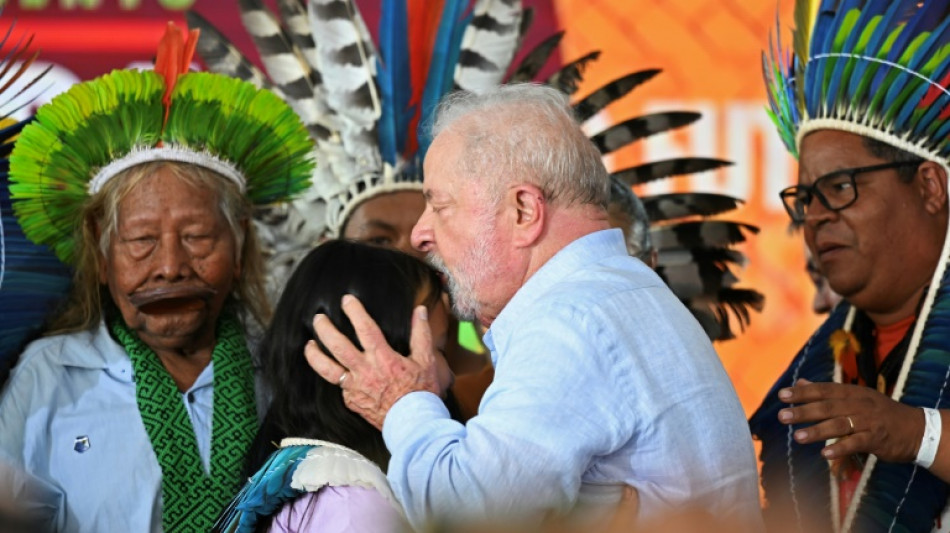
'A new history': Brazil's Lula decrees six Indigenous reserves / Photo: © AFP
Brazil's President Luiz Inacio Lula da Silva on Friday decreed six new Indigenous reserves, the first after a dearth of such expansion under his far-right predecessor Jair Bolsonaro.
Under the decree, Indigenous people are guaranteed exclusive use of natural resources on these lands, viewed by scientists as a bulwark against Amazon deforestation -- a major challenge in the fight against climate change.
Lula signed the official decrees on the final day of a gathering of Indigenous people from around the country in the capital Brasilia.
"It is a time-consuming process, but we are going to make sure that as many Indigenous reserves as possible are legalized," the president said.
"If we want to achieve zero deforestation by 2030, we need registered Indigenous reserves."
Under four years of Bolsonaro, who had vowed to not cede "one more centimeter" of land to Brazil's Indigenous communities, average annual deforestation had increased by 75 percent compared to the previous decade.
Bolsonaro instigated policies that favored the agriculture and logging industries, which are mostly responsible for deforestation.
Two of the six new reserves are in the Amazon.
The largest, named Unieuxi, was allocated to 249 members of the Maku and Tukano peoples on more than 550,000 hectares in the northern state of Amazonas.
Two others are in the country's northeast, one in the south, and one in central Brazil.
Friday’s announcement was made at a closing ceremony for the 19th edition of "Terra Livre" (Free Land), a gathering of thousands of Indigenous peoples from across the vast country.
Lula signed the decrees next to prominent Indigenous leaders such as chief Raoni Metuktire, who presented him with a traditional headdress of blue and red feathers.
According to the latest census, dating from 2010, Brazil is home to about 800,000 Indigenous people. Most of them live on reserves that take up 13.75 percent of the national territory.
- 'Fighting to recover' -
The last declaration of a new Indigenous reserve in Brazil dates to five years ago, when then-president Michel Temer granted the Guato people rights to 20,000 hectares (some 49,400 acres) of ancestral land in the western Mato Grosso state.
Lula vowed to approve new reserves "as soon as possible" after taking office for a third term on January 1. He had previously served as president from 2003 to 2010.
He created the country's first-ever ministry for Indigenous affairs, under Minister Sonia Guajajara.
"When they say that you occupy 14 percent of the territory and that it is a lot, it is necessary to remember that before the arrival of the Portuguese you occupied 100 percent," Lula said to loud cheers by the crowd who made the "L" of Lula with an index finger and thumb.
More reserves are in the pipeline: Guajajara announced last month that 14 reserves were ready to be legalized -- covering nearly 900,000 hectares in total.
These included the six announced Friday.
"We are going to write a new history, for the sake of all humanity, of our planet," Guajajara said after Friday's signing.
S.M.Riley--TNT