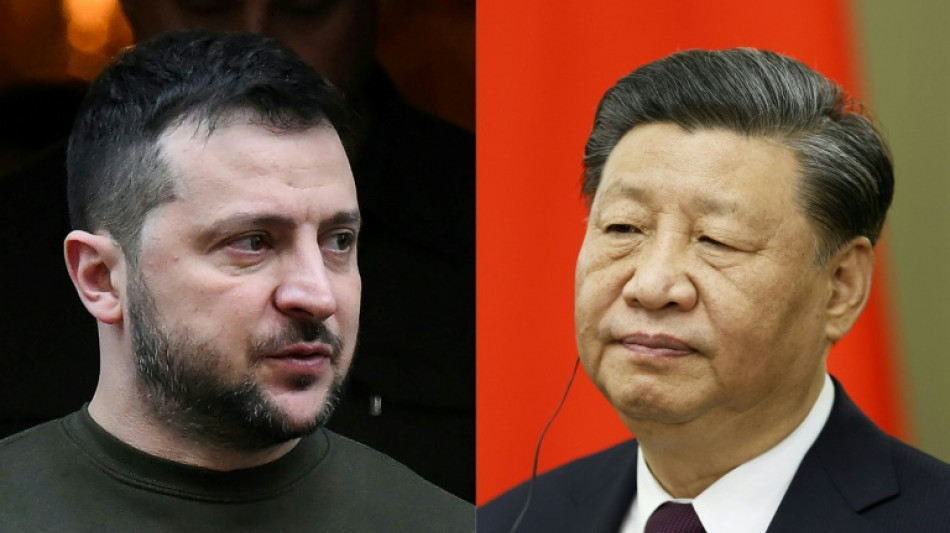
Beijing-led talks on Ukraine a 'trap' for the West: analysts / Photo: © AFP/File
China and Ukraine's leaders speaking this week raises the unflattering prospect of Kyiv and the West having to reject a Chinese proposal to end the Ukraine war, analysts say.
The one-hour conversation between Xi Jinping and Volodymyr Zelensky on Wednesday was the first since Russia invaded its pro-Western neighbour more than a year ago.
Xi, who has refused to condemn President Vladimir Putin's invasion and maintained cordial ties with Moscow, advocated peace negotiations.
Beijing claims that Zelensky initiated the call, after China published a 12-point position paper on Ukraine in February and the Ukrainian leader said he would be open to dialogue with Xi.
"Despite Russia's stumbling invasion, the status quo is untenable," said Can Kasapoglu of the US thinktank Hudson Institute.
"Ukraine needs to attempt to fundamentally change the political and military dynamics of the conflict."
Ukrainian forces have said they are preparing for a spring operation to further push back Russians in the east of the country.
But "even if it conducts a successful counter-offensive that secures large swathes of land, Ukraine can only solidify the reacquisition of its occupied territories via diplomatic means," Kasapoglu said.
- 'Decline in popular support' -
Kyiv has relied heavily on Western weaponry to defend itself, and a high-ranking European official this month said Ukraine was "in dire need of munitions".
The United States alone has spent billions in economic and military aid since the February 2022 invasion.
But 26 percent of Americans think that aid to Ukraine has been excessive, according to a Pew Research Centre poll published in January.
Marlene Laruelle of George Washington University said this trend would probably increase pressure for a diplomatic solution.
"This decline in popular support for Ukraine is likely to become more pronounced in the coming months regardless of how the conflict evolves," she wrote recently.
"If the Ukrainian counteroffensive is successful, calls for diplomatic negotiations will intensify, while if it fails, calls for concessions to achieve a ceasefire will grow."
- 'What Ukrainian integrity?' -
The timing of Wednesday's phone call could possibly signal a go-ahead from Putin, after Singaporean diplomat Chan Heng Chee last week said that no contact had been made between Xi and Zelensky until then because the Russian leader had likely told Xi he was "not ready to negotiate".
Jean-François Di Meglio, a French researcher based in Taiwan, said China was hoping to position itself as a key mediator.
"China is really entering the great diplomatic game, pursuing its agenda of a new global governance," he said.
He said any peace negotiations were likely to follow Beijing's February 12-point plan.
"Whatever Xi proposed cannot be very different," he said, and would include "territorial integrity".
"But what does Ukrainian integrity mean for the Chinese? We have no idea," he said.
"What will be the borders?"
Moscow in 2014 invaded and annexed the Crimean Peninsula, after a referendum not accepted by Kyiv or the West.
And since its full-scale invasion last year, it has annexed four regions of Ukraine -- Donetsk, Lugansk, Kherson and Zaporizhzhia -- after staging local polls also dismissed by Kyiv and the West as a sham.
- 'Trap' -
Dan Baer, a researcher for the Carnegie Endowment for International Peace, said last week there was "no way that China could be a credible mediator" in view of its support to Moscow.
China would likely start by suggesting a ceasefire, said China expert Yawei Liu at the same Carnegie conference.
But "that's not something Ukraine wants to see now because if you call a ceasefire, then Crimea, Donbas and other areas are still occupied," he said.
Di Meglio said any Chinese-led negotiations risked casting Ukraine and its allies as hardliners bent on rejecting a peace proposal.
"That's the huge trap," he said.
Moscow said on Thursday it welcomed any attempt to end the Ukrainian conflict on its own terms.
"We are ready to welcome anything that can bring forward the end of the conflict in Ukraine and the achievement of Russia's goals," Kremlin spokesman Dmitry Peskov told reporters.
White House national security spokesman John Kirby on Wednesday called the Xi-Zelensky phone call a "good thing".
But "if there's going to be a negotiated peace, it's got to (be) when President Zelensky is ready for it... where he can do it from a position of strength," he said.
S.Mitchell--TNT