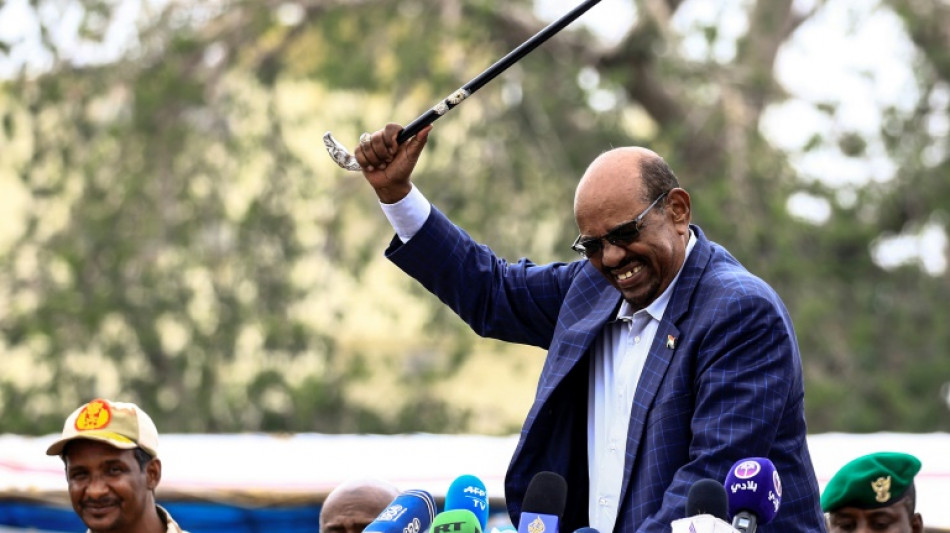
Bashir's cronies escape jail, adding to Sudan war drama / Photo: © AFP/File
Before they went to war with each other, Sudan's rival generals rose to prominence under the regime of deposed strongman Omar al-Bashir. This week, that old guard has reappeared.
Wanted by the International Criminal Court, former top Bashir aide Ahmed Harun announced via Sudanese media on Tuesday that he and other former old regime officials had escaped Khartoum's Kober prison, where they had been since Bashir's ouster after pro-democracy protests in 2019.
The fighting pits army chief Abdel Fattah al-Burhan against his fellow 2021 coup leader and former deputy, Mohamed Hamdan Daglo, head of the paramilitary Rapid Support Forces (RSF).
Since their coup, civilian political leaders have warned of "the return of the old regime", after several high-ranking officials from the Bashir era found roles in Burhan's administration.
For the Forces of Freedom and Change (FFC), the main civilian bloc ousted from power by Burhan and Daglo, the re-emergence of Harun was proof that "the deposed regime and its dissolved party are -- through their assets in the armed forces -- behind the ongoing war".
But Magdi el-Gizouli of the Rift Valley Institute said that while Bashir's inner circle being free might affect the "ideological propaganda" battle, it "is not a significant development in terms of warfare."
Sudan specialist Jonas Horner told AFP that Bashir's cronies are in a position "to contribute thinking and perhaps mobilise key sections" of Islamist factions which played an integral part in Bashir's rule since his own coup in 1989.
"But I do not think that under the current circumstances they are viable or eligible to take or re-take positions in government," Horner added.
- Crimes against humanity charges -
Both the warring generals fighting since April 15 rose to power under Bashir.
Burhan, de facto leader of Sudan since the 2021 coup, rose through the ranks under the longtime autocrat.
He was a senior general during the Darfur war, which since 2003 has left some 300,000 dead and millions displaced.
Burhan's coup-partner-turned-rival, General Mohamed Hamdan Daglo -- commonly known as Hemeti -- leads the RSF, which emerged from the Janjaweed militia that Bashir unleashed on non-Arab ethnic minorities in Darfur.
Harun -- former minister of state for humanitarian affairs and also an ex-governor of South Kordofan -- is implicated in the Darfur atrocities.
He has been wanted by The Hague-based ICC since 2007 for 20 counts of crimes against humanity and 22 counts of war crimes, including on a charge of recruiting, arming and funding the Janjaweed.
Like much of Bashir's inner circle, Harun was detained -- along with Bashir himself, who was convicted of corruption -- in Kober prison until this week.
He stepped into the fray of the latest conflict late Tuesday, releasing a recorded TV address to say he and other top Bashir officials were out of jail, and "have now taken responsibility for our protection in our own hands" in another location.
According to the army, Bashir and a handful of other prisoners had been moved since before fighting erupted on April 15 to a military hospital "due to health conditions", where they remain "under the guard of judicial police".
Daglo's RSF, keen to exploit the news as a propaganda blow against the army, claimed in a statement on Wednesday that the war was "a cover" to "get the leaders of the deposed regime out of prison".
Eager to shift attention from his background as a Janjaweed commander in Darfur, Daglo now portrays himself as the saviour of Sudan, fighting against "radical Islamists" who want to keep Sudan "far removed from democracy".
Burhan calls him a "criminal".
- 'Strange wild card' -
According to Horner, the former regime officials have already garnered a win in escaping prison.
But they "are much more likely to want to keep their heads down, because they are very polarising" both within Sudan, "and certainly to the international community".
World leaders have been open to negotiating with both Burhan and Daglo, but alignment with Bashir's long-sanctioned regime would be a liability.
Careful to avoid claiming the army had secured his release, Harun intentionally put distance between the army and the escaped officials.
"In fact, there is probably none", Horner said.
As for Bashir, Alan Boswell from the International Crisis Group think tank said that were he to "pop up again as a political actor, I think it could be a very strange wild card".
"If he was to choose a side in this, it would seem like he would choose the army... but he could just as well be on his own side", Boswell added.
P.Johnston--TNT