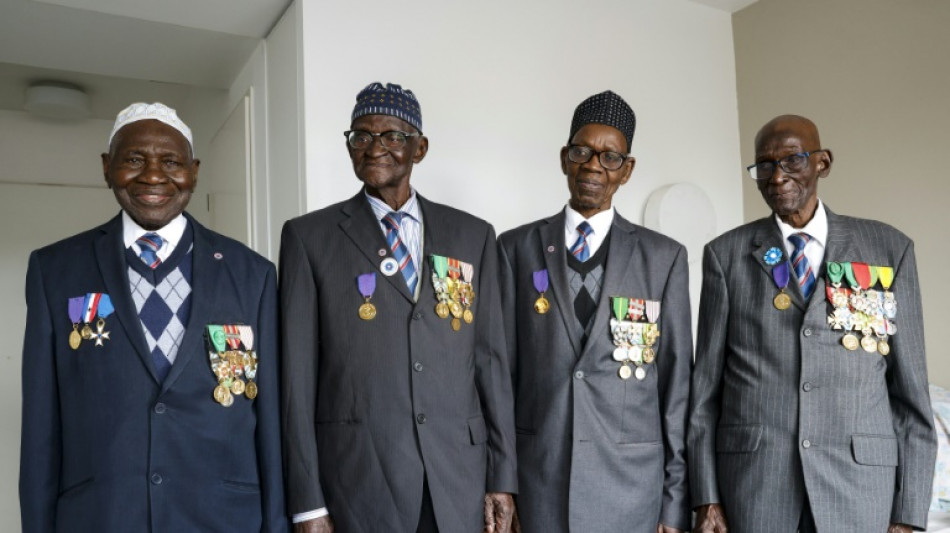
France lets aged African army veterans finally 'go home' / Photo: © AFP
Three suitcases sit piled on top of one another in 95-year-old Yoro Diao's cramped studio apartment outside Paris.
After nearly 20 years of living thousands of miles from his family so he could claim his French army pension, the old soldier is finally being allowed to return to live in his native Senegal.
"It's a victory," the decorated veteran told AFP as he prepared to fly back on Friday with eight other former soldiers aged 85 to 96. "We're going home to live with our grandchildren."
"I'm going to live and eat well. I'll walk around the village. It's paradise over there," he added, a smile lighting up his thin face.
Hundreds of thousands of African soldiers fought for their colonial master France in the two world wars and against independence movements in Indochina and Algeria.
But until this year, surviving veterans among the so-called "Senegalese Infantrymen" had to live in France for half the year or lose their pension.
In January, the French state dropped the condition, saying they could return home for good and continue receiving their monthly allowance of 950 euros ($1,000).
It would also pay for the flight and move of any veterans wishing to leave.
- 'Neglected' -
In his small room in the Paris suburb of Bondy, Diao pulled a fourth suitcase from beneath his bed.
From it he drew out pictures of his family in Senegal, men he fought with in Algeria and Southeast Asia, and the day in 2017 when he was awarded France's highest honour, the Legion d'Honneur.
Then "President (Francois) Hollande was supposed to hand it to me, but he was busy, so it was a prefect instead," he said wryly.
As he packed, Diao left himself written reminders dotted around the room.
In the frenzy of preparations, his passport, which was in the pocket of one of his jackets, was shipped in a container by mistake, and he had to obtain a second emergency document.
Some 37 retired colonial soldiers like Diao still live in France, according to the Association for the Memory and History of Senegalese Infantrymen.
Its head, Aissata Seck, said the nine returning to Senegal on Friday was the culmination of a decade-long campaign for their rights.
"They were long neglected," said Seck, 43, whose late grandfather was also a colonial soldier.
- 'Given back their dignity' -
When she first met Diao and his comrades 10 years ago, many lived alone in tiny hostel rooms sharing a communal bathroom, effectively stuck far from home yet unable to bring their families to France on their meagre income.
Their pensions were increased to adjust for inflation for the first time in almost five decades in 2006.
"I was shocked that all these old men who had contributed to our freedom couldn't even become French," she said.
Only after years of lobbying were the foreign veterans finally granted French nationality in 2017 by Hollande.
President Emmanuel Macron's government then lifted the six-month residency condition for their pension in January.
Finally, "they have been given back their dignity," Seck said.
The government's decision came after a film starring French actor Omar Sy -- best known abroad for Netflix series "Lupin" -- helped shine light on the plight of France's forgotten colonial troops.
In "Father and Soldier", Sy plays a Senegalese father who joins the French army during World War I to keep an eye on his son after he is forced into uniform.
- 'I lost a lot of friends' -
Diao said he gave his youth to France. He spent three years fighting in the Indochina war that raged from 1946 to 1954 in Vietnam.
"It was terrible... I was the head medic, in charge of the stretcher bearers, carrying the wounded under enemy fire," he said.
"I lost a lot of friends."
He was then deployed to Algeria for two years during another bitter war for independence from France.
After all those sacrifices, being forced to spend six months in France every year has been tough.
He was in France when his wife of 40 years died.
"I lost her just like that, without being there... It was painful," he said quietly.
Before she died, he flew twice to Senegal in the same year to look after her.
Because he broke the six-month rule, the French government slapped him with a huge fine.
Ever since it has deducted 66 euros ($72) from his monthly stipend. He still owes some 13,000 euros ($14,000) to the French state.
Diao said the French government's waiver has been a long time coming -- too late for some veterans who are now too frail to make the journey home.
But for those who still can, "it's better late than never," he said.
T.Ward--TNT