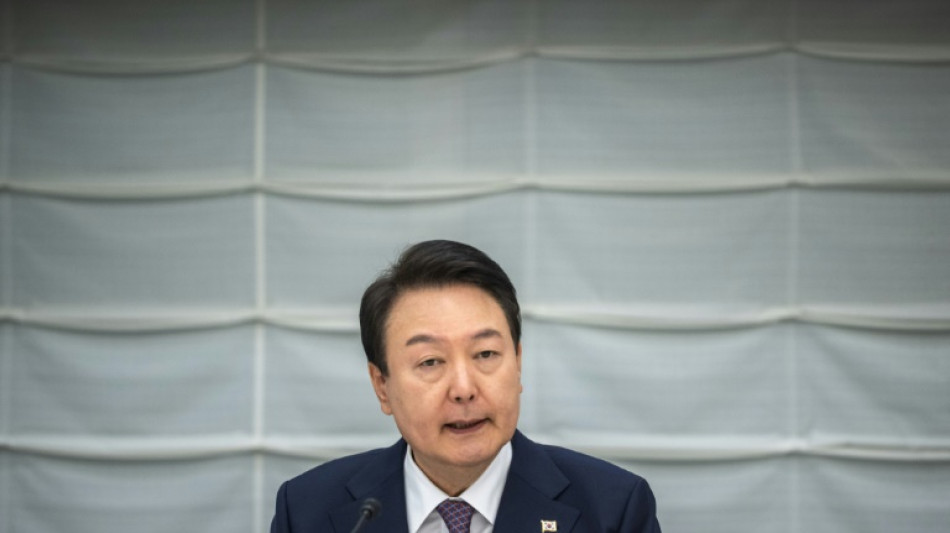
South Korea's Yoon heads to US ahead of Biden summit / Photo: © POOL/AFP
South Korea's President Yoon Suk Yeol flew to Washington Monday for a six-day state visit, as the allies move to bulk up military cooperation over North Korea's expanding nuclear threats.
Pyongyang has conducted another record-breaking string of sanctions-defying launches this year, including test-firing the country's first solid-fuel ballistic missile this month -- a key technical breakthrough for Kim Jong Un's military.
In response, Yoon has pulled South Korea closer to long-standing ally Washington, and the trip has a packed schedule including a summit with US President Joe Biden on Wednesday, where the pair will celebrate 70 years of ties.
"The two leaders will spend a lot of time together over the course of many events (to) celebrate the achievements of the South Korea-US alliance over 70 years, and exchange in-depth views on the alliance's future," principal deputy national security adviser Kim Tae-hyo told reporters ahead of the trip.
But analysts say Yoon and Biden will have a lot to hash out at their summit, as even though such events are "highly scripted" the two leaders have some "uncomfortable" topics to discuss, said Katharine Moon, Professor Emerita of Political Science at Wellesley College.
The trip comes as Yoon grapples with the South's increasingly nervous public about the US commitment to so-called extended deterrence, where US assets -- including nuclear weapons -- serve to prevent attacks on allies.
A majority of South Koreans now believe the country should develop its own nuclear weapons, multiple surveys show. Yoon has hinted Seoul could pursue this option.
"There is a greater need for the United States to show its deterrence commitments at the alliance level," said Park Won-gon, a professor of North Korean Studies at Ewha University in Seoul.
The South Korean president has seen his domestic approval ratings dive, hit hard by public disapproval over his handling of a recent US intelligence leak that appeared to reveal Washington was spying on Seoul.
He has also faced domestic backlash over a March summit with Japanese Prime Minister Fumio Kishida, with critics accusing him of prioritising diplomacy over resolving disputes over Tokyo's wartime treatment of Koreans, including forced labour and sexual slavery.
Biden is eager for both countries, which are two of Washington's major regional allies, to work more closely over North Korea.
Q.Marshall--TNT