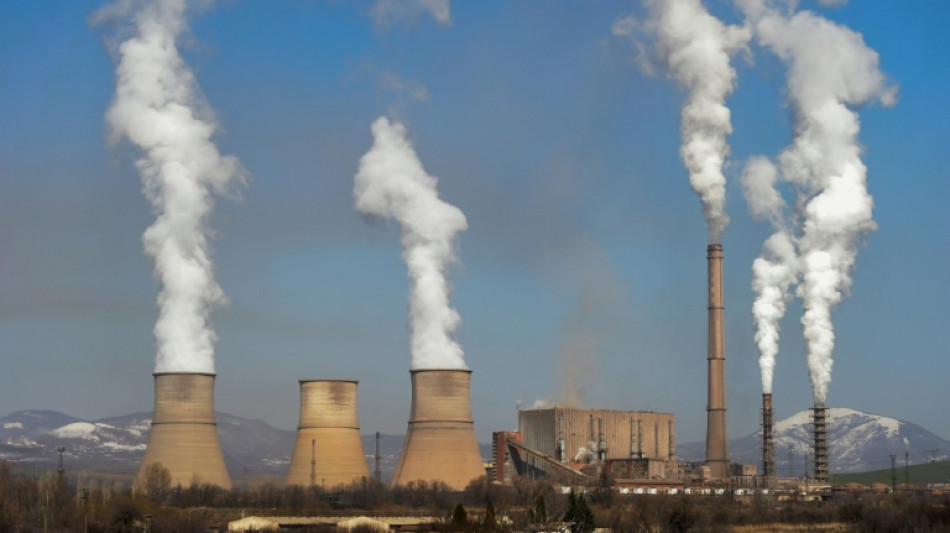
EU lawmakers adopt vast carbon market reform / Photo: © AFP
The European Parliament adopted sweeping climate measures on Tuesday aimed at massively cutting EU greenhouse emissions, including the introduction of a carbon border tax on imports.
The legislative step crystallises an ambitious EU plan to reform Europe's carbon market by broadening an emissions trading scheme to more industries and lowering quotas of allowable polluting gases.
"With today's votes, we reach another milestone," European Commission chief Ursula von der Leyen tweeted.
She urged EU member states to give final approval to the laws so they can come into effect.
Under the incoming legislation, European Union carbon emissions would be reduced by 62 percent by 2030, compared to levels in 2005 -- a big step up from a previous target of a 43 percent cut.
The EU, made up of 27 European countries, is collectively the third biggest global emitter of carbon dioxide.
The biggest by far is China, which is greatly expanding its fleet of coal-fired power plants despite a vow to have carbon emissions peak by 2030 then reduced to net zero by 2060.
Then comes the United States, historically the biggest carbon-gas emitter, which has a long-term strategy of reaching net zero by 2050.
US President Joe Biden has brought in a $370-billion Inflation Reduction Act providing hefty subsidies for US industry to drive the push for a greener America.
Brussels is preparing separate EU legislation to boost European industrial competitivity in the face of the US subsidies and colossal Chinese investment in the renewable energy sector.
- 'Adjustment' on imports -
The EU was a pioneer in shifting to more environmentally responsible energy and industry policies, setting its greenhouse gas emissions on a downward path over the past three decades.
But lately it has encountered headwinds, particularly from higher energy costs resulting from Russia's war in Ukraine and uncomfortably steep inflation.
While still intent on pursuing its green transition, it will levy the carbon tax on imports to ensure its industries are not undercut by companies outside the bloc not facing the same costs.
Technically called an "adjustment", not a tax, this measure requires importers into the EU whose products exceed the bloc's carbon norms to buy an "emission certificate".
Initially oriented towards the most polluting sectors -- producers of steel, aluminium, cement, fertiliser and electricity -- MEPs also added hydrogen suppliers, and Brussels is looking at expanding the list to makers of organic chemicals and polymers.
The money raised, as much as 14 billion euros a year, will feed into the EU budget.
The carbon tax is to start out as in pilot form in October this year before being broadened between 2026 and 2034 as emission quotas for European industrials are phased out.
F.Adams--TNT