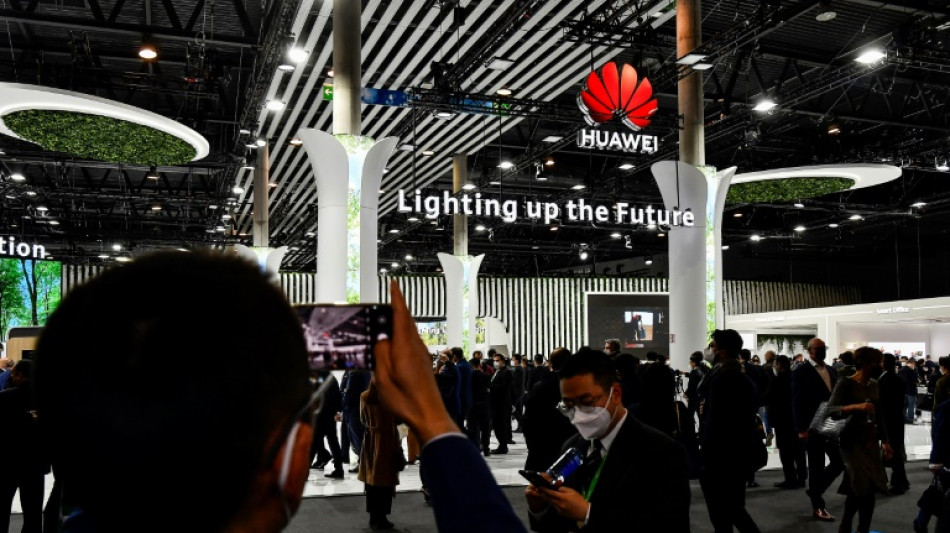
Chinese firms push 5G credentials despite US ban
On a stage reserved for the biggest players in the global telecoms industry, three Chinese firms took their place alongside three Western companies -- and pushed the message that they wanted to "work together".
But the state-owned companies -- China Mobile, China Telecom and China Unicom -- have been barred from doing business in the United States, severely hampering their global ambitions.
The US authorities cited security and risks of meddling by the Chinese state -- similar reasons lay behind Huawei's exclusion from the US market in 2020.
With a relatively small international footprint, all three firms used their presentations at the Mobile World Congress in Barcelona to trumpet their achievements in their homeland.
"By the end of 2022, we are expected to roll out a total of over one million 5G base stations, with subscribers using 5G networks to exceed 330 million," said Yang Jie, boss of China Mobile.
The rollout of 5G -- a faster, more efficient mobile network -- is seen as vital for a host of future technologies, not least self-driving vehicles and advanced industrial machinery.
But the rest of the world is lagging far behind China, and analysts are expressing concern that excluding the Chinese firms from the global market will do more harm than good.
- 'National security' risks -
In his pitch to the MWC, Vodafone boss Nick Read was explicit about the challenge faced by Europe.
"At (the) current rate, it will take at least until the end of the decade for Europe to match the transformational, full 5G experience that China will already have achieved this year," he said.
The three state-owned firms have been integral to that effort.
China Mobile boasts almost one billion subscriptions, making it by far the biggest firm in the world. The other two Chinese companies each have more than 300 million subscriptions.
And all three are heavily pushing 5G.
"If we look at the world of the way it is now, at least on the consumer side, 65 percent of 5G sits in mainland China," said Dario Talmesio of Omdia, a research firm.
He said "a body of expertise, experience... and best practices" was being established in the region.
"Can the rest of the world confidently say: 'We don't need that'?"
The US government believes they can live without it.
In banning China Unicom in January, the US Federal Communications Commission said the company could be exploited by the Chinese government and posed "significant national security and law enforcement risks".
- 'Hearts and minds' -
The battle lines are drawn, but on stage the three Chinese firms were cautious not to tackle the US ban directly.
Yang ended his video presentation by saying China Mobile was "willing to work with all sectors of society" to "unleash the infinite potential" of 5G and other technology.
China Telecom chief Ruiwen Ke said he wanted to "work together" to "create a better future".
The Chinese firms were on a "hearts and minds mission", according to Ben Wood of research firm CCS Insight, using their platform in Barcelona to stress China's strengths more generally.
"The Chinese are very proud of what they have created and they want to come and tell that story," he said.
"And they want to make sure that they set the agenda for the future evolution of technology."
Wood and Talmesio both highlighted the massive advantage enjoyed by the Chinese firms because of the sheer size of their domestic 5G business.
Talmesio said the firms were sending a "clear message" in Barcelona: "We're here, we're still international, we're happy to do business with anyone if they'll let us."
F.Lim--TNT