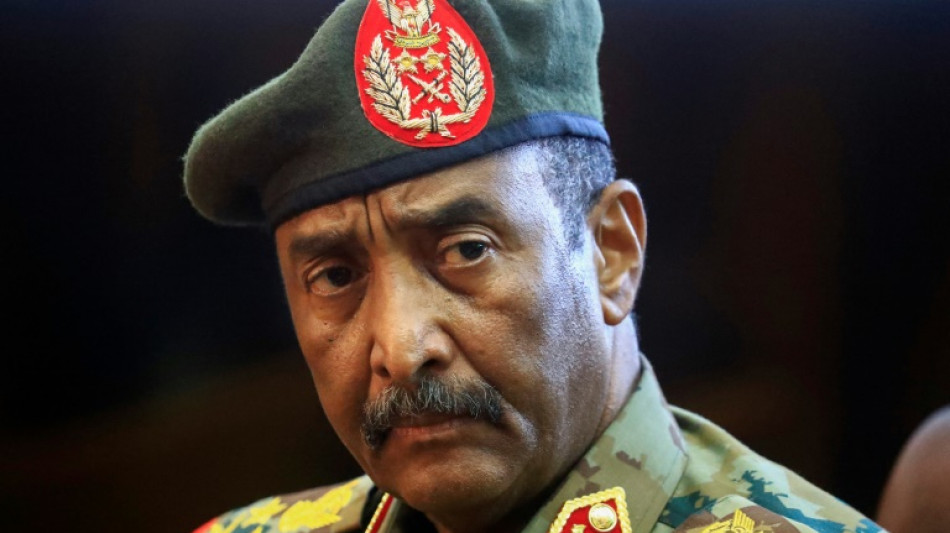
Sudan's army chief Abdel Fattah al-Burhan, at war with his deputy / Photo: © AFP/File
Sudan's army chief General Abdel Fattah al-Burhan, who became the face of endless military rule in Sudan with his 2021 coup, is now locked in battle with his second-in-command.
To seize power in Sudan's most recent coup, Burhan joined forces with Mohamed Hamdan Daglo, commander of the large and heavily armed paramilitary Rapid Support Forces (RSF).
They have now turned on each other.
At the time, the coup had derailed a fragile transition to civilian rule after the 2019 ouster of longtime autocrat Omar al-Bashir, and stifled pro-democracy hopes of breaking the cycle of successive coups that has defined Sudan's modern history.
- 'A veteran soldier' -
Born in 1960 in a village north of Khartoum, the moustached Burhan -- known for his signature green beret and military uniform -- remained relatively unknown for most of his career.
"He's never been in the limelight," an army officer, who did not want to be named, told AFP in 2019, as Burhan rose to prominence.
"He's a high-ranking officer within the armed forces, but basically he's a veteran soldier."
Burhan commanded the country's ground forces before Bashir made him inspector general of the army in February 2019, two months before the military removed Bashir from power.
In 2015, he coordinated the deployment of Sudanese troops in Yemen as part of a Saudi-led coalition against the Iran-backed Huthi rebels.
The general worked closely with the heavily armed RSF for operations in Yemen, inadvertently boosting both his and future coup partner Daglo's profile internationally.
It was then with Daglo's support that Burhan got the top job in 2019.
Following Bashir's overthrow, Burhan was sworn in as Sudan's interim leader on April 11, 2019.
In August that year, he was tasked with chairing the ruling Sovereign Council of military and civilian figures, steering the transition to a fully-fledged democracy.
As Sovereign Council chairman -- where he began to switch out military regalia for pinstriped suits -- Burhan cemented Sudan's ties with global powers and regional players, including the United States and Israel.
In February 2020, he met with Israeli Prime Minister Benjamin Netanyahu in Uganda, breaking with longtime convention and to start a process of normalisation of ties.
He also maintained close relationships with influential northern neighbour Egypt.
Though the general has also made several trips to rich Gulf countries -- on whose largesse impoverished Sudan has often depended -- experts note that his deputy-turned-rival Daglo often beat him to each visit.
- Political crisis -
By October 25, 2021, all pretence of post-Bashir civilian transition was abandoned when Burhan took to national TV in the middle of the night.
In one fell swoop, he dissolved the transitional government, arrested civilian leaders and installed himself in power, with Daglo as his right-hand man.
Spiralling political and economic turmoil proved unsustainable for Burhan, who in July of last year made a surprise vow "to make room for political and revolutionary forces and other national factions" to form a civilian government.
The apparent concession from the coup leader -- met with scepticism from pro-democracy activists -- launched a shaky-footed political process that culminated in a framework agreement, signed in December.
With experts pointing to internal pressures on Burhan to nip Daglo's ambitions in the bud, the army chief sought to use the political process to curtail the RSF's autonomy.
It proved too little too late, however, when the two generals turned on each other, with an all-out conflict erupting on Saturday.
V.Allen--TNT