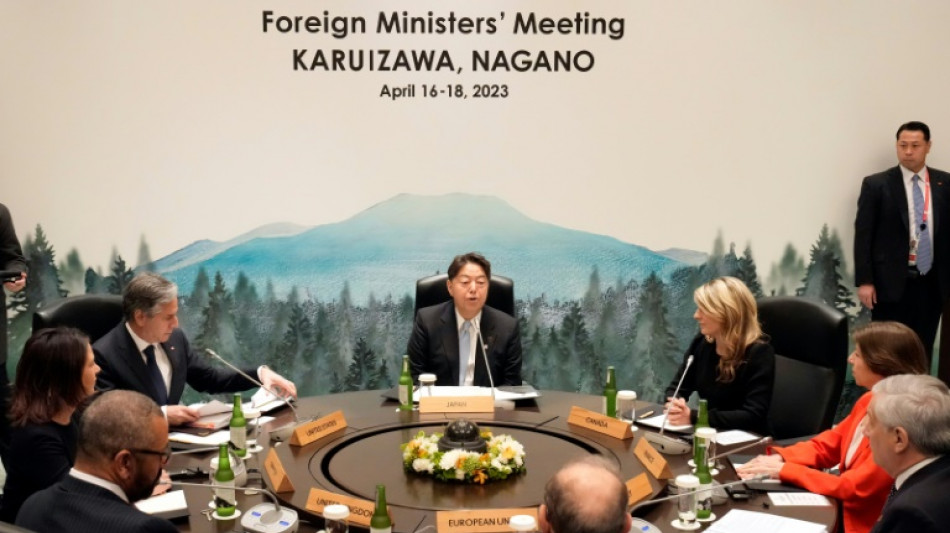
'United': G7 diplomats offer common front on China / Photo: © POOL/AFP
For G7 diplomats meeting in the Japanese resort town of Karuizawa, unity was the name of the game on Monday, with ministers lining up to insist there is no daylight between them on China policy.
The two days of talks are taking place under the long shadow cast by controversial remarks from French President Emmanuel Macron, who last week suggested Europe should avoid "crises that aren't ours".
From the opening remarks of Monday's first session, the desire to emphasise common ground was on clear display, with Japan's Foreign Minister Yoshimasa Hayashi telling his counterparts "the unity of the G7 is extremely important".
Monday's first session, and the ministers' working dinner the night before, focused on China and regional challenges, with Hayashi urging counterparts to "demonstrate to the world the G7's strong determination" to defend the "international order based on the rule of law".
Host Japan has put regional challenges atop the agenda, and recent events including Chinese military drills around Taiwan and North Korean missile tests have sharpened that focus.
As the ministers began talks, the US Navy announced it had sailed a guided-missile destroyer through the Taiwan Strait in a freedom-of-navigation operation, with Beijing saying it had tracked the vessel.
The controversy over Macron's remarks will prompt closer scrutiny of whatever language a final statement uses on China and its threats to seize self-ruled Taiwan.
But comments during bilateral talks on Monday showed the direction of travel, with US Secretary of State Antony Blinken saying discussions so far had "only reinforced the convergence of views that we have", as he met with his French counterpart Catherine Colonna.
"We're united, we're giving clearly the same signal to the rest of the world that any situation requires respect of international law as a precondition to the rest," Colonna added.
- Striking a balance -
The ministers are expected to agree strong language in a final statement on Tuesday, warning against militarisation of the South China Sea, and repeating opposition to any "change of the status quo by force" on Taiwan.
They are also likely to warn about the weaponisation of trade, and the need for diversification of supply chains on sensitive material like semiconductors -- seen as another message directed at Beijing.
"There is a lot of unity in the room and basically you'll see that reflected," a senior State Department official said.
The ministers will send the message that "we want to work with China but we are certainly going to stand up against any coercion" or market manipulation, the official added.
Still, for all the outward expressions of unity, Macron's comments reflect the fact that there are real differences among the allies, said Jacques deLisle, director of the Asia programme at the Foreign Policy Research Institute in Philadelphia.
"Europe's assessments of China and views of Taiwan have moved toward positions that the US has favoured. But this has not brought consensus," he said.
"Washington's views of China have become still more negative and, relatedly, signals of support for Taiwan have grown much stronger, maintaining a gap between European and American positions."
And in a sign that the daylight between the allies remains a concern, German Foreign Minister Annalena Baerbock warned Europeans "must not withdraw into our shells."
"We must not limit ourselves to defending the European peace," she told a press conference in Karuizawa.
Despite the focus on China, Ukraine has remained a priority at talks with the diplomats committing to "intensifying" sanctions against Russia, without outlining any specific new measures.
They also agreed stepped-up efforts to "prevent and respond to evasion of sanctions as well as third party weapon supply to Russia," likely to be seen as a further warning to China, among others, on cooperating with Moscow on its war in Ukraine.
W.Baxter--TNT