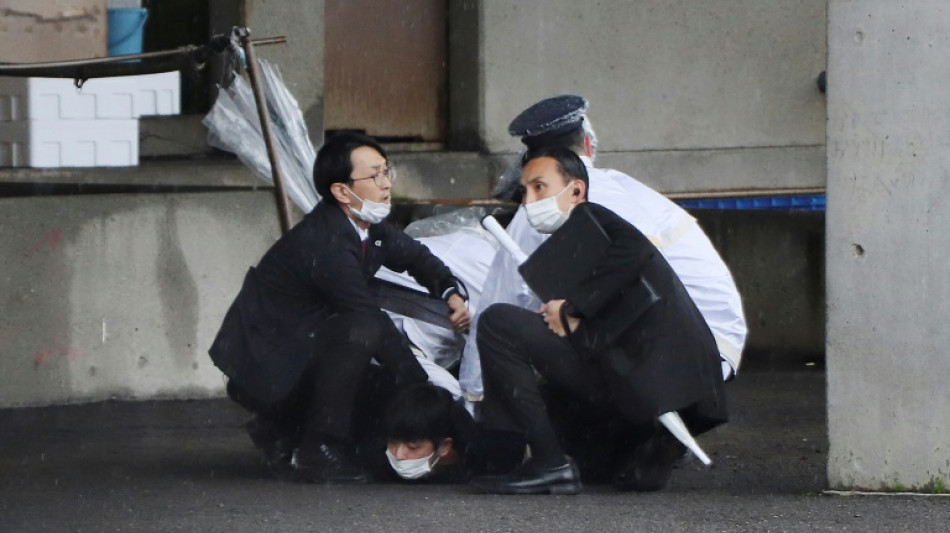
Japan PM safe after 'smoke bomb' at speech: Japanese media / Photo: © JIJI Press/AFP
Japanese Prime Minister Fumio Kishida was evacuated from a port in Wakayama on Saturday after a blast was heard, but he was unharmed in the incident, local media reported.
Footage on Japanese television showed a disturbance in a crowd gathered where Kishida was due to speak, and then the sound of a blast and white smoke.
A person was detained at the site in western Japan, national broadcaster NHK and others said.
There was no immediate official confirmation of the incident, with local police declining to comment.
NHK showed footage of security and police detaining an individual as a crowd scattered and shrieked.
"I was stunned. My heart is still beating fast," a woman at the scene told the broadcaster.
Another person at the scene told NHK that the crowd began to disperse in panic even before the blast, after someone said an explosive had been thrown.
Kishida had just finished sampling fish at the site and was about to deliver remarks to a crowd in support of a ruling party candidate in upcoming lower house by-elections when the incident occurred.
"That something like this happened in the middle of an election campaign that constitutes the foundation of democracy is regrettable. It's an unforgivable atrocity," Hiroshi Moriyama, the ruling Liberal Democratic Party (LDP)'s election strategy chairman, told NHK.
The person detained was arrested on suspicion of obstruction of business, the broadcaster said.
Japan has bolstered security around politicians after the assassination of former prime minister Shinzo Abe, who was shot and killed while speaking at a campaign event in July 2022.
His alleged assassin, Tetsuya Yamagami, reportedly targeted him over his links to the Unification Church, and the incident sparked revelations about the connection between the sect and political figures in Japan.
Yamagami was reportedly angry at the sect over large donations his mother made to the group that left the family bankrupt.
Abe was relatively unprotected and speaking on a street in western Nara, and his assassination prompted a major security review of how political figures are protected.
The incident comes as Group of Seven climate and energy ministers meet in the northern city of Sapporo, and a day before G7 foreign ministers arrive in Karuizawa in Nagano for talks.
Japan will host the G7 leaders' summit next month in Hiroshima.
F.Hughes--TNT