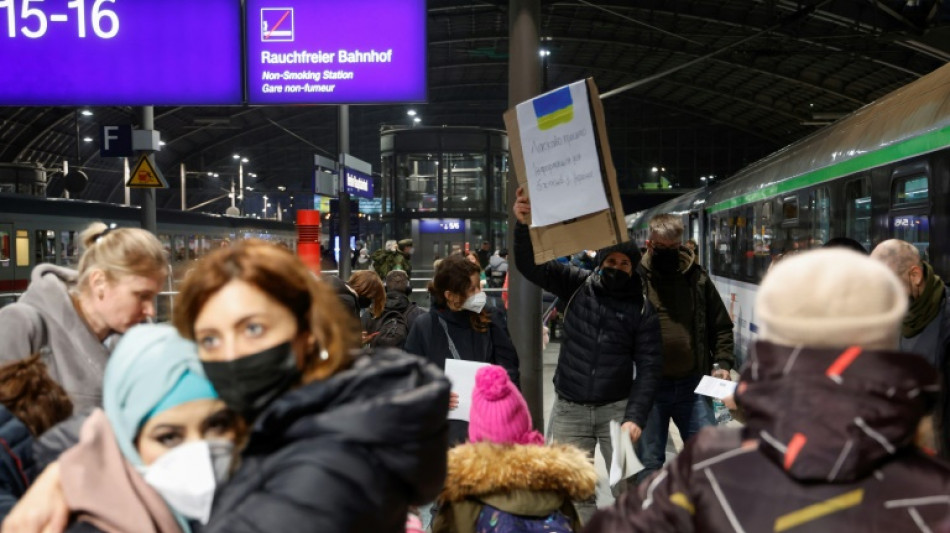
Tired and emotional, Ukrainians arrive by train in Berlin
At Berlin central station, commuters rush past a mother and her four children as they stand bewildered on the platform, weighed down by heavy luggage.
Two of them, still toddlers, are wearing hats and jackets in blue and yellow, the colours of the flag of Ukraine, the country from where they have just fled.
Germany has opened its doors to refugees from Ukraine since Russia's invasion of the country began last week, displacing more than half a million people already.
National rail operator Deutsche Bahn has laid on free travel for refugees and is also preparing to charter additional trains from the Polish border.
"We are going to Dresden (in eastern Germany). We have a good friend there who said he could find us a place to stay," 17-year-old Ukrainian student Maxym Floria tells AFP.
Floria set off four days ago with his mother and younger brother from Izmail, in the Odessa region, and has travelled through Moldova, Romania, Hungary, Slovakia and Poland to get here.
"If Odessa fell we didn't stand a chance, so we decided to leave with my family," he said.
Only a relatively small number have made it to Germany so far: around 1,800, according to a spokesman for the interior ministry.
- Men left behind -
Of the more than 500,000 people who have left Ukraine to seek refuge in neighbouring countries, more than half of them are in Poland, according to the UNHCR.
Floria's father, like all men aged between 18 and 60, has not been allowed to leave Ukraine as he has been called up to fight.
The family are not intending to stay in Germany permanently.
"I firmly believe that we will be able to go home safely and that everyone will fight for our country," Floria said, visibly emotional and exhausted.
Berlin is expecting to see a sharp increase in the number of women and children arriving from Ukraine in the coming days.
The German capital and the surrounding state of Brandenburg have already reactivated some of the systems deployed in 2015 to cope with an influx of refugees from the Middle East, mainly Iraq and Syria.
Ukraine is at least 700 kilometres (430 miles) from Berlin, but Interior Minister Nancy Faeser has repeatedly stressed that Germany's borders are open to those fleeing the conflict.
- Night train from Warsaw -
The Russian invasion has provoked an outpouring of support in Germany, with more than 100,000 people joining a demonstration in Berlin on Sunday to show solidarity with Ukraine.
Some have also taken to social media to organise initiatives to transport food and clothes to the Polish-Ukrainian border and to offer accommodation in Berlin.
The European Union is planning to grant Ukrainians fleeing the war the right to stay and work in the 27-nation bloc for up to three years.
At Berlin Hauptbahnhof, one of the largest stations in Europe, the situation is a far cry from 2015, when Germans welcomed cohorts of refugees from Afghanistan, Iraq and Syria by serving them soup and handing out toothbrushes.
On platform 14, police officers and volunteers draped in Ukrainian flags are there to welcome a handful of refugee families who have just arrived on the night train from Warsaw.
Berlin has already prepared 1,300 emergency beds for refugees and is planning to add 1,200 more in the coming days.
In Brandenburg, which borders Poland, accommodation is being readied for 10,000 people, regional interior minister Michael Stuebgen told the RBB broadcaster.
The authorities are also counting on support from the 330,000 Ukrainians or people of Ukrainian origin already living in Germany, many of whom still have family and friends back home.
G.Waters--TNT