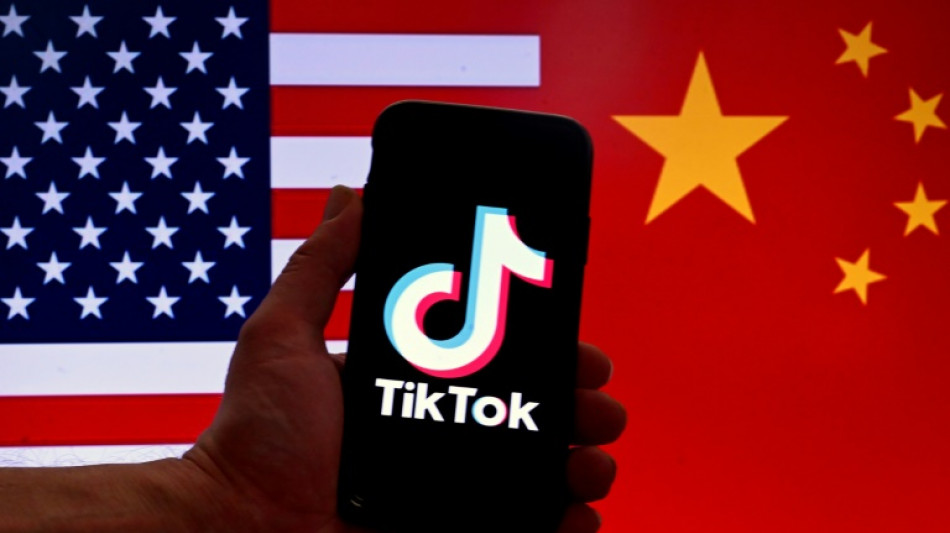
China says does not ask firms for foreign data as TikTok row grows / Photo: © AFP/File
China insisted Friday it does not ask companies to hand over data gathered overseas, as the Chinese-owned TikTok faces mounting calls for a ban in the United States.
Pressure is building on the massively popular video-sharing app -- owned by the Chinese firm Bytedance -- to obtain new ownership or lose access to the enormous US market.
In a gruelling five-hour hearing with US lawmakers Thursday, TikTok CEO Shou Zi Chew faced relentless questioning from combative US lawmakers on both sides of the political aisle over the app's ties to China and its danger to teens.
At the crux of much of the fears over TikTok is a 2017 Chinese law that requires local firms to hand over personal data to the state if it is relevant to national security.
Beijing on Friday denied it would ask Chinese firms to hand over data gathered overseas and claimed it "attaches great importance to protecting data privacy".
China "has never and will not require companies or individuals to collect or provide data located in a foreign country", foreign ministry spokesperson Mao Ning told a regular briefing.
"The US government has so far not provided any evidence that TikTok poses a threat to its national security," Mao added.
In one particularly heated exchange Thursday, Chew was forced to acknowledge that some personal data of Americans was still subject to Chinese law, but insisted that would soon be changed.
The firm also acknowledged in November that some employees in China could access European user data and then admitted in December that employees had used the data to spy on journalists.
But the group has insisted that the Chinese government has no control over or access to its data.
"ByteDance is not owned or controlled by the Chinese government and is a private company," Chew told lawmakers in his opening remarks, referring to TikTok's China-based parent company.
"We believe what's needed are clear transparent rules that apply broadly to all tech companies -- ownership is not at the core of addressing these concerns," Chew added.
The Harvard-educated former banker failed to defuse an existential threat to TikTok as the app seeks to survive a White House ultimatum that it either split from its Chinese ownership or be banned in the United States.
Lawmakers from the House Energy and Commerce Committee afforded Chew no respite, frequently denying him opportunities to expand on his answers or tout the site's huge global popularity with young people.
- Project Texas -
A ban would be an unprecedented act on a media company by the US government, cutting off the country's 150 million monthly users from an app that has become a cultural powerhouse -- especially for young people.
"TikTok has repeatedly chosen the path for more control, more surveillance and more manipulation. Your platform should be banned," committee chair Cathy McMorris Rodgers said.
Supporters of TikTok and free speech activists criticised the hearing as political theatre and urged against an outright ban.
"Taking a bludgeon to TikTok, and by extension to Americans' First Amendment protections, is not the right solution to the risks that TikTok poses to the privacy of Americans and to the national security of the United States," said Nadine Farid Johnson of PEN America, which defends free speech.
And Beijing noted on Friday that "some in the US congress stated that seeking a ban of TikTok is a xenophobic political persecution".
TikTok still hopes to appease the authorities.
Chew's testimony promoted the company's elaborate plan -- known as Project Texas -- to satisfy national security concerns, under which the handling of US data will be ring-fenced into a US-run division.
But lawmakers poured doubts on the project, saying it would do nothing to remove their concerns that TikTok was vulnerable to China.
R.Hawkins--TNT