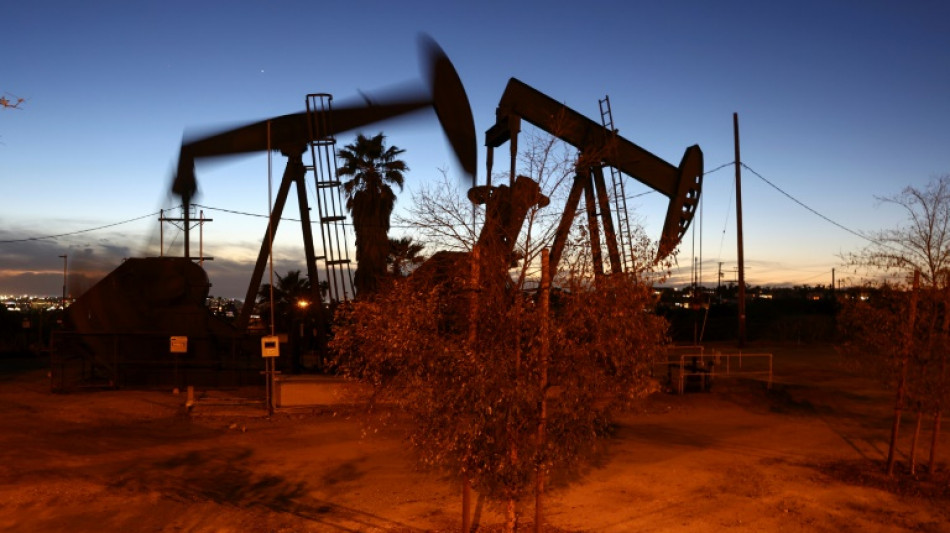
Ukraine crisis challenges oil industry caution at high prices
As commodity prices soar, the Ukraine crisis has prompted demands from petroleum lobbies for a reboot of US energy policy to promote domestic oil and gas production.
But recent history suggests Wall Street may be an even bigger barrier than Washington to increased exploration and production.
As oil prices have risen over the last year -- including Thursday's brief surge above $100 a barrel -- companies ranging from giants like Chevron to mid-sized players such as Devon Energy have chosen to only lift capital investment modestly.
That approach has reflected the clear preference within the investment community for producers to steer extra cash to debt reduction and shareholder givebacks, while also ramping up low-carbon investment initiatives.
Companies have also been cautious in light of the ongoing Covid-19 pandemic and uncertainty over the recovery in energy demand.
Peter McNally, analyst at Third Bridge, predicted companies would not rush to shift strategies over the latest spike in commodity prices.
"Everyone has been telling these companies not to drill so much, whether it's the shareholders, (socially minded) investors or President (Joe) Biden," he said.
"The industry has twice been at price points like this over the last year and it hasn't ended well."
Dan Pickering of Houston-based Pickering Energy Partners thinks the political and investor tone towards energy could become "less adversarial and more supportive" in light of Ukraine.
"Climate goals won't go away, but those long-term initiatives will wind up more balanced against short-term necessities," he said.
- Energy crisis 'likely' -
As the world's third biggest producer of oil and the source of as much as 40 percent of Europe's natural gas, Russia's centrality to the global economy as an energy producer has been a key factor in the West's response to the invasion of Ukraine.
On Thursday, the White House announced a barrage of new penalties on Russia, including sanctions on four major Russian banks and export controls to impede Russia's high-tech industry.
The measures, though, stopped short of moving directly to impede Russia's energy production.
But Thursday's rise in oil and natural gas prices from already elevated levels pointed to the unease surrounding Russia's output, a dynamic that also boosted shares of Cheniere Energy, a producer of liquefied natural gas that could be used to supplement European stockpiles.
The situation means a "global energy crisis is likely to unfold," said a note from Rystad Energy CEO Jarand Rystad.
"Full-scale military conflict between Russia and the West is unlikely, but a deep economic war is almost inevitable," Rystad said, adding that Russia could weaponize its energy exports.
The American Petroleum Institute said Thursday that Biden should shift course due to Ukraine, calling on the president to allow more developments on federal land and in offshore areas and to clear red tape from the permitting process.
"As crisis looms in Ukraine, US energy leadership is more important than ever," the lobbying group said on Twitter.
- Whither green energy? -
Congressional Republicans have also cited Ukraine as a component of their opposition to Biden's energy and environmental agenda, which has included the cancelation of the Keystone Pipeline and restrictions on federal energy development.
Senator Bill Cassidy, a Louisiana Republican, called for the United States to "flood" the world with cheap energy in order to "destroy" Russia's energy-financed "war machine."
But leading US producers, while in broad favor of government policies to allow drilling access, have until now been reticent to emphasize more drilling as their prime focus.
Devon Energy last week released a 2022 capital budget range in line with last year, even as its earnings surged. The company authorized a huge dividend hike and touted its "limited" reinvestment of free cash.
Chevron Chief Executive Mike Wirth also vowed to "stay disciplined on capital," adding that the company's long-term pricing outlook "hasn't changed a lot" and sticking with the company's vows to expand low-carbon programs to address climate change.
Jim Krane, an energy analyst at Rice University's Baker Institute, said higher energy prices typically encourage the development of alternatives to fossil fuels.
While the Ukraine crisis exacerbates short-term worries about energy security, it does not alter the need to transition to cleaner sources, he said.
"The world needs to get off fossil fuels and develop alternatives," he said, adding that the Ukraine crisis "might slow down the process in some places and speed it up in others."
P.Jones--TNT