Despite West's help, Ukraine forces vastly outnumbered by Russia
Ukraine's armed forces find themselves vastly outnumbered and outmatched in firepower by their Russian opponents, despite growing military assistance for Kyiv's troops by the West.
Russian President Vladimir Putin, whose country had massed some 150,000 troops on the border in recent months, on Thursday ordered military operations against Ukraine.
There are also, according to Western estimates, some 30,000 Russian troops deployed in Belarus, ostensibly for exercises, who could also attack Ukraine from the north.
And Russia has massed naval forces in the Black Sea and closed to navigation the Sea of Azov between Russia and Ukraine.
According to the London-based International Institute for Strategic Studies (IISS), Russia's armed forces amount to 900,000 troops, plus some two million reserves and more than half a million other forces.
Ukraine's forces meanwhile amount to barely more than the number of troops Russia had amassed around its borders, with a standing army of 145,000, 45,000 in the air force and 11,000 in the navy, according to the IISS.
It has some 100,000 other forces and 900,000 reserve soldiers.
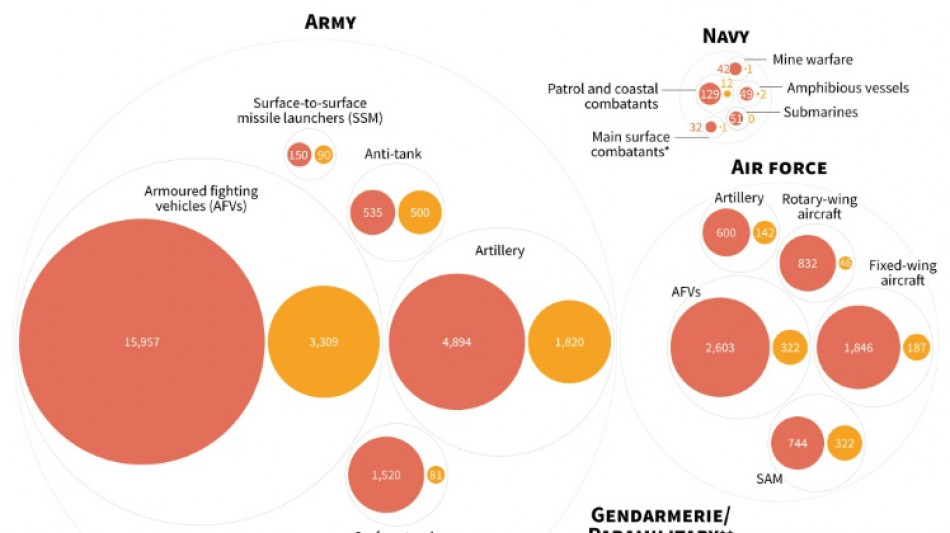
Analysts also note that the gulf in firepower is even wider in terms of military hardware, with Russia's almost 16,000 armoured fighting vehicles -- including tanks -- dwarfing the Ukrainian fleet of 3,300.
Artillery numbers show a similar difference, while the Ukrainian air force is a tenth the size of its Russian counterpart.
"The military balance of power is totally overwhelming" in favour of Moscow, said Francois Heisbourg, special advisor to the Foundation for Strategic Research (FRS) in Paris.
- 'Firmly against Ukraine' -
Ukraine has benefited from substantial Western military aid since the onset of the conflict in its east from 2014, including $2.5 billion worth from the United States, $400 million of that in 2021 alone.
Until the current tensions erupted, some US troops had been training Ukrainian forces to use American equipment, notably light weaponry, patrol vessels and Javelin anti-tank missiles.
Britain has also been involved in training Ukrainian troops for several years and in January said it was sending offensive anti-armour weaponry to Ukraine, the first time it has supplied lethal arms to the country.
But Russia's armed forces have also undergone significant reforms in recent years, following the military's perceived lacklustre performance in the 2008 conflict with Georgia.
The reform "has made Russia a far more capable military power today than at any time since the dissolution of the Soviet Union", IISS analysts said.
Commanders have also been able to garner valuable experience in war theatres notably during the Russian deployment of troops in Syria to support Bashar al-Assad's regime.
Analysts at the Royal United Services Institute (RUSI) said in a report earlier this month that Ukraine's air defences were "woefully deficient" both in terms of quality and quantity.
Meanwhile the country also faces the problem of sharing a land border of almost 2,000 kilometres (1,250 miles) with Russia, most of which is exposed to attack, and a 1,000-kilometre border with Moscow's ally Belarus.
"The conventional military balance is stacked firmly against Ukraine," the RUSI analysts said.
Ukraine has also been the target of repeated cyberattacks which the West has blamed on Russia and experts say have the potential to cripple the country.
But the RUSI analysts also noted that the "threat of unconventional resistance" should concern Moscow, which would want to avoid a drawn-out and bloody conflict especially in urban centres.
Ukraine's government has invested a lot in promoting national unity, they said, and Kyiv would want to "protract the fighting to the point where Moscow will be denied anything but an embarrassing, messy and attritional struggle", they said.
A.M.Owen--TNT