Trudeau revokes emergency powers after Canada trucker-led protests end
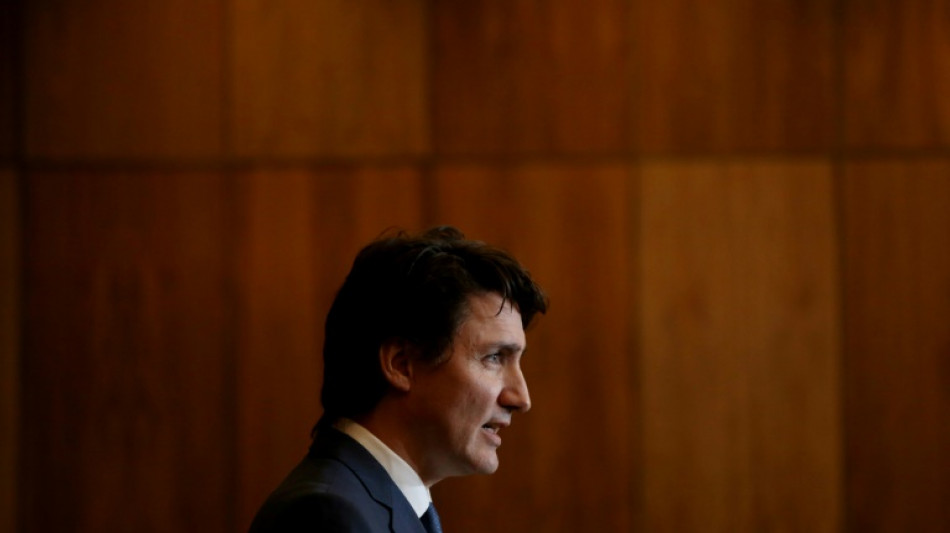
Canadian Prime Minister Justin Trudeau on Wednesday revoked emergency powers used to dislodge trucker-led protests in Ottawa and blockades of border crossings to the United States, as he declared the crisis over.
"Today, we're ready to confirm that the situation is no longer an emergency," the prime minister told a news conference. "Therefore, the federal government will be ending the use of the emergencies act."
"The threat continues," Trudeau said, but added it is no longer "acute."
"We are confident that existing laws and bylaws are sufficient to keep people safe."
The rarely used powers had been invoked nine days earlier -- for only the second time ever in peacetime -- and their final approval was still being debated in the Senate when Trudeau lifted them.
On Sunday, the last big rigs were towed out of the Canadian capital after a two-day police crackdown that saw nearly 200 arrests and dozens of vehicle seizures.
Several border crossings have also been reopened after being cleared of economically damaging blockades.
For weeks, Canada had been in the international spotlight as thousands of protesters, led by truck drivers furious over Covid-19 vaccination requirements for transporting freight across the border with the United States, converged on Ottawa.
Truckers and their supporters also blocked for days several border crossings, including a bridge between Windsor in Canada and the US city of Detroit, freezing a major trade route critical to industry, including automobile manufacturing.
As they dug in, the protesters inspired copycats in other countries, from France to New Zealand, with Washington girding itself for a possible trucker protest to coincide with next week's State of the Union presidential address.
Their demands also grew to include an end to all pandemic rules and, for many, a wider anti-establishment agenda.
- 'Sledgehammer' -
Criticized for failing to act decisively early on, Trudeau invoked the Emergencies Act, which gave the government sweeping powers to deal with a major crisis.
The move split opposition parties. Critics accused the prime minister of using "a sledgehammer" on protesters and a civil liberties group sued over Trudeau's declaring a state of emergency for the first time since 1970.
Trudeau's father, former prime minister Pierre Trudeau, had used the measure after militant Quebec separatists kidnapped a lawmaker and a British trade attache and set off bombs in Montreal.
"Today's announcement is proof that the prime minister was wrong when he invoked the Emergencies Act," Tory interim leader Candice Bergen said Wednesday.
Trudeau defended his decision, saying: "As the weeks went by, it became obvious that provincial and local authorities needed more tools in order to enforce the law and protect Canadians."
He noted also that Parliament would conduct a thorough review of his decision in the coming months.
Last weekend, after nearly a month of incessant loud honking and complaints from Ottawa residents of harassment by protesters, police deployed from across the nation moved in.
Hundreds of officers in riot gear cleared the main protest hub in downtown Ottawa Saturday, using batons and pepper spray and making dozens of arrests, as they worked to flush out a hard core of demonstrators occupying the Canadian capital.
They pushed into the city center -- facing off in tense scenes with determined protesters who hurled gas canisters and smoke grenades at advancing police, linking arms and chanting "freedom."
At their peak the protests drew 15,000 to the capital, but polls show Canadians, once sympathetic to the trucker-led movement, have now turned against them.
T.Bennett--TNT