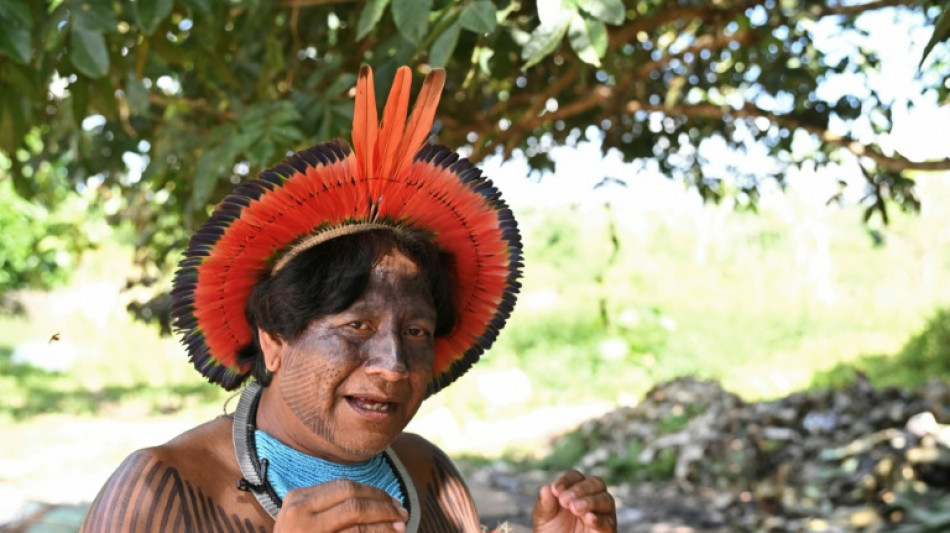
New gold rush threatens indigenous havens in Brazil's Amazon / Photo: © AFP
Indigenous chief Bepdjo Mekragnotire is once again preparing to lead a group of warriors to chase wildcat gold miners away from his people's territory in Brazil's Amazon rainforest.
Wearing a red feather headdress, Bepdjo told AFP of rising tensions with intruders in the Bau Indigenous Territory in Para state, four years after his people expelled almost 200 prospectors.
"The miners are stubborn. They enter by any means. Because today the price of gold is very high," Bepdjo, 45, told AFP in Pykany, a village of his Kayapo people in a territory neighboring Bau.
"We have to expel them, otherwise, they'll just keep pushing in."
The price of gold -- a safe-haven asset in troubled times -- has hit a new era of record highs amid global instability.
This is pushing wildcat miners into relatively untouched areas like Bau.
In February, guns were briefly drawn on both sides when chief Bepdjo and a group of Kayapo warriors came across miners in a canoe. He said they kicked out 24 people.
Afterward, a coalition of Indigenous organizations, in a letter seen by AFP, warned authorities including the IBAMA environmental agency, of "the imminent risk of a large-scale armed conflict," and asked them for help.
Bepdjo is tired of waiting.
"We don't know how many prospectors are inside, we just get there and see," he told AFP.
Jair Schmitt, acting president of IBAMA, told AFP that the agency was focused on Indigenous territories "facing particularly critical situations. IBAMA cannot be physically present in every area."
-'Deeper into the jungle' -
Experts see protected Indigenous lands as one of the best defenses against climate change and deforestation.
From the air, on a flight with Greenpeace, AFP witnessed the crushing pressure on protected areas -- and the difference that the tribal areas make.
Vast landscapes of rivers gouged out for mines and forest broken by farmland came to a dramatic halt at the border of the Indigenous territories, where the lush green canopy resumed as far as the eye could see.
Amazon Mining Watch said an area of 223,000 hectares was impacted by mining in Brazil between 2018 and 2025 -- almost 80 percent of it illegally.
Since leftist President Luiz Inacio Lula da Silva returned to office in 2023, his government has cracked down on wildcat mining. His far-right predecessor Jair Bolsonaro had been accused of fostering a climate of impunity in the Amazon.
But mining barons, whose operations have turned from true artisanal mining to multi-million dollar operations using large machinery and fleets of small planes, have adapted quickly.
Nilton Tubino, appointed by Lula's government to lead operations to protect Indigenous territories, told AFP that a "new gold rush" was fueling illegal mining across the Amazon.
"The miners are retreating deeper and deeper into the jungle," he said.
"We are constantly grappling with the challenges posed by the sheer scale of these territories... and the organizations' capacity to rapidly rebuild what we destroy."
In the past three years, IBAMA has destroyed more than 690 excavators, 1,300 barges and 80 aircraft -- equipment worth almost $800 million.
Schmitt of IBAMA said the greatest difficulty was "confronting organized crime" as major factions, the Primeiro Comando da Capital (PCC) and Comando Vermelho (CV), have expanded into the Amazon.
These groups were on Thursday designated as terrorist organisations by the United States.
- 'Ghost mines' -
The Escolhas Institute, which analyzes Brazil's gold supply chain, said the country produced 71 tons of gold in 2025, mainly exported to Canada, Switzerland, and the United Kingdom.
Brazil is working on new legislation to bolster gold tracking, alongside police initiatives like a library of gold "DNA" to trace the origin of the ore back to specific sites in the Amazon.
Larissa Rodrigues from the Escolhas Institute said that due to a government clampdown, gold that previously "exited Brazil through the front door" was being smuggled out through countries like Guyana or Venezuela.
Other loopholes exist to launder gold, such as "ghost mines," detailed in a Greenpeace investigation published Friday.
The sites hold artisanal mining permits and declare gold sales but when you fly over them, there is no sign of extraction activity.
Danicley de Aguiar, coordinator of Greenpeace Brazil's Indigenous Peoples' campaign told AFP that gold taken from protected areas was likely laundered through such schemes.
Fernando Lucas, president of the Federation of Gold Miners' Cooperatives in Para, told AFP that he was sick of miners being "branded as criminals".
He said many want to operate legally but get caught up in red tape and called for a more "organized, sustainable model."
- 'Temptation' -
Chief Bepdjo is also dealing with divisions among his own people, some of whom -- including his predecessor -- support wildcat mining.
The dispute pushed some village residents to move to the other side of the river.
"Very often the miners themselves come to talk to us, offering money, saying 'you'll have a car, you'll have women', so it's a temptation. A young person who doesn't think it through will want those things," said Takagmoro Kaiapo, 25, son of the former chief.
V.Bennett--TNT