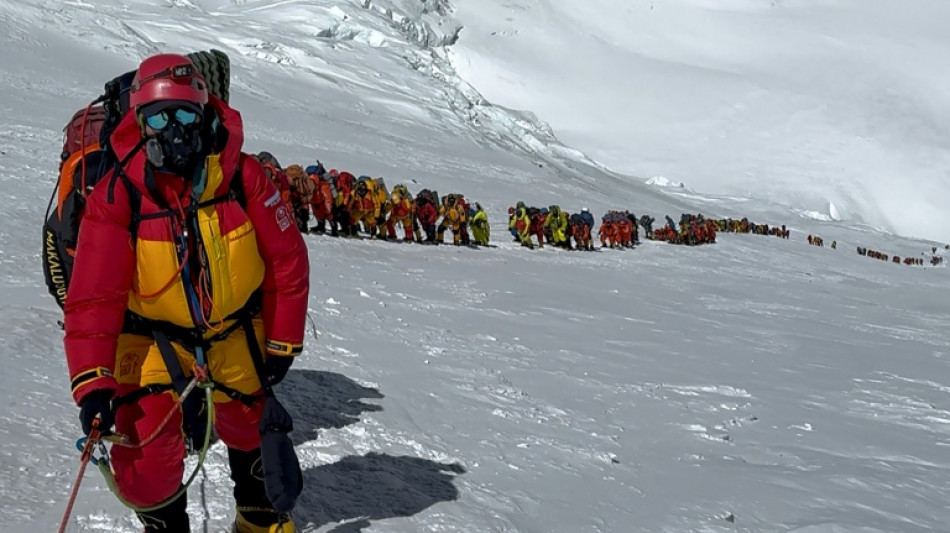
Nepal's record-breaking Everest season nears end / Photo: © AFP
Nepal is eyeing a record-breaking Everest season with more climbers expected to reach the top than ever before, officials said Wednesday, as the climbing window nears its end.
More than 950 climbers have reached the top of the 8,849-metre (29,032-foot) peak this season, said Nepali government official Khim Lal Gautam, speaking at a mountaineering conference in Kathmandu.
"It is truly historic," Gautam, a mountaineer himself who was assigned by the tourism ministry to help oversee expeditions from base camp, told AFP.
"By Thursday, the number (of climbers) can surpass 1,000", he said.
The season began with fears of delay after a serac -- a block of glacial ice -- blocked the way, but Nepali climbers have established an alternative route.
The world's highest peak, which straddles the Nepal-China border, can be scaled from either Nepal or the northern face in Tibet. But China closed its route this year.
The Guinness World Records says the most ascents of Everest in a single season was 872, achieved in 2019.
Nepal issued a record 494 Everest permits for foreigners this season, with a city of tents up at the foot of the mountain for climbers and support staff.
- 'Come together' -
Climbers and officials said that a wide summit window -- a period of stable weather that allows safe attempts -- contributed to a surge of successful ascents.
On Thursday alone, an estimated 275 climbers reached the summit, marking the busiest single day on the southern side.
The climbing season is will end within a few days.
After that, the final number of those who summited will be tallied after the climbs are verified, which require photographs and statements from the climber's expedition company and guides.
Five people have died this season -- two Indians and three Nepali climbers involved in Everest preparations.
That compares to the 18 people who died in 2023, the deadliest season on the mountain.
"There have been some deaths," said British climber Kenton Cool, who broke his own record of most summits by a non-Nepali with his 20th climb.
"But I think this year really shows that teams can come together to open the route to Everest, despite the delay, and we still get a pretty good season," Cool told reporters.
"And I think that should be celebrated."
- Overcrowding, climate concerns -
The large numbers have rekindled concerns about overcrowding on the mountain, particularly in the low-oxygen "death zone" near the summit.
Climbers waiting to summit were seen in photographs standing in line on the icy heights.
But guides said that improved logistics and technology -- including access to the internet -- made climbing safer.
"Climbing has now become more comfortable... up to Everest Camp II, we can check the weather conditions before ascending," said Everest guide Dorchi Sherpa, 30.
"The main cause of accidents is weather -- it is the primary risk factor."
Lukas Furtenbach, of Austria-based Furtenbach Adventures, said that warmer temperatures have also helped.
"Summit days were warm, and that helped to keep the number of frostbites low, because otherwise long traffic jams could have been deadly," Furtenbach said.
He also noted, however, that temperature rise driven by climate change brought a longer-term danger.
"The effects of climate change were quite visible -- it was extremely warm even at the base camp," he said.
Veteran Nepali climber Kami Rita Sherpa, 56, who extended his own record with a 32nd ascent this year, warned that the rising numbers are making conditions more congested.
"The expedition this time felt a bit crowded because clients have increased compared to last year," he said.
"The government should regulate this... They should let in only climbers of quality... There should be a limit."
T.Bailey--TNT