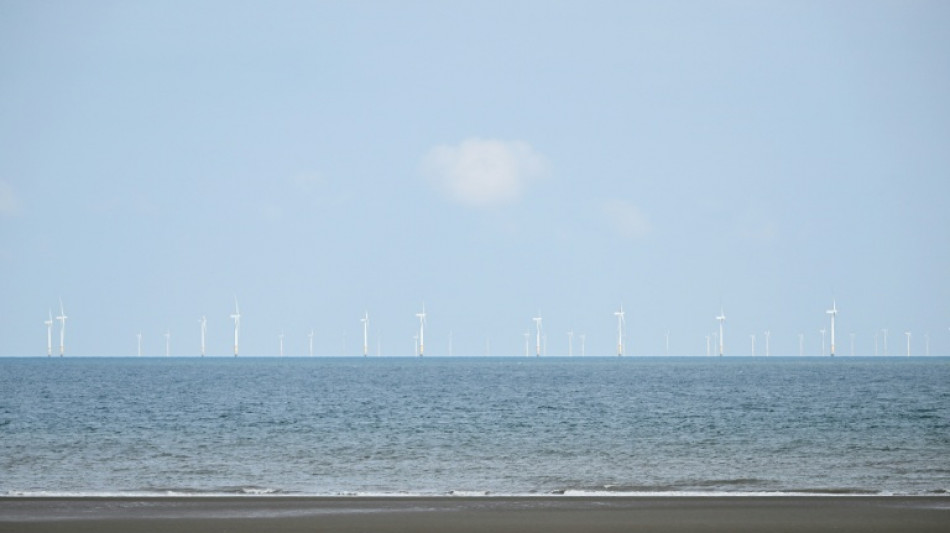
UK tackles electricity price link to world gas amid Mideast war / Photo: © AFP
Britain's government Tuesday announced measures aimed at weakening the link between world market gas prices and the cost of UK electricity as the Middle East crisis fuels energy bills.
The move heads plans by Prime Minister Keir Starmer's Labour administration to accelerate a clean-energy drive it began on winning power nearly two years ago.
Pointing to "the second fossil fuel shock in less than five years" caused by the Russia-Ukraine and US-Iran wars, Energy Secretary Ed Miliband said "the era of fossil fuel security is over".
He added in a London speech that "the era of clean energy security must come of age.
"For Britain and so many other countries, clean energy is now the only route to financial security, energy security and indeed national security."
- 'Picking up tab' -
Britain is one of the leading players in renewable energy in Europe owing to onshore and offshore wind power.
Despite this, gas plays an outsized role in the cost of electricity in Britain, setting the wholesale price of power around 60 percent of the time despite supplying a much smaller and decreasing share of the country's current energy needs.
"When global gas prices spike, people here shouldn't be picking up the tab," Starmer said in a statement Tuesday.
"Our focus is simple: easing pressure on household budgets now, while building a homegrown energy system that protects families from global instability in the years ahead."
The UK's action comes as other European countries have voiced plans to speed up their clean energy drive in the wake of the outbreak of the Middle East war.
To help break the link between global gas and UK electricity prices, Britain's finance minister Rachel Reeves will hike the government's windfall tax on low-carbon electricity generators to 55 percent from 45 percent, supporting households and businesses.
The government is also proposing that those running clean power generators, which supply about one third of Britain's power, voluntarily switch to fixed-price contracts, offsetting the fallout from volatile pricing.
The UK has set a target to consume zero-carbon electricity by 2030 and is aiming to reach net-zero greenhouse gas emissions by 2050 to combat climate change.
- 'Powering millions of homes' -
The government's other new proposals outlined Tuesday include "driving forward plans to massively expand renewables" on state-owned land.
It added that placing solar panels and wind turbines on industrial and railway sites could power about five million homes.
The state proposes to also "speed up clean, homegrown power" via a further overhaul of "planning, land access and grid connection processes".
In addition, the government wants to make it easier for people to switch to cheaper electric transport and heating.
Since winning power, Labour has placed big emphasis on using cleaner energy sources to help drive the UK economy, which has so far struggled to take off.
Ahead of UK local elections next month, Miliband hit out at opposition parties who want new exploration of the North Sea as the war in the Middle East conflict cuts global oil and gas supplies.
"Even before the Iran war we were seeing record demand for technologies like rooftop solar, batteries, heat pumps and electric vehicles," the energy minister said Tuesday.
"And in the teeth of this crisis, demand for them is surging... Opponents of clean energy want to stand in the way of what the British public want."
Greenpeace welcomed the moves, with its political campaigner Angharad Hopkinson saying "the government is absolutely right to be looking at every possible solution to cut our dependence on volatile fossil fuels and take back control of our energy".
R.Campbell--TNT