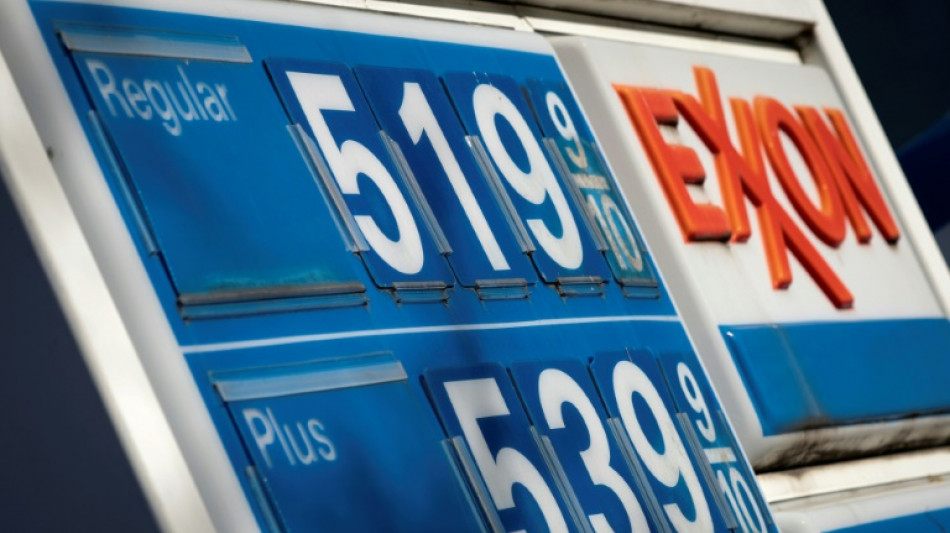
Boosted by oil prices, ExxonMobil, Chevron throw cash at investors / Photo: © GETTY IMAGES NORTH AMERICA/AFP/File
ExxonMobil and Chevron reported soaring profits Friday despite lower oil and natural gas volumes as the petroleum giants return billions of dollars to shareholders in the wake of lofty crude prices and refining margins.
Both US oil giants scored huge profit increases propelled by elevated crude prices since the Russian invasion of Ukraine. But both companies have thus far avoided additional capital spending increases to fund drilling and development in spite of a tightening global energy outlook.
"We continue to invest prudently," said Kathy Mikells, chief financial officer of ExxonMobil, which increased spending on share buybacks by $20 billion.
"We're going to stay disciplined on capital. We've given you a range, we've stuck within the that range ever since we started putting it out there," said Mike Wirth, chief executive of Chevron, which raised its plans for share buybacks to $10 billion per year after previously targeting $5 to $10 billion per year.
Both oil giants are implementing planned 2022 capital spending increases, but ruled out additional investment.
Part of the reticence to spend more to drill comes as the oil giants ramp up investment in hydrogen, carbon capture and storage and other low-carbon ventures amid pressure from environmental, social and governance (ESG) investors.
- Russia hit -
After a dreadful 2020 amid Covid-19 lockdowns that devastated petroleum demand, oil companies returned to profitability in 2021 and have continued to see earnings soar in 2022.
ExxonMobil's first-quarter profits more than doubled to $5.5 billion, as a strong market for energy commodities more than offset a $3.4 billion hit in one-time costs connected to its withdrawal from the vast Sakhalin offshore oil field following Russia's invasion of Ukraine.
Revenues rose 52.4 percent to $87.7 billion.
At Chevron, profits came in at $6.3 billion, more than four times the year-ago level on 70 percent rise in revenues to $54.4 billion.
Friday's eye-popping profits could add to cries of oil industry "profiteering" from congressional Democrats, who plan legislation in the wake of painful gasoline price hikes. Petroleum industry officials have dismissed the effort as "political posturing."
Oil prices have generally lingered above $100 a barrel after spiking to around $130 a barrel in early March shortly after Russian invasion of Ukraine.
Natural gas prices have also been elevated amid worries over the reliability of Russian supplies to Europe, while refining profit margins are "above the 10-year range, with the tight supply/demand balance expected to persist," as ExxonMobil put it.
Wirth said there are few signs of immediate relief in the tight oil market, given rising demand with more economies reopening from Covid-19 lockdowns, moves by some oil majors to cut oil investment in favor of low-carbon energy and other factors.
"Inventories are quite low, demand is still strong and economies at this point seem to be handling it," Wirth said on a conference call with analysts. "At some point, particularly if prices were to move higher, I do think it starts to be a bigger drag on the economy."
But the oil market remains cyclical and "the supply response is coming," he said.
- Not chasing growth -
Although both companies have announced plans to lift production later in the 2020s decade, output dipped in the first quarter.
ExxonMobil's oil and gas output declined three percent from the 2021 period, with ExxonMobil pointing to severe cold weather that crimped output in Canada, as well as scheduled maintenance activity in Qatar and Guyana.
While Chevron touted a 10 percent jump in US oil and gas production following an aggressive ramp-up in the Permian Basin in Texas, overall oil and natural gas volumes fell two percent from last year's level.
Factors in the production decline included lower output in Thailand and the effect of lost output from a project in Indonesia where the contract expired.
Chevron Chief Financial Officer Pierre Breber said the company's record in the Permian Basin shows the ability to grow output efficiently as he confirmed the company would not lift its capital budget beyond the current range of $15 to $17 billion in 2022.
"We can sustain and grow our traditional energy business at very reasonable rates," Breber said. "We don't need to grow faster. We don't get paid for that. There's no time in our history where the market has valued growth."
Shares of ExxonMobil dipped 1.3 percent to $86.07 in afternoon trading, while Chevron dropped 2.4 percent to $157.99.
M.Wilson--TNT