The Med gets first offshore wind farm as Italy vows energy revolution
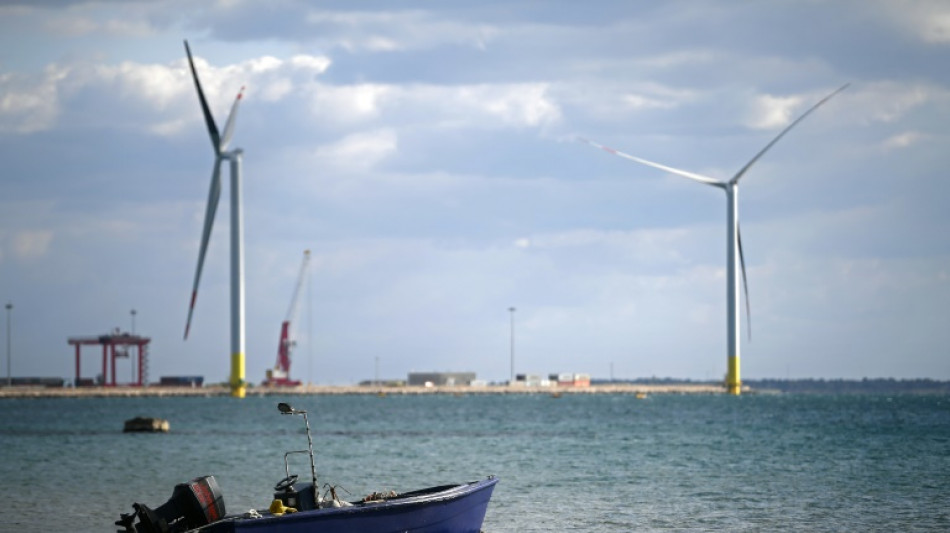
The Mediterranean's first offshore wind farm is rising from the shallows off Italy, its turbines a symbol of hope for a Europe suffering an energy crisis exacerbated by war.
The park will stretch out from the port in Taranto, a city in the south blighted by a noxious steel plant and unemployment, but which now finds itself centre stage in the country's race to scale up green power.
"This is a big chance to change hearts and minds on renewables," said Fabio Matacchiera, an activist in Taranto, where child tumours are well above the average but poor locals cling to jobs in dirty energy.
The Kremlin's invasion of Ukraine in February prompted an outraged European Union to pledge to sharply reduce its dependency on Russian gas, and expand clean energy faster to compensate.
Italy is one of Europe's biggest guzzlers of gas, which currently represents 42 percent of its energy consumption. It imports 95 percent of the gas it uses, 45 percent of which comes from Russia.
An "accelerated investment in renewables... remains the only key strategy in the long term," Prime Minister Mario Draghi told parliament last week, with Rome planning to stop using Russian gas by 2025.
As the Ukraine conflict rages, Italy's cabinet has approved six new wind farms to be built on land, from Sardinia to Basilicata, and has committed to unlocking "several tens of gigawatts of offshore wind power".
- Deep waters -
Offshore is more complicated: average water depths in the Mediterranean are much deeper than in areas such as the North Sea, making bottom-fixed installations difficult and costly.
The Mediterranean is also one of the world's busiest waterways, as well as the sea in Europe most prone to severe climate change.
But the invention of floating turbines has increased its potential.
France recently held the world's first auction for a commercial-sized floating offshore wind farm, and other Mediterranean countries such as Greece and Spain are also planning auctions for large-scale projects, according to the WindEurope association.
Once complete, the Beleolico farm off Taranto's sandy beach in Puglia, down in the heel of Italy's boot-shaped peninsula, will have 10 bottom-fixed, red and white-bladed turbines.
Together they will be capable of powering 21,000 homes.
Renexia, the company behind it, says it also has plans for a vast floating wind farm with 190 turbines off the island of Sicily, which would produce energy for 3.4 million families and create hundreds of jobs.
- Sunken treasures, beach views -
The project has met some opposition from locals convinced it would ruin the view in tourist hotspots -- though Renexia's general manager Riccardo Toto told AFP it would be "practically invisible" from the coast.
Treasure hunters have been known to uncover sunken ancient artefacts off Sicily, but there are none on the site in question, he said.
The turbines can also boost, rather than damage, biodiversity by acting as artificial reefs.
Italy's Ecological Transition Ministry has received 64 expressions of interest for floating offshore wind farms -- but the number of projects held up by bureaucracy is "staggering", WindEurope said.
Beleolico, which Renexia hopes will be operational by May, has been 14 years in the making.
Greenpeace Italy head Giuseppe Onufrio slammed the delays as "absurd".
"Some (farms) are authorised after six, seven years, and the technology changes year by year and so the risk is that plants are authorised despite being outdated."
- Cut red tape -
Draghi insists the government "is working to streamline procedures, cut red tape and speed up investments".
But Davide Tabarelli, economics professor and head of energy think tank Nomisma Energia, told AFP he was "amazed and stupefied" to see Draghi describe renewables as the "only key strategy".
Beleolico, a symbol of Italy's offshore potential, "is constantly being thrown around as the immediate solution to the energy crisis, and the fact that we can do without gas, especially Russian gas".
But there are several "serious problems", he said, not least the difficulties storing wind energy, for suitable batteries do not exist, leading to waste.
Rome's vow that it is readying to turn off the gas to punish the Kremlin is remarkable, he added, "as if, after 30 years of promises on renewables, the problem could be solved in the space of a few weeks".
P.Murphy--TNT