Markets rise, oil holds losses on Russia-Ukraine hopes
Asian markets rebounded and oil held steep losses Wednesday on hopes that Russia will not invade Ukraine after Moscow said some of its troops on the countries' border had started pulling back.
While not verified, the claims by Russia provided some much-needed relief for investors, who had grown increasingly fearful of a conflict in Eastern Europe after Western powers warned for days that an attack was imminent.
The news also helped traders brush off another forecast-busting surge in the US producer price index that some warned could indicate another painful jump in consumer inflation down the line.
Equities were sent into a spiral after a top US security adviser said Friday that Russian President Vladimir Putin could send troops into Ukraine any day, adding to a range of risk-off issues plaguing the markets including soaring prices, the end of central bank financial support and the coronavirus pandemic.
But the mood lifted Tuesday after Russia's defence ministry said some of the more than 100,000 soldiers amassed around Ukraine in recent weeks had started to return to their barracks.
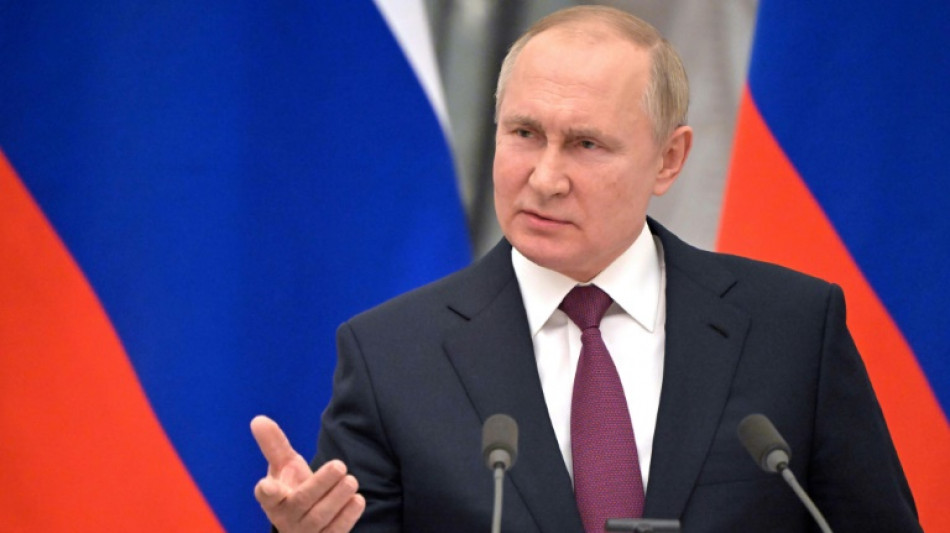
Then, after three hours of talks, Putin and German Chancellor Olaf Sholz held a news conference in which the Russian leader confirmed a "partial pullback of troops" and said he was willing to look for diplomatic solutions to the crisis, adding that "of course" he did not want war.
"We are ready to work further together. We are ready to go down the negotiations track," Putin said. "We want to resolve this issue now, right now or in the near future, through negotiations, peaceful means."
He said he hoped Western leaders would listen to his concerns about NATO's expansion towards Russia's border and possible Ukraine membership.
Still, while Joe Biden said the United States was "ready with diplomacy", he warned Putin's soldiers "remain very much in a threatening position".
While politicians remained wary, investors jumped on the positive developments.
All three Wall Street indexes jumped after three days of hefty losses, which were also fanned by inflation worries.
And Asia built on the gains in early exchanges.
Tokyo piled on more than two percent, while Hong Kong, Seoul, Wellington, Taipei and Manila jumped more than one percent each. Shanghai, Sydney and Jakarta were also up, though Singapore inched down.
Crude stabilised, having tanked more than three percent on Tuesday as the easing of Russia-Ukraine tensions tempered fears about supplies at a time when demand is soaring, which is adding to inflationary pressures.
Both main contracts remain at more than seven-year highs and observers warned they could break above $100 soon.
"Volatility and uncertainty is just going to be heightened. That can be due to Russia-Ukraine, it could be due to stubborn inflation," Brenda O’Connor Juanas, at UBS, told Bloomberg Television.
"There is a lot more for clients and investors to be uncertain about."
The news out of Europe overshadowed data showing US producer prices rising twice as much as expected in January, adding to fears the Federal Reserve will embark on an aggressive campaign of monetary tightening.
"Factory-gate inflation remained very hot, prompting expectations for inflation to run hotter a little longer, and supporting the case for the Fed to kick off their rate hiking cycle with a half-point rate increase," said OANDA's Edward Moya.
"Americans expect inflation to eventually ease next year, but they are growing nervous the peak could be far worse than they initially expected. President Biden is expected to acknowledge the recent surge with food and gasoline prices, which means executive orders may be coming.
Investors are now awaiting the release of minutes from the Fed's January policy meeting, hoping it will provide clues about the pace and timing of any rate hikes.
- Key figures around 0250 GMT -
Tokyo - Nikkei 225: UP 2.1 percent at 27,428.02 (break)
Hong Kong - Hang Seng Index: UP 1.3 percent at 24,681.79
Shanghai - Composite: UP 0.7 percent at 3,469.46
West Texas Intermediate: FLAT at $92.08 per barrel
Brent North Sea crude: DOWN 0.1 percent at $93.20 per barrel
Euro/dollar: DOWN at $1.1346 from $1.1361 late Tuesday
Pound/dollar: UP at $1.3543 from $1.3541
Euro/pound: DOWN at 83.78 pence from 83.88 pence
Dollar/yen: UP at 115.70 yen from 115.62 yen
New York - Dow: UP 1.2 percent at 34,988.84 (close)
London - FTSE 100: UP 1.0 percent at 7,608.92 (close)
S.Arnold--TNT