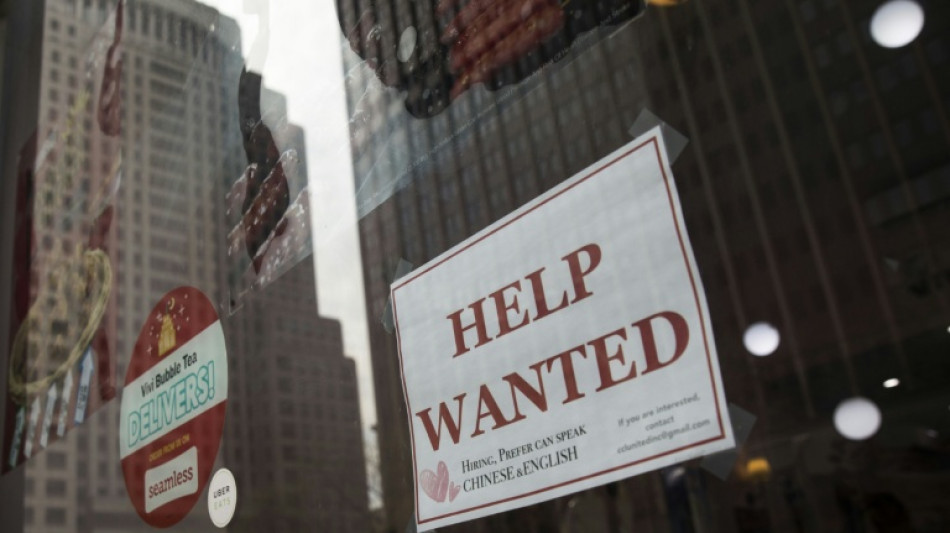
Slowing US job growth poses midterms challenge for Trump / Photo: © GETTY IMAGES NORTH AMERICA/AFP
The United States posted weaker-than-expected job growth in June as new data showed the labor market is facing headwinds ahead of testing midterm elections for President Donald Trump's Republicans.
Total nonfarm payroll employment grew by 57,000 and the unemployment rate fell slightly to 4.2 percent, the US Bureau of Labor Statistics (BLS) said in a statement on Thursday.
After months of seesawing growth and contraction, the US job market posted strong gains in the last three months -- but Thursday's data revised some of those numbers down.
Employment in April and May were revised down by 74,000 jobs, the BLS said.
June's data badly missed market expectations, with economists polled by Dow Jones Newswires and the Wall Street Journal expecting growth of 115,000 jobs.
Nevertheless, job growth remained in positive territory, with the US Federal Reserve not expected to intervene on the labor side of its mandate.
All eyes have been on the Fed since new chair Kevin Warsh took over, with the central bank indicating its focus was firmly on taming surging inflation.
Fed policymakers have indicated they expect one rate hike by the end of the year in order to curb inflation, but a slowing job market may give them pause.
Reacting to Thursday's jobs data, however, analyst Wendy Edelberg told AFP she expected the Fed to hold rates steady for now.
"It feels to me like they are looking for reasons to stand pat, and this gives them a reason," said Edelberg, a senior fellow at the Brookings Institution.
- Wages lag inflation -
Inflation in the world's largest economy has been hitting fresh three-year highs for months, as the fallout of Trump's war on Iran ripples through the economy.
Thursday's data showed that average hourly earnings for US workers increased by 3.5 percent over the year, lagging behind inflation by 0.7 percentage points.
The disparity means that US workers have, on average, lost purchasing power, with their wages not keeping up with price rises.
Kathy Bostjancic, chief economist at Nationwide, read Thursday's data as positive overall, with job growth affected by "negative drag" from higher energy prices for hirers.
The unemployment rate's ticking down was mainly due to a sharp drop in the labor force participation rate to its lowest level since March 2021.
Dan North, senior economist at Allianz Trade, told AFP the drop in the labor force participation rate was a significant development.
"The participation rate shows you what's happening within the entire population," he said. "It's the percentage of the population that's actually driving the economy."
US labor supply has been plummeting due to an aging population, lower net migration and people dropping out of the workforce after being unable to find work.
"Everybody that has a job is clinging to their jobs, but employers are saying 'we don't need to hire anybody right now.'"
The main job growth sectors in June included health care and social assistance, while the leisure and hospitality sector lost jobs after a strong showing the previous month.
- Political implications -
Jobs across a slew of major sectors remained largely stagnant, including in manufacturing, retail trade, transportation, financial activities.
The Republican Party faces midterm elections in November, with Democrats seeking to wrest control of both houses of Congress.
Trump has implemented wide-ranging and often disruptive policies aimed at bringing back manufacturing jobs to the United States.
Democratic Senator Elizabeth Warren responded to Thursday's data by saying Trump's "failing economic agenda is weakening the labor market."
The White House, however, dismissed criticism of its performance, with spokesman Kush Desai saying the "labor market remains solid thanks to President Trump's economic agenda."
"Americans can count on the best being yet to come."
T.F.Russell--TNT