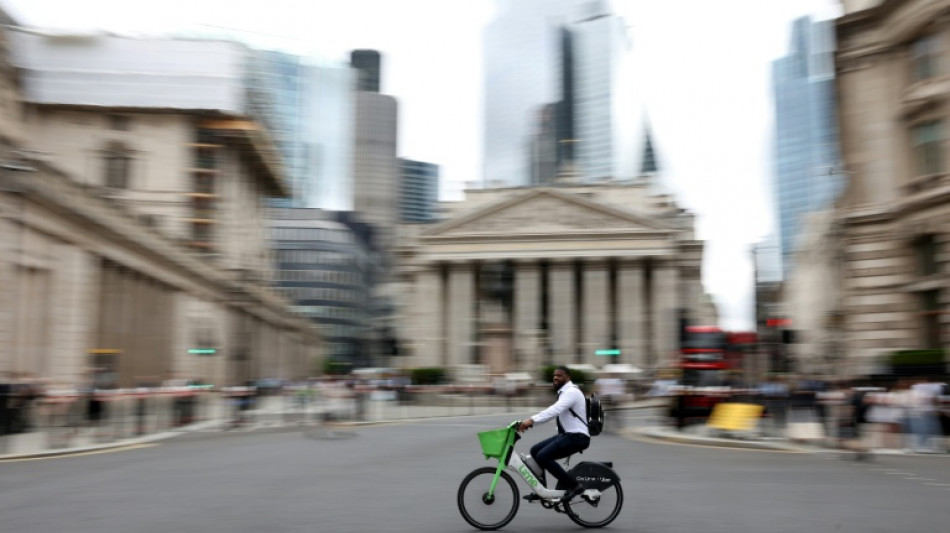
Bank of England follows Fed in holding interest rate / Photo: © AFP
The Bank of England held its benchmark interest rate at 3.75 percent Thursday, opting against an increase despite elevated inflation after the US-Iran war pushed up energy prices.
The widely expected BoE decision came after the Federal Reserve on Wednesday signalled a US rate increase this year even as it kept borrowing costs steady.
The Bank of Japan on Tuesday raised interest rates to a 31-year high as it battles inflation caused by the Middle East war, while the European Central Bank last week raised its benchmark rate for the first time since 2023.
"Oil prices have fallen in recent days, and that's encouraging," Bank of England governor Andrew Bailey said after the decision.
"But they're still higher than before the war," he noted. "Whatever happens in the future, the higher energy prices of the past four months mean there's already some inflationary pressure in the pipeline."
Britain's annual inflation rate remained at 2.8 percent in May, official data showed Wednesday, far above the central bank's two-percent target.
"Our job is to make sure that higher inflation does not persist and have long-lasting effects on the economy," the central bank said in a statement Thursday.
Two members of the bank's monetary policy committee voted for an immediate quarter-point increase to 4.0 percent.
Bailey joined the six remaining members in calling for no change, minutes of the meeting showed.
The BoE said it would keep a close watch over the wider UK and global economy, including British unemployment.
The jobless rate eased to 4.9 percent in the three months to the end of April, after a 5.0-percent reading in the first quarter, the Office for National Statistics said earlier Thursday.
The youth unemployment rate held steady at more than 16 percent, the ONS said.
A government-commissioned review last month warned that Britain risked creating a "lost generation" as the number of 16- to 24-year-olds not in employment, education or training topped one million in the first quarter of the year.
- Key vote -
Britain's economy contracted slightly in April as the Middle East war hit growth.
While that conflict appears close to being over, fighting within Britain's Labour party is clouding the outlook for the country's economy.
Britain was also holding a key local election Thursday that could trigger the endgame for Labour leader Keir Starmer's beleaguered premiership, or win him a reprieve.
Labour party veteran and Greater Manchester mayor Andy Burnham is looking to win the parliamentary by-election for the Makerfield constituency in northwestern England, so that he can then try to replace Starmer as prime minister.
Starmer, in power since July 2024, has been clinging on by his fingernails since centre-left Labour suffered a drubbing in local and regional elections last month.
He has been rocked by several policy U-turns and a scandal over his appointment of Peter Mandelson, a former associate of convicted sex offender Jeffrey Epstein, as the UK's ambassador to Washington.
P.Jones--TNT