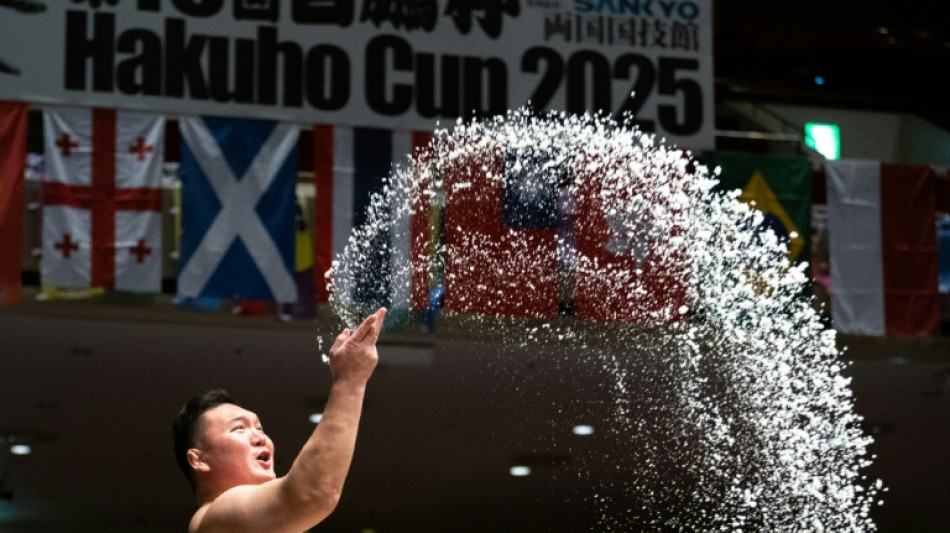
Salt: integral ingredient of sumo stars' art / Photo: © AFP/File
Paris will be the setting next weekend for one of Japan's oldest martial art forms, sumo wrestling, but an unheralded star of the major two-day tournament will be 100 percent French: the 200 kilogrammes of customised Guerande salt ordered by organisers.
"It's an essential part of sumo wrestling. The tournament cannot take place without salt," David Rothschild -- the chief organiser of the Paris event, a rarity outside of Japan -- told AFP.
Salt does indeed play a central role in sumo wrestling, a sport that also has a sacred dimension rooted in the Shinto religion.
Sumo competitions are punctuated by different ritual elements.
"When the wrestler claps his hands, it is to call upon the gods. When he stamps his feet, it is to drive away demons. And the salt is to purify the space," Rothschild explained.
"It is there to ward off anything that might cause trouble: injuries, curses, that sort of thing."
Before each bout, wrestlers throw a generous handful of salt onto the dohyo -- the 4.55-metre-diameter wrestling ring -- in a gesture intended to drive away evil spirits, which is often one of the sport's most iconic images.
During the bouts, the wrestlers, known as rikishi, compete on a clay surface covered with a thin layer of salt, which is swept from time to time by the yobidashi (announcers).
Over the course of the Paris tournament, 200kg (440 pounds) of salt will be required for these ancient rituals.
When they were contacted to supply the salt for the event, Meredith and Gautier Ferard, salt producers in the French coastal town of Le Croisic, were somewhat taken aback.
"It's true that it's not a very common request. But I thought to myself: 'Why not?'" Meredith said.
- 'Sacred salt' -
For the tournament –- the first of its kind in France since 1995 -– the Ferards received a set of highly precise specifications regarding the salt required.
"They asked for a relatively white colour and, above all, a very fine grain size to prevent it from damaging the skin on the wrestlers' feet," Meredith explained.
"The sodium chloride molecule, as it occurs in nature, is rather cubic in shape. And if they have soft skin with 200kg on top of it, that can hurt!"
Harvested last summer, the fleur de sel was then stored, dried, dehumidified, sieved and finally ground by hand.
While the use of their salt for a sumo competition may seem unusual, Meredith pointed out that the mineral, sometimes nicknamed 'white gold', holds a sacred significance in many cultures.
"We already experience it in our daily lives," she said. "My office overlooks the salt marshes. We have a space that has been shaped by human hands for 2,000 years, a product that is entirely natural, entirely handmade.
"So it makes perfect sense that this salt is considered sacred and that it's part of the sumo tournament.
"I just hope it lives up to expectations, that the sumo wrestlers are happy to use our salt and that our salt does what it needs to do for their bouts," she added.
M.Davis--TNT