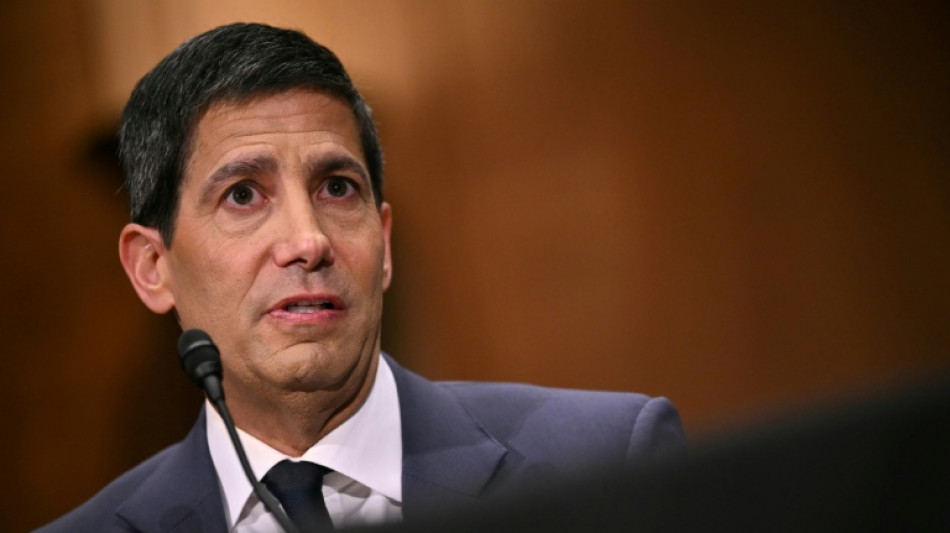
With Fed under intense Trump pressure, new chief to be sworn in at White House / Photo: © AFP
Incoming Federal Reserve chair Kevin Warsh will be sworn in at the White House on Friday, taking the reins of the US central bank as it faces unprecedented pressure from President Donald Trump to cut interest rates.
Warsh, who Trump nominated for the role, has backed rate cuts in the past, even as the world's largest economy faces inflation at a three-year high.
Trump frequently criticized and insulted Warsh's predecessor, Jerome Powell, even pursuing a criminal probe that the outgoing chair said was meant to pressure the Fed over monetary policy decision-making.
The White House has separately sought to fire Fed Governor Lisa Cook, a Biden Administration appointee, over mortgage fraud allegations. That case is pending before the Supreme Court.
It is unusual for the chief of the Fed -- an independent non-partisan body that sets monetary policy according to a dual mandate on inflation and employment -- to be sworn in at the White House.
The last central bank chief to do so was Alan Greenspan in 1987 under then-president Ronald Reagan.
Trump will host the ceremony on Friday, the White House told AFP this week.
At his Senate confirmation hearing, Warsh insisted that he would "absolutely not" be a puppet for the president.
"Mr. Warsh insists that he will defend the Fed's independence in monetary policy," said David Wessel, senior fellow at the Brookings Institution.
"I hope he is true to his word. The risks are higher than ever."
- Balancing mandates -
Warsh will take over a divided Fed facing high inflation -- fueled by the energy price surge that resulted from Trump's war on Iran -- and a labor market showing signs of weakness.
The US central bank has a dual mandate to keep inflation to its long-term target of two percent while also maintaining maximum employment.
US consumer inflation in April came in at 3.8 percent, a three-year high, with American households battered by years of above-expected price increases since the pandemic.
At a Fed meeting last month, a majority of policymakers indicated that rate hikes may be necessary if inflation continues to remain above the Fed's long-term target.
Warsh has argued that productivity gains from artificial intelligence-led innovation will allow the US economy to grow rapidly without adding to inflation.
The US unemployment rate has remained relatively stable around 4.3 percent for the last year. But job growth -- often used as a proxy for economic activity -- has see-sawed wildly between expansion and contraction from month to month.
That situation -- high inflation and inconsistent job growth -- has left the Fed in a potentially sticky situation of having to choose between its mandates.
"Kevin Warsh will not be able to deliver the rate cuts that the president wants," said Wessel. "At some point, the president may grow impatient and will begin attacking Mr. Warsh as he did Jerome Powell."
Warsh takes over at "a time of disruption and rebalancing in the overall authority of the president," said Columbia Law professor Kathryn Judge, whose research focuses on central banking.
Fed chiefs have traditionally had a large influence on the rate-setting committee, but with policymakers currently divided on the path forward, the idea of the so-called "chairman-led Fed" will be "meaningfully tested" in the months to come, she said.
M.Davis--TNT