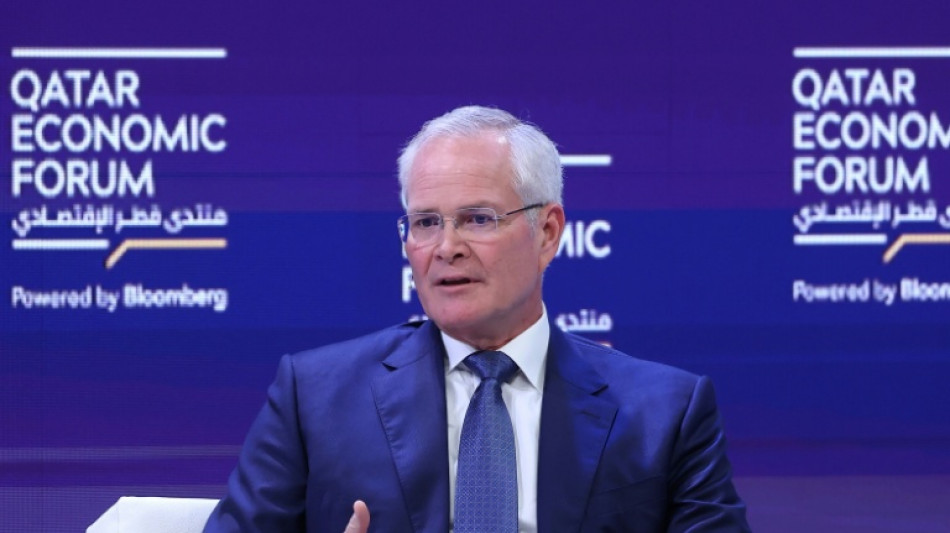
ExxonMobil CEO sees chance of higher oil prices as earnings dip / Photo: © AFP/File
US oil giants reported lower earnings Friday with accounting effects muting the benefits of the Middle East oil shock, as ExxonMobil's CEO cautioned that crude prices could still increase.
Oil prices jumped during the quarter from the mid-$60s in early February to more than $100 a barrel at times in March as Iran's almost complete shutdown of the Strait of Hormuz roiled global markets.
While surging prices are ultimately expected to boost US oil company earnings, both ExxonMobil and Chevron suffered a significant hit in the first quarter because of how US accounting rules require the reporting of derivative contracts.
ExxonMobil reported profits of $4.2 billion, down 45.8 percent from the year-ago period. But profits would have been $8.8 billion excluding these "timing effects" that ExxonMobil expects will reverse in future quarters.
At Chevron, profits came in at $2.2 billion, down 36.9 percent. But the hit from timing effects was around $3 billion, said chief financial officer Eimear Bonner.
While oil prices have risen since the US and Israel launched strikes on Iran on February 28, the increase thus far has been measured, ExxonMobil CEO Darren Woods said, but he warned that prices could spike.
"If you look at the unprecedented disruption in the world's supply of oil and natural gas, the market hasn't seen the full impact of that yet," Woods said.
"You only have to look at the ranges that oil prices have moved at, which are very consistent with the last 10 years in the history versus this (historically) unprecedented disruption," he said.
"So there's more to come if the strait remains closed."
Woods said the oil market has so far been able to manage the dislocation because of the amount of crude in commercial inventories and the release of some strategic governments reserves.
However, those supplies are running their course, he said.
An April securities filing by ExxonMobil revealed that attacks on facilities in Qatar and the United Arab Emirates had negatively affected its output.
Woods said Friday it was hard to estimate how long it would take to repair a site in Qatar because officials with the project, which is operated by QatarEnergy, have not yet been able to do enough work.
The Qatar outage dented ExxonMobil's natural gas output, which fell 8.2 percent from the year-ago level.
- Questions on Venezuela -
Chevron CEO Mike Wirth described the outlook for the oil market as extremely uncertain, saying: "I'm not sure I could argue with a lot of confidence that I could describe what it looks like."
Under one scenario, the Strait of Hormuz could be reopened relatively quickly "and we get back into a market that's pretty well supplied," Wirth said.
But another scenario would yield a much "tighter" market, said Wirth, adding that the company is not ramping up investment or otherwise shifting from its long-term strategy.
On Venezuela, Wirth reiterated that Chevron remains interested in bolstering its long-term position but continues to await key details on issues such as royalty terms and dispute resolution.
"There are still questions," Wirth said. "We need to see further progress before you would put more capital to work."
Shares of ExxonMobil fell 1.2 percent in afternoon trading while Chevron dropped 1.6 percent.
S.Arnold--TNT