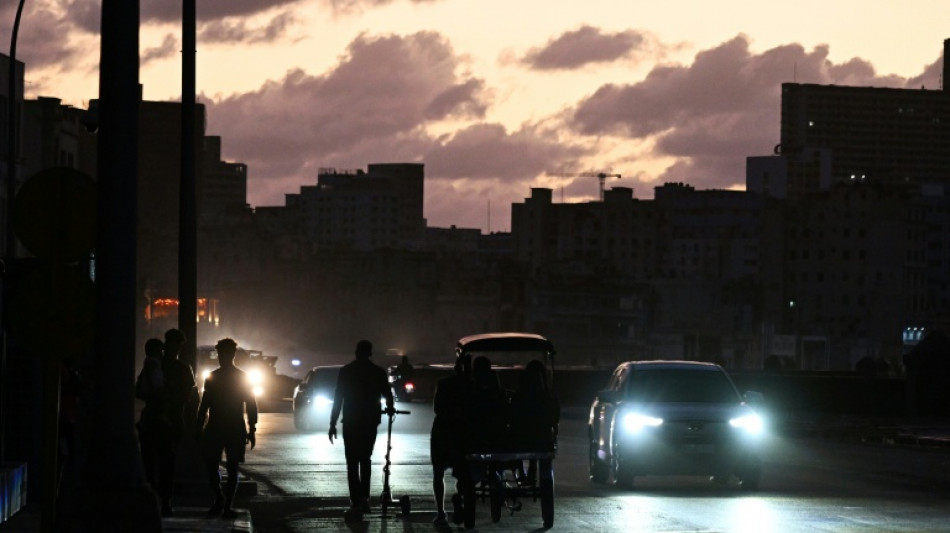
Cuba hit by second nationwide blackout in a week / Photo: © AFP
Cuba plunged into darkness for the second time in less than a week on Saturday after its national power network failed again, strained by aging infrastructure and a US oil blockade.
As night fell, Havana's streets were mostly pitch black, with people navigating using phone lights or flashlights, just five days after the previous blackout.
In the touristy old city, some restaurants were able to stay open thanks to generators, with musicians playing music, but the regular blackouts have made life more difficult for Cubans.
"This is becoming unbearable," Ofelia Oliva, a 64-year-old Havana resident, told AFP.
"It hasn't even been a week since we experienced a similar situation. It is getting tiresome," Oliva said as she returned home after giving up on plans to visit her daughter.
The "total disconnection" of the national electricity system was due to an outage in a power unit at one of the country's thermoelectric plants, causing a "cascading effect", the state-owned Cuban Electric Union said.
It said it was activating micro-grids to provide power to critical facilities, including hospitals and water treatment plants.
"I wonder if we're going to be like this our whole lives. You can't live like this," Nilo Lopez, a 36-year-old taxi driver, told AFP.
- US blockade -
The country's electricity generation is sustained by a network of eight aging thermoelectric plants -- some in operation for over 40 years -- that suffer frequent breakdowns or must be shut down for maintenance cycles.
Cubans face daily blackouts of up to 15 hours in Havana. In the interior of the island, these outages can exceed 40 hours.
The breakdowns have intensified since Cuba's main regional ally and oil supplier, Venezuela's socialist leader Nicolas Maduro, was captured in a US military operation in January.
And US President Donald Trump has threatened to impose tariffs on countries that sell oil to Cuba.
No oil has been imported to the island since January 9, hitting the power sector while also forcing airlines to curtail flights to the island, a blow to the all-important tourism sector.
The blackout occurred as an international aid convoy began to arrive in Havana this week, bringing sorely-needed medical supplies, food, water and solar panels to the island.
- 'Honor of taking Cuba' -
The crisis in the country of 9.6 million people comes as Trump has made no secret of his desire to see regime change in Havana.
"I do believe I'll be...having the honor of taking Cuba," he said.
"Whether I free it, take it -- think I could do anything I want with it, you want to know the truth. They're a very weakened nation right now."
The next day, Cuban President Miguel Diaz-Canel warned that "any external aggressor will encounter an unbreakable resistance."
Tanieris Dieguez, Cuba's deputy chief of mission in Washington, told AFP earlier this week that Havana was open to broad talks with Washington and allowing more investment.
But she said Cuba's political system would "never" be part of the negotiations.
The outages as well as regular shortages of food, medicine and other basics are spurring frustrations, with demonstrators vandalizing a provincial office of the Cuban Communist Party last weekend.
With Cuba in desperate need of fuel, maritime trackers reported this week that two tankers carrying Russian oil and diesel appeared to be on their way to the island, but their status remains unclear.
Some took the latest outage in stride.
Meiven Rodriguez, 40, kept working in a small shop, selling cigarettes and using her phone light to count money.
A few fishermen cast for sardines into the dark waters of the oceanfront city.
"What would we do at home?" said Leonsio Suarez, 50.
E.Cox--TNT