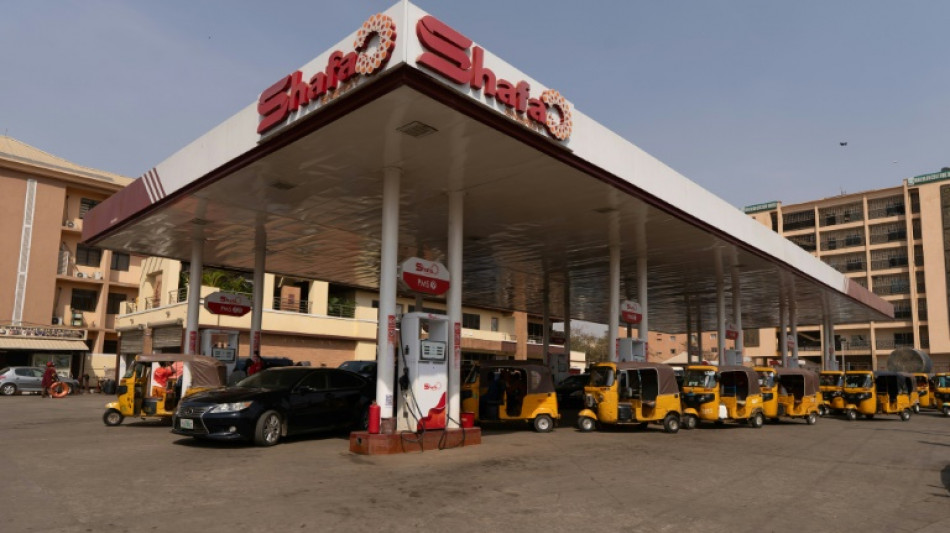
Far from war, global fuel frustrations mount / Photo: © AFP
Far from the Middle East war, fallout from oil disruptions is reverberating across the world, unsettling lives from Lagos to Manila as people adjust to fuel price hikes and gas shortages.
Benchmark oil prices are hovering around $100, a surge of around 40 to 50 percent since the war against Iran began to disrupt oil supplies.
Weeks before war broke out, Adeola Sanni, a 36-year-old Nigerian entrepreneur making corporate uniforms in Lagos, had planned to hire an additional worker.
Now those plans are on hold as her budget is eaten up buying petrol to power up generators to run her sewing machines after fuel prices jumped about 20 percent in Africa's most populous country.
Nigeria's electricity supply is unstable at the best of times, but has worsened in recent weeks due to gas supply shortages, forcing businesses and households to spend more on private power generators.
"I am currently spending more than 33 percent more on fuel than I used to," Sanni, told AFP.
In Nigeria, petrol prices rose recently from 830 naira a litre in Lagos to 1,250 naira ($0.59 to $0.90) -- a record high in a country where the pump price was just 195 naira at the beginning of 2023 -- before easing to 1,130.
Public transport fares have jumped by as much as a third adding to the misery of passengers still reeling from a cost of living crisis caused by reforms that slashed fuel subsidies.
- Plans in disarray -
Indians like housewife Kriti Prasad have been found themselves desperately hunting for cooking gas as supplies dwindle. People have been queuing up across the country outside gas cylinder agencies.
Electric induction stovetops have also been selling out in India as households rush to find alternatives. Those needs can be especially acute during religious festivals like Eid for Muslims and the approaching Hindu festival of Chhath.
"I have been trying to book a gas cylinder for days now but I have had no luck so far. This has thrown all our plans in disarray," Prasad, 43, told AFP.
"The government is saying there is no need to panic but the ground reality is different."
Small and medium-sized Indian restaurants have also been forced to alter menus as authorities prioritize household supplies of gas. With black market gas prices nearly double, some are looking to cook on wood stoves or use less energy-consuming methods.
- 'No one wins in war' -
In the Philippines, some tricycle taxi drivers have seen fuel price hikes slash their daily earnings in half.
Romeo Cipriano has been driving a tricycle in Manila for four decades and says fuel prices are now the highest he has seen.
He recently joined hundreds of drivers lining up for cash handouts of 5,000 pesos ($84) that the government hopes will provide temporary relief.
Patiently awaiting his subsidy at the Manila community centre, Cipriano said he could only pray for a quick end to the war.
"We're not the only ones affected," he said. "No one wins in war."
Authorities have also increased fares on some local transport to offset fuel costs.
- 'Critical' diesel costs -
French fisherman David Le Quintrec said diesel prices for vessels had seen an "enormous" increase, forcing them to sail shorter distances to save on fuel.
"Diesel has reached a price that's quite critical for us," said Le Quintrec, unloading sole and sea bass caught recently overnight at the port of Lorient.
The fisherman, who also heads the French Union of Artisanal Fishermen (UFPA), has seen fuel prices skyrocket in just 10 days, from 60 cents a liter to nearly 90 cents.
Not far away, fishing operations mananger Jerome Nicol, sees little hope. If diesel reaches one euro per liter, his fleet's five trawlers will remain in port because it will no longer be profitable to send them out.
"For boats consuming more than a tonne of fuel per day, that's several hundred euros more," he said.
- Iranian veggies, cigarettes -
Just over the border from Iran, in the Turkmenistan capital Ashgabat, pensioner Shemshat Kurbanova is used to buying Iranian juices and fruits. But now most of the products have shot up in price.
Iran has banned all goods and agricultural exports, triggering economic pressure on Turkmenistan and the wider Central Asia region, where Tehran has had a growing economic influence.
"I used to appreciate their low prices. But now everything has doubled," Kurbanova said.
Government worker Kerim Ballyev has curbed his heavy consumption of Iranian cigarettes.
"It's too expensive for me," he said. "I won't be buying a whole pack, I'll buy them individually."
- No fuel, no job -
In Thailand, from the capital Bangkok to the northern Chiang Rai, drivers and riders are lining up for fuel as they face worsening shortages worsened and rising prices.
Grab food delivery rider Oracha, 48, said she was losing money because she has to switch off her app to search for fuel for an hour.
"I lose my income for that hour," she said, adding she normally makes 30 to 50 baht ($0.92 to $1.53) an hour and has to work longer to make up for lost time.
"If there's no fuel, it feels like I don't have a job at all."
burs/rl
J.Sharp--TNT